
Skip to content
Start My 3 Free Days $0 today · cancel anytime

5th Grade Prime Numbers Resources

3 5th grade prime numbers resources: 1 worksheet, 1 song, 1 video and more. How teachers use these

5th Grade Prime Numbers Resources

3 5th grade prime numbers resources: 1 worksheet, 1 song, 1 video and more. How teachers use these

Worksheet
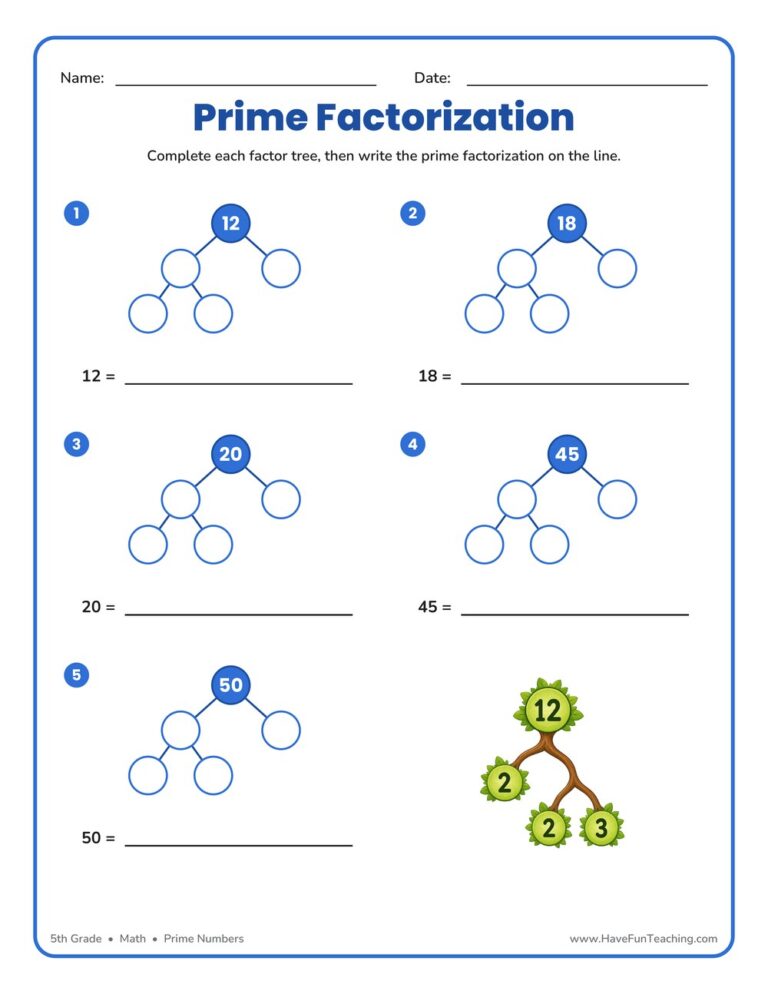
Worksheet5th GradePrime Factorization Worksheet

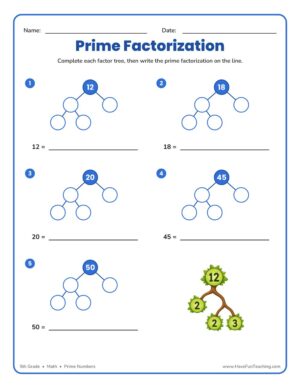
This prime factorization worksheet lets 5th graders complete five factor trees and write each number's prime factorization. A full answer key is included, making it perfect for no-prep practice, homework, or math centers.

Activity
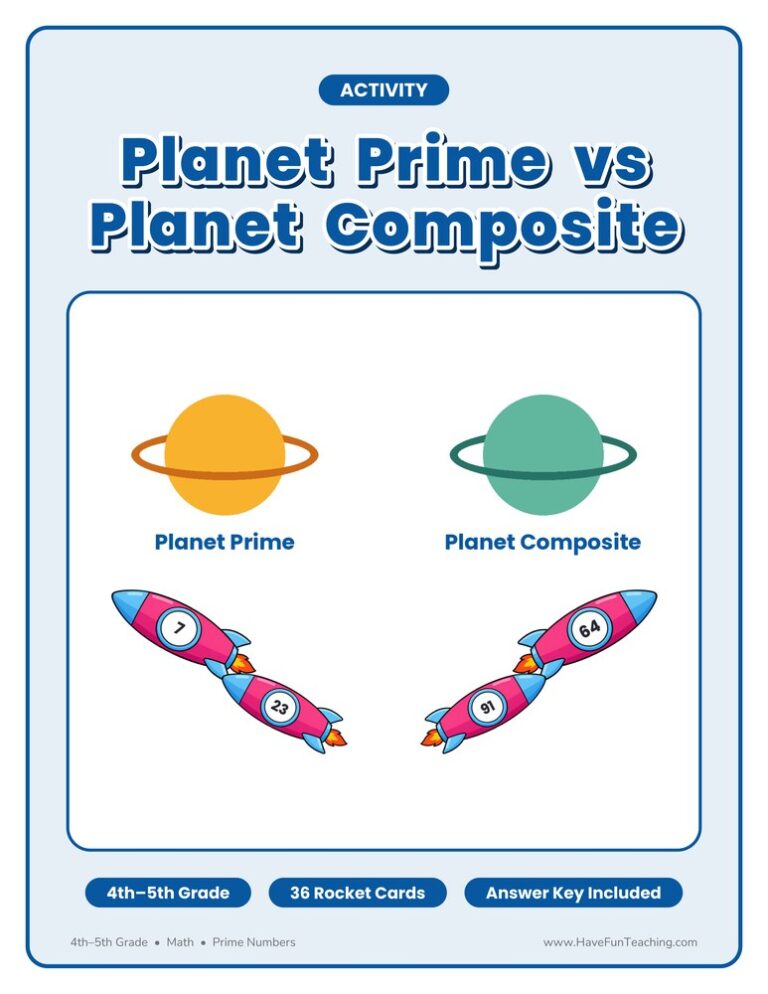
Activity5th GradePlanet Prime vs Planet Composite Activity

This planet prime vs planet composite activity is a number-card sorting game for 4th and 5th grade, with a recording sheet and factor pair practice page. Answer key included for quick checking.

From our teachers' playbook

Only two factors? You're prime!

What do 5th graders learn about prime numbers?

A prime number has exactly two factors: 1 and itself. Fifth graders sort numbers up to 100 into prime and composite, and they learn the special cases: 1 is neither, and 2 is the only even prime. Then they break composite numbers into their prime building blocks with factor trees: 36 = 2 × 2 × 3 × 3. Prime factorization makes finding common factors and simplifying fractions much faster. The click moment: every composite number has its own prime "recipe," and there's only one!

Our favorite ways to teach prime numbers

Prime numbers feel like a secret code. These moves help kids crack it.

Rectangle test

Give kids square tiles and a number, like 12. How many different rectangles can they build? 12 makes several, but 7 only makes one long row. If a number makes just one rectangle, it's prime. Building it shows what "only two factors" really means.

Why it works: going from real objects to pictures to symbols is a core recommendation of the U.S. Department of Education's elementary math guide.
Planet Prime vs Planet Composite ActivityTry it withPlanet Prime vs Planet Composite ActivityActivitiesOpen it →
Grow a factor tree

Model a factor tree for 48, splitting it into any two factors and circling each prime as you reach it. Then kids try 60 starting with different factors. When everyone ends up with the same primes, jaws drop!

Why it works: pairing a picture with each word gives kids two ways to remember it, a well-tested principle of how people learn (Mayer, 2009).

Prime Factorization WorksheetTry it withPrime Factorization WorksheetWorksheetsOpen it →

Sing the primes

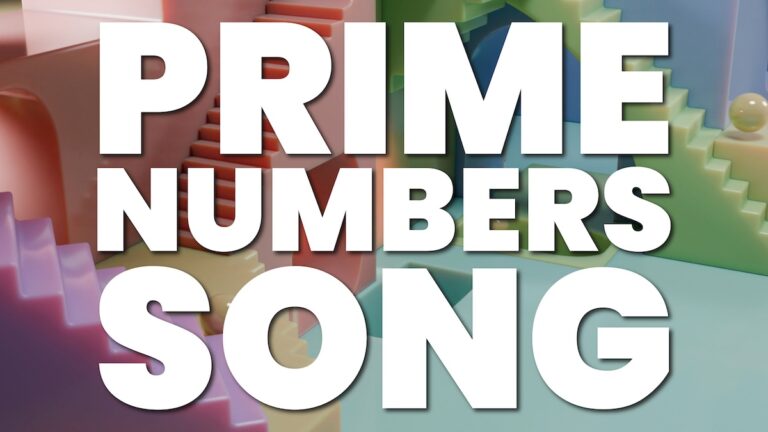
Play the Prime Numbers Song at the start of math for a week. Kids pick up the first primes (2, 3, 5, 7, 11, 13...) and the rule for what makes a number prime. A catchy tune helps them recall it on tests.

Why it works: a catchy, repeating tune gives the brain a hook to hang words on, so sung text is remembered better (Wallace, 1994).

Prime Numbers SongTry it withPrime Numbers SongSongsOpen it →

Questions parents and teachers ask

What is a prime number?

A prime number is a whole number greater than 1 with exactly two factors: 1 and itself. Examples are 2, 3, 5, 7, 11 and 13.

Is 1 a prime number?

No. The number 1 has only one factor, itself, so it is neither prime nor composite. It's one of the most common questions kids ask.

What is prime factorization?

It's writing a composite number as a product of prime numbers. For example, 36 = 2 × 2 × 3 × 3. Kids usually find it with a factor tree.

Why do kids need to know prime numbers?

Prime numbers help with finding factors, greatest common factors and least common multiples. They make simplifying and adding fractions much easier in 5th and 6th grade.



