Skip to content
Start My 3 Free Days $0 today · cancel anytime

5th Grade Force Resources

4 5th grade force resources: 2 worksheets, 1 activity and 1 flash card. How teachers use these

5th Grade Force Resources

4 5th grade force resources: 2 worksheets, 1 activity and 1 flash card. How teachers use these

Worksheet
Worksheet5th GradeNewton's Laws Force and Motion Worksheet

This Newton's Laws force and motion worksheet has 5th grade students name the law behind six everyday events and explain one in writing, with an answer key for fast checking.

Worksheet
Worksheet5th GradeSimple Machines Worksheet

This simple machines worksheet has 5th graders sort everyday objects into six machine columns and name the machine each tool uses. An answer key is included for quick, confident checking.

Activity
Activity5th GradeMotion Activity

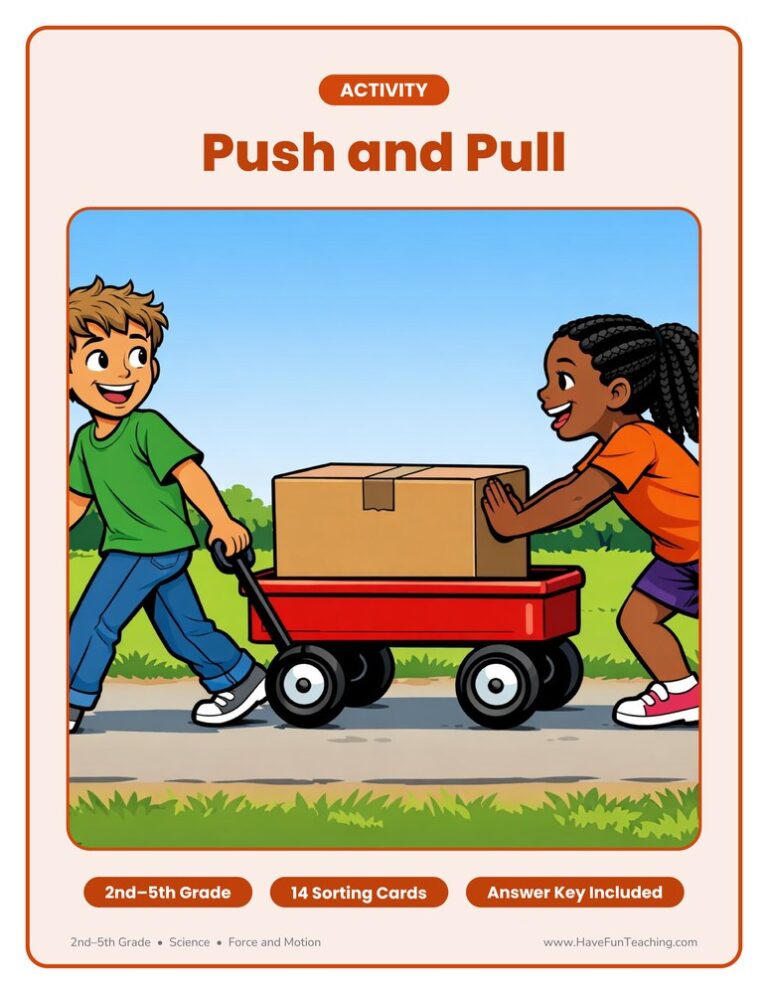
This motion activity helps 2nd to 5th grade students sort everyday actions into pushes and pulls, with 14 sorting cards, a practice page, and an answer key included.

Flash Cards
Flash Cards5th GradeForce and Motion Word Wall

Post these force and motion word wall flash cards for 2nd to 5th grade: 16 science words with kid-friendly meanings, plus a vocabulary practice page, answer key included.

From our teachers' playbook

Every push and pull counts

What do 5th graders learn about force?

A force is a push or a pull, and fifth graders learn that forces are everywhere, even when nothing seems to move. A big focus in 5th grade is gravity: Earth's gravity pulls everything toward the center of the planet, which is why a dropped ball always falls down. Kids learn about balanced forces (a tug-of-war tie) and unbalanced forces (one side wins). They also explore friction, the force that slows things down, and measure forces in units called newtons. The click comes when kids realize a book sitting on a desk has forces pushing on it right now.

Our favorite ways to teach force

Forces are invisible, so we make them visible. These are the moves that help.

Draw the arrows

Model force diagrams with arrows: a longer arrow means a stronger push or pull. Show a book on a desk with gravity pulling down and the desk pushing up. Then kids draw arrows for a ball being kicked.

Why it works: showing first, practicing together, then letting kids try alone is the "gradual release" model teachers have relied on for decades (Pearson and Gallagher, 1983).

Newton's Laws Force and Motion WorksheetTry it withNewton's Laws Force and Motion WorksheetWorksheetsOpen it →

Word wall of forces

Post force words like gravity, friction and balanced on a word wall with a quick picture for each. Kids point to a word and use it while explaining an experiment, which builds real science vocabulary.

Why it works: pairing a picture with each word gives kids two ways to remember it, a well-tested principle of how people learn (Mayer, 2009).

Force and Motion Word WallTry it withForce and Motion Word WallFlash CardsOpen it →

Ramp and friction test

Kids roll a toy car down a ramp covered with different surfaces: paper, carpet, foil. They measure how far it goes each time. It's a simple way to see friction in action.

Why it works: kids understand an idea best when they touch it, then draw it, then write it, the order the U.S. Department of Education recommends for elementary math.

Motion ActivityTry it withMotion ActivityActivitiesOpen it →

Questions parents and teachers ask about force

What is force in 5th grade science?

A force is a push or a pull on an object. Fifth graders learn about gravity, friction and balanced and unbalanced forces.

What does gravity do?

Gravity is a pulling force. Earth's gravity pulls objects toward the center of the planet, which is why things fall down when you drop them.

What is the difference between balanced and unbalanced forces?

Balanced forces are equal in strength and don't change an object's motion. Unbalanced forces are unequal and make an object start moving, stop or change direction.

How can I teach force at home?

Try simple experiments: push a toy car on carpet and on tile, or drop different objects. Ask your child what force is acting and how they know.