
Skip to content
Start My 3 Free Days $0 today · cancel anytime

1st Grade Homophones Resources

1 1st grade homophones resources: 1 worksheet. How teachers use these

1st Grade Homophones Resources

1 1st grade homophones resources: 1 worksheet. How teachers use these

Worksheet
Worksheet1st GradeHomophones Worksheet

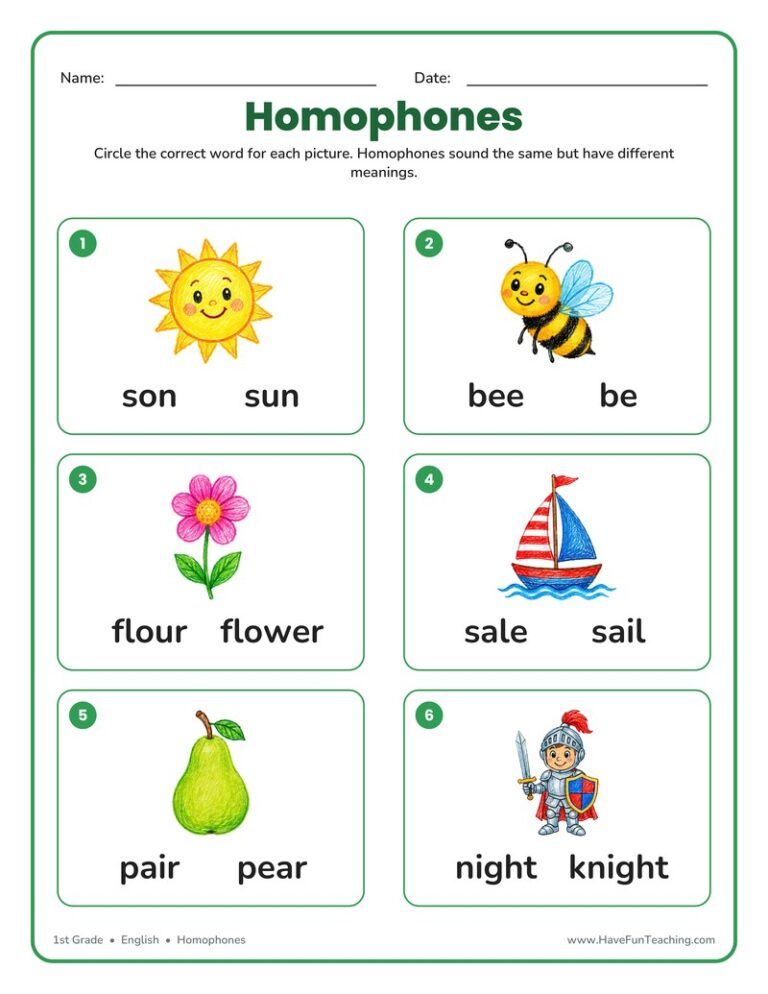
This first grade Homophones worksheet has students circle the correct homophone that matches each picture, from sun and son to flower and flour. A complete answer key is included for quick, no-prep vocabulary practice.

From our teachers' playbook

Same sound, different word, big giggles

What do 1st graders learn about homophones?

First graders discover that some words sound exactly the same but have different spellings and meanings. They start with everyday pairs like to / two, see / sea, eye / I and blue / blew. The goal is to hear the match, picture the meaning, and use the sentence to choose the right spelling. The click moment comes when a child reads "I see the sea" and laughs because the two words sound like twins but look totally different!

Our favorite ways to teach homophones

Little learners need to see the difference and hear the sameness. These moves do both.

Draw the difference

Fold a paper in half. On one side kids write "sea" and draw waves; on the other, "see" with a big pair of eyes. The picture becomes their memory hook every time they write the word.

Why it works: children learn more from words and pictures together than from words alone (Mayer, 2009).

Homophones WorksheetTry it withHomophones WorksheetWorksheetsOpen it →

Hold up the right card

Give each child two cards, like "two" and "to." Read a sentence aloud: "I have ___ cats." Everyone holds up their answer at once, so you can check the whole room in a second.

Why it works: pulling an answer out of memory makes it stick far better than rereading it, one of the strongest findings in learning research (Dunlosky and colleagues, 2013).

One pair a day

Introduce a single homophone pair each morning and add it to a word wall. Revisit three old pairs during transitions. A little review across weeks beats a one-day homophone blitz.

Why it works: the brain holds on to what it meets again and again over time; spaced practice was rated among the very best methods (Dunlosky and colleagues, 2013).

What's on this page

Teacher favorites right now: Homophones Worksheet.

Homophone questions teachers and parents ask

What are homophones for 1st grade?

Homophones are words that sound the same but have different spellings and meanings. Easy first grade examples are to/two, see/sea, I/eye, be/bee and blue/blew.

How do you teach homophones to a first grader?

Teach one pair at a time with a picture for each meaning. Then have kids choose the right word in short sentences so they learn to use context.

Is it normal for first graders to mix up homophones?

Yes! Mixing up to, two and too is extremely common in first grade and well beyond. Gentle, short daily practice helps more than correcting every slip.

What is the difference between homophones and homonyms?

Homophones sound the same but are spelled differently, like see and sea. Homonyms are spelled and sound the same but mean different things, like bat the animal and bat for baseball.


