
Skip to content
Start My 3 Free Days $0 today · cancel anytime

1st Grade Density Resources

2 1st grade density resources: 1 worksheet and 1 activity. How teachers use these

1st Grade Density Resources

2 1st grade density resources: 1 worksheet and 1 activity. How teachers use these

Worksheet
Worksheet1st GradeSink Float Identify Worksheet

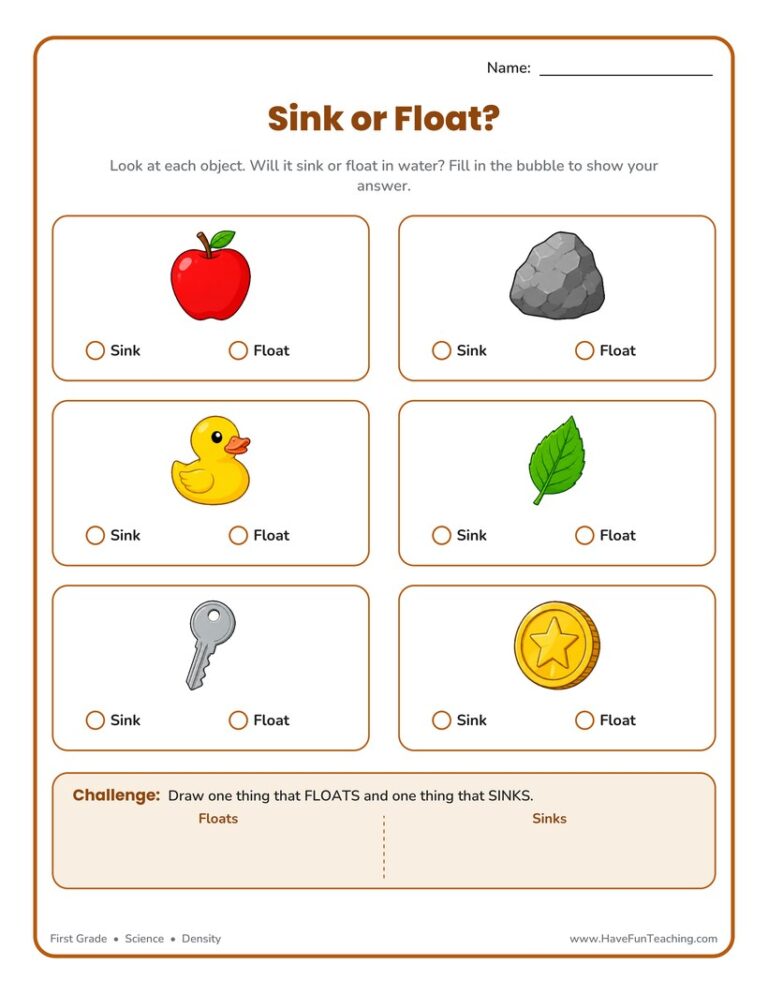
This sink float identify worksheet lets first graders predict whether an apple, rock, duck, and more will sink or float in water. Includes an answer key for a fun, hands-on introduction to density.

Activity
Activity1st GradeSink or Float Activity

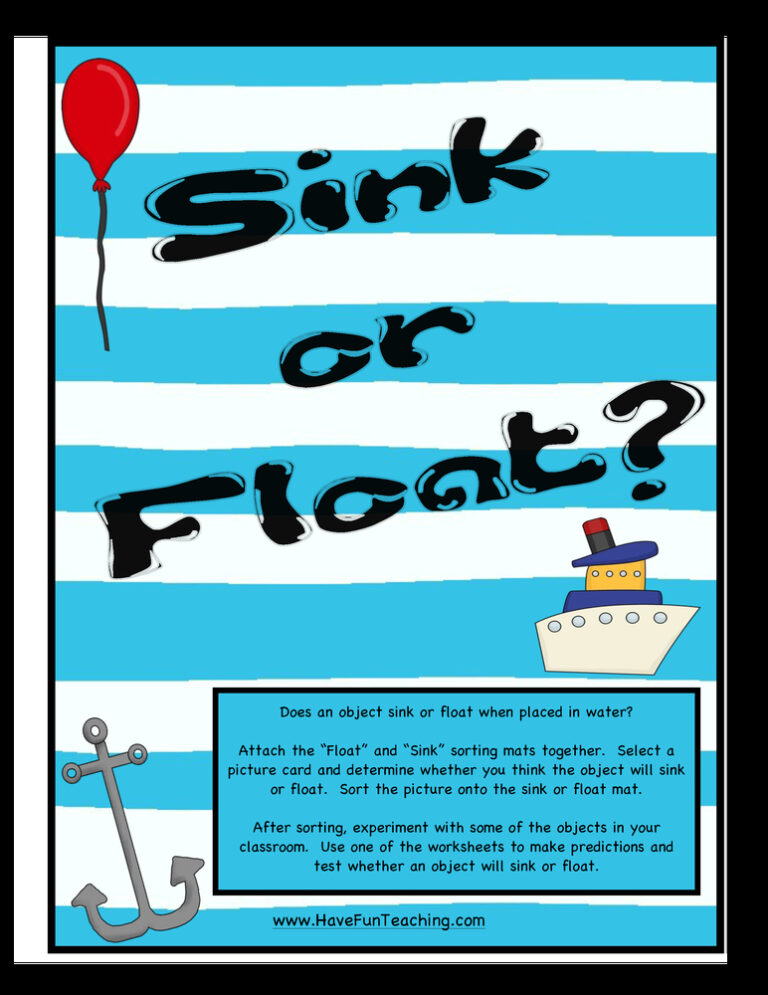
This sink or float activity has kindergarten and 1st grade scientists predict and sort 12 picture cards on a Float and Sink mat, then circle new floating objects. Answer key included.

From our teachers' playbook

Will it sink or float? Let's find out!

What do 1st graders learn about density?

First graders do not need the word density to start exploring it. They drop objects in a tub of water, predict whether each one will sink or float, and record what happens. The surprise is the best part: a big wooden block floats while a tiny penny sinks! That is when kids learn that size alone does not decide, and what the object is made of matters too. They practice the science habits of predicting, testing, observing and sorting results.

Our favorite ways to teach sink or float

This topic is made for hands-on learning. Here is how we keep it messy in a good way.

Predict, drop, record

Set out a tub of water and ten classroom objects. Kids circle "sink" or "float" before each drop, then test it. Real objects first, then the worksheet, so the record matches what they saw.

Why it works: the U.S. Department of Education's guide for teaching elementary math recommends moving from hands-on objects to drawings to numbers.

Sink or Float ActivityTry it withSink or Float ActivityActivitiesOpen it →
Think out loud with a surprise

Hold up an apple and a small rock. Say "The apple is bigger, so I think it will sink... let's see!" When it floats, model how a scientist changes their idea. Kids love catching the teacher being wrong.

Why it works: handing over the work step by step, from teacher to student, is one of the most widely used teaching frameworks (Pearson and Gallagher, 1983).

Sink Float Identify WorksheetTry it withSink Float Identify WorksheetWorksheetsOpen it →

Sort the pictures

The next day, kids look at pictures of objects and decide sink or float from memory. Pulling it back out of their heads makes the learning last. Then test any they argue about!

Why it works: researchers who compared ten study methods found practice testing is one of the two that work best (Dunlosky and colleagues, 2013).

Sink Float Identify WorksheetTry it withSink Float Identify WorksheetWorksheetsOpen it →

What's on this page

Teacher favorites right now: Sink Float Identify Worksheet and Sink or Float Activity.

Questions teachers and parents ask about sink or float

How do you explain density to a 1st grader?

Say it is how tightly packed something is for its size. A rock is packed tight, so it sinks. A wooden block has lots of tiny air spaces, so it floats. Keep the focus on testing, not the vocabulary.

Why do some heavy things float?

Floating depends on what an object is made of and its shape, not just its weight. A big log floats because wood is lighter than the same amount of water.

What objects are good for a sink or float experiment?

Try a coin, a crayon, a cork, a plastic spoon, a metal spoon, an apple, a rock, a sponge and a leaf. Mixing in a few surprises keeps kids guessing.

Is sink or float in the 1st grade science curriculum?

Many first grade classrooms explore objects and materials through simple investigations like this. It builds the habit of predicting and testing that kids use in every science unit later.



