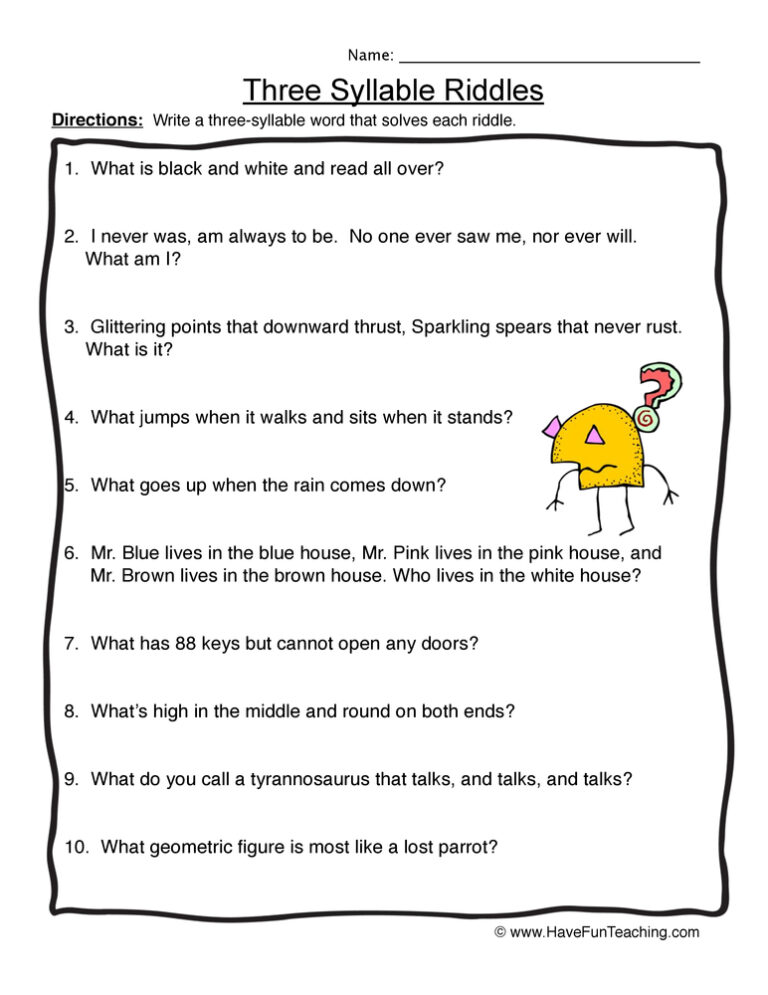
This three syllable riddles worksheet asks 4th graders to solve six riddles, then split each answer into its three syllables. An answer key is included, making syllable practice quick to check.
This rolling for syllables worksheet has 4th graders sort twelve words onto die-face cards by syllable count, then divide new words with slashes. An answer key is included for easy checking.
Fourth graders use syllables to read and spell long, multisyllabic words. They learn the six syllable types: closed, open, silent e, vowel team, r-controlled and consonant-le, and use them to decide how a vowel sounds. They also peel off prefixes and suffixes first, then split the base: un | for | get | ta | ble. Knowing where to split helps with words they have never seen before in science and social studies books. The click comes when a fourth grader reads a word like "independence" smoothly instead of skipping it.
Our favorite ways to teach syllables
By fourth grade, syllables are a decoding tool for big words. These moves give kids a plan they can use on any page.
Show the big word plan
Write a long word on the board and think out loud: "First I look for a prefix and a suffix. Then I find the vowels and split." Read each chunk, then blend the whole word. Practice the same plan on three more words together.
Why it works: showing first, practicing together, then letting kids try alone is the "gradual release" model teachers have relied on for decades (Pearson and Gallagher, 1983).
Kids roll a die and find a word with that many syllables in their reading book. Then they split it and read it to a partner. The roll adds a game feel to real reading practice.
Why it works: playful practice with a clear goal keeps kids practicing longer, and simple learning games have been shown to build real skills (Ramani and Siegler, 2008).
Hand out three-syllable riddles as a quick check. Kids have to read and split each word to solve it. Riddles show you who can decode long words without help.
Why it works: researchers who compared ten study methods found practice testing is one of the two that work best (Dunlosky and colleagues, 2013).
Closed (cat), open (go), silent e (cake), vowel team (rain), r-controlled (car) and consonant-le (table). Each type tells readers how the vowel will sound.
Why do 4th graders still learn syllables?
Fourth graders read many longer words in science and social studies. Splitting words into syllables helps them decode and spell those words instead of guessing.
How do I teach multisyllabic words?
Teach a simple plan: find prefixes and suffixes, find the vowels, split the word into chunks, read each chunk and then blend the whole word.
How can I help my 4th grader read long words at home?
When your child gets stuck, cover part of the word with your finger and read one chunk at a time. Then slide your finger away and read it all together.
Written by the Have Fun Teaching team of elementary teachers and homeschoolers. Research: Pearson, P. D., & Gallagher, M. C. (1983). The instruction of reading comprehension. Contemporary Educational Psychology, 8(3). Ramani, G. B., & Siegler, R. S. (2008). Promoting broad and stable improvements in low-income children's numerical knowledge through playing number board games. Child Development, 79(2). Dunlosky, J., Rawson, K. A., Marsh, E. J., Nathan, M. J., & Willingham, D. T. (2013). Improving Students' Learning With Effective Learning Techniques. Psychological Science in the Public Interest, 14(1).
3 days free
2:39Ready to print!
Printables · Songs · Games
Loved by 2 million teachers & families
Where learning feels like play.
Printables, songs and games for every subject, Preschool through 6th. Ready to teach today, and kids beg for more.
$0due today
then $39.97$35.97for your first year, and $39.97 a year after that.



 Try it withRF.4.3 Fourth Grade Common Core LessonCommon Core LessonsOpen it →





