Skip to content
Start My 3 Free Days $0 today · cancel anytime

4th Grade Electricity Resources

5 4th grade electricity resources: 5 worksheets and 1 activity. How teachers use these

4th Grade Electricity Resources

5 4th grade electricity resources: 5 worksheets and 1 activity. How teachers use these

Worksheet
Worksheet4th GradeCircuits Worksheet

This Circuits Worksheet helps 4th Grade students label the battery, bulb, switch, and wire, decide whether a circuit is open or closed, and explain how current flows. Answer key included, so checking work is quick.

Worksheet
Worksheet4th GradeElectricity Worksheet

This Electricity Worksheet pairs a short reading passage with vocabulary and explanation questions that show 4th graders how current, circuits, conductors, and insulators work. Answer key included for fast, no-prep science practice.

Activity
Activity4th GradeLight Bulb Cut Outs

This light bulb cut outs worksheet gives 4th grade students four bulbs to fill with electricity facts, color and cut out, making a bright science bulletin board that celebrates what the whole class has learned.

Worksheet
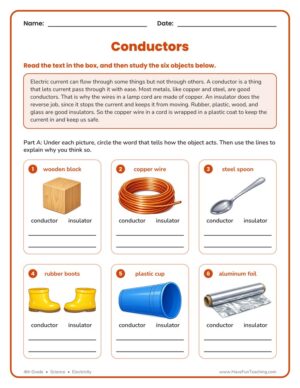
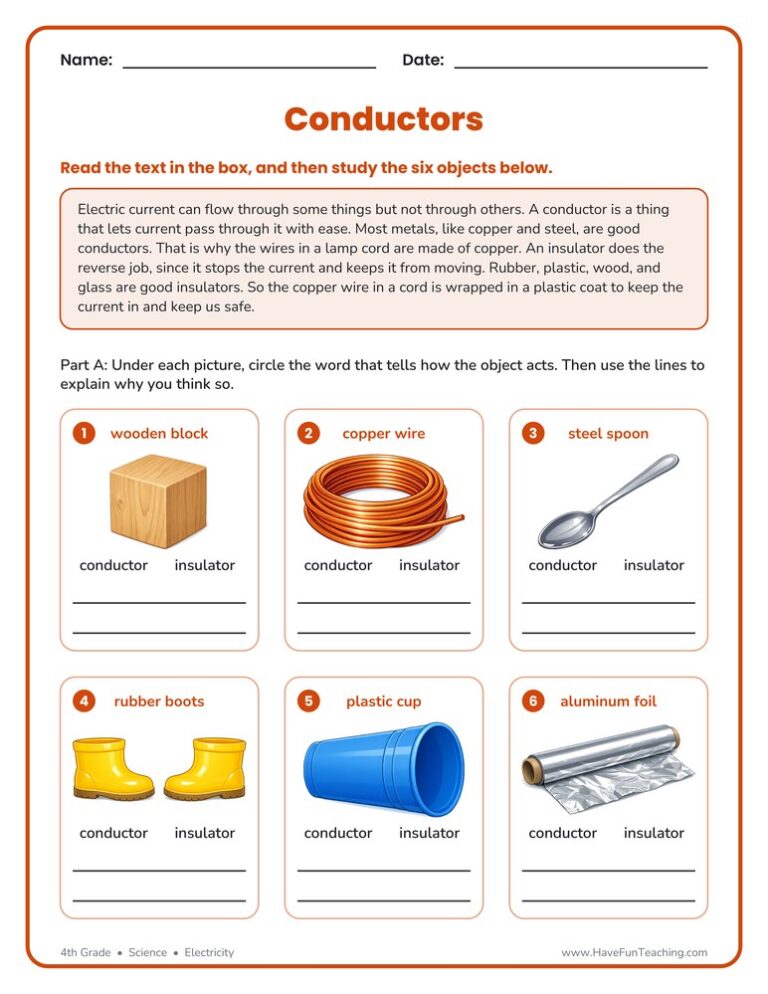
Worksheet4th GradeConductors Worksheet

This conductors worksheet has 4th graders read a short passage, sort six objects as conductors or insulators, and explain each choice. An answer key is included for easy checking.

Worksheet
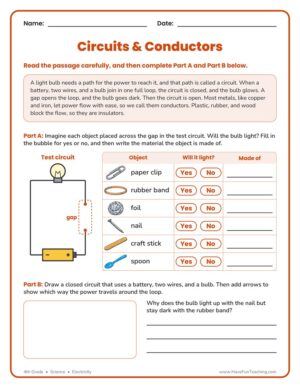
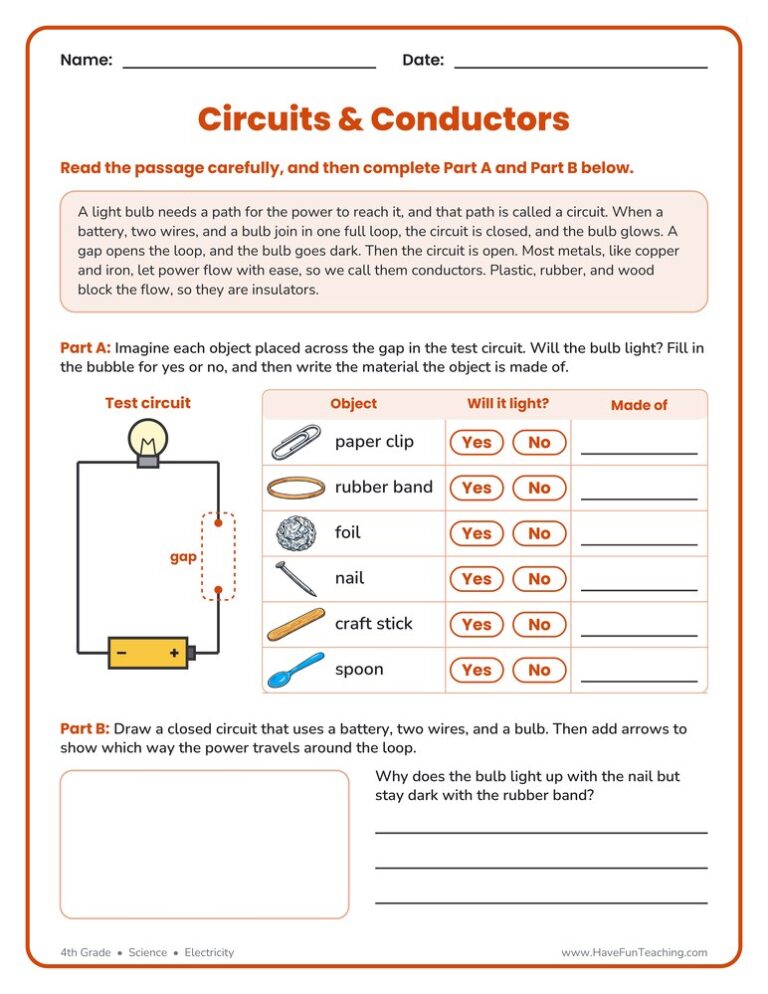
Worksheet4th GradeCircuits Conductors Worksheet

Use this circuits conductors worksheet to help 4th grade students predict which objects light a bulb, draw a closed circuit, and explain conductors and insulators. An answer key is included for quick checking.

From our teachers' playbook

Close the loop, light the bulb!

What do 4th graders learn about electricity?

Fourth graders learn that electricity is energy that flows along a path called a circuit. A simple circuit needs a power source (like a battery), wires, and something to use the energy (like a bulb). If the loop is closed, the bulb lights; open it with a switch, and it goes dark. Kids test which materials are conductors (metal lets electricity flow) and which are insulators (rubber and plastic block it). The click is the first time their own bulb glows!

Our favorite ways to teach electricity

Electricity is invisible, so we make it visible with drawings, models and safe hands-on tests.

Draw the loop

Kids draw a battery, wire and bulb, then trace the path of energy with a finger. Ask "Where would a break stop the light?" and have them draw an open circuit too. Drawing the path makes the invisible idea concrete.

Why it works: children learn more from words and pictures together than from words alone (Mayer, 2009).

Circuits WorksheetTry it withCircuits WorksheetWorksheetsOpen it →

Light it up

Kids cut out and put together a paper light bulb, labeling the filament, glass and base. Then they explain how electricity travels through it. Building the model gives them words to describe what's happening inside.

Why it works: going from real objects to pictures to symbols is a core recommendation of the U.S. Department of Education's elementary math guide.

Light Bulb Cut OutsTry it withLight Bulb Cut OutsActivitiesOpen it →

Circuit check-in

End each lesson with three quick questions: What makes a circuit closed? Name one conductor. What does a switch do? Answering from memory helps kids keep the new vocabulary straight.

Why it works: a big review of study methods ranked quick self-quizzing among the most powerful ways to remember (Dunlosky and colleagues, 2013).

Electricity WorksheetTry it withElectricity WorksheetWorksheetsOpen it →

What's on this page

Teacher favorites right now: Circuits Worksheet, Electricity Worksheet and Light Bulb Cut Outs.

Questions parents and teachers ask

What do 4th graders learn about electricity?

They learn how circuits work, the difference between open and closed circuits, and which materials are conductors or insulators. Many classes also cover how electricity changes into light, heat and sound.

What is the difference between a conductor and an insulator?

A conductor lets electricity flow easily, like copper or aluminum. An insulator blocks it, like rubber, plastic or wood. That's why wires are metal inside and plastic outside.

What is a simple circuit for kids?

A closed loop with a battery, wires and a bulb. When the loop is complete, electricity flows and the bulb lights. Any break stops the flow.

How do I teach electricity safety to kids?

Teach that small batteries are safe for experiments, but wall outlets and power lines are never for play. Keep water away from anything plugged in, and always ask an adult first.