
Skip to content
Start My 3 Free Days $0 today · cancel anytime

Preschool Senses Resources

4 preschool senses resources: 2 songs, 2 videos, 1 activity and more. How teachers use these

Preschool Senses Resources

4 preschool senses resources: 2 songs, 2 videos, 1 activity and more. How teachers use these

Video
VideoPreschoolSenses Song (MP3)

While listening to the Senses Song (MP3), students learn the five senses and examples of how you use each sense daily.

Video
VideoPreschoolSenses Song (Animated Music Video)

While watching the Senses Song (Animated Music Video), students learn about the five senses. The senses song teaches Touch, Taste, Smell, Sight, and Sound.

Flash Cards
Flash CardsPreschoolFive Senses Flash Cards

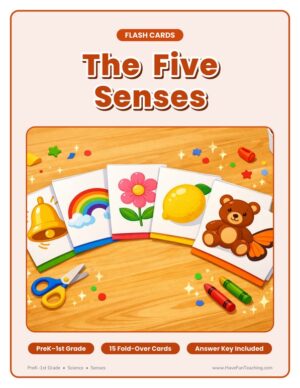
Five senses flash cards for Preschool through 1st Grade: 15 fold-over picture cards pair each sense with its body part, plus a practice page and answer key included to make learning the senses hands-on.

Workbook
WorkbookPreschoolFive Senses Mini Pack

Using this Five Senses Mini Pack, students learn about Five Senses through ten fun worksheets and two activities.

From our teachers' playbook

Look, listen, sniff, touch and taste!

What do preschoolers learn about the five senses?

Preschoolers learn that their bodies have five amazing tools for exploring the world: sight, hearing, smell, touch and taste. They match each sense to its body part (eyes, ears, nose, hands or skin, and tongue) and start using describing words like soft, loud, sweet and bumpy. Then they become little scientists, using their senses to observe and talk about what they notice. The big moment is when a child closes their eyes, holds a mystery object and says "It feels rough and it smells like an orange!"

How we teach the five senses

This is the most hands-on unit of the preschool year. Here is how we keep it fun and memorable.

Sing and point

Play a senses song and have kids point to their eyes, ears, nose, hands and tongue as each sense comes up. After a few days, pause the song and let them shout the next one. Singing and pointing ties each sense to its body part.

Why it works: a catchy, repeating tune gives the brain a hook to hang words on, so sung text is remembered better (Wallace, 1994).

Senses Song (Animated Music Video)Try it withSenses Song (Animated Music Video)SongsOpen it →
Which sense is it?

Show a picture card, like a bell, a flower or a lemon, and ask "Which sense would you use?" Some pictures have more than one answer, which leads to great conversations. A lemon? You can see it, smell it and taste it!

Why it works: children learn more from words and pictures together than from words alone (Mayer, 2009).

Five Senses Flash CardsTry it withFive Senses Flash CardsFlash CardsOpen it →

Mystery bag

Put a pinecone, a cotton ball or a block in a bag and let kids feel without looking. Ask for one describing word before they guess. It builds vocabulary and shows that touch alone can tell us a lot.

Why it works: the U.S. Department of Education's guide for teaching elementary math recommends moving from hands-on objects to drawings to numbers.

Senses Song (MP3)Try it withSenses Song (MP3)SongsOpen it →

Questions parents and teachers ask

What are the five senses for preschoolers?

Sight, hearing, smell, touch and taste. We see with our eyes, hear with our ears, smell with our nose, touch with our skin and hands, and taste with our tongue.

Why teach the five senses in preschool?

The senses are how young children learn about everything. Talking about them builds vocabulary, observation skills and early science thinking, and it is easy to do with everyday things.

What are easy five senses activities at home?

Do a taste test with sweet, sour and salty foods, smell spices from the kitchen, or play "I spy" for sight. Ask your child to describe what they notice with a new word each time.

How long should a preschool senses unit last?

Many teachers spend one to two weeks, often one day per sense, then a final day using all five together. Short daily activities work better than one long lesson for this age.



