Skip to content
Start My 3 Free Days $0 today · cancel anytime

Electricity Resources

6 electricity resources: 6 worksheets and 1 activity. How teachers use these

Electricity Resources

6 electricity resources: 6 worksheets and 1 activity. How teachers use these

Worksheet
Worksheet4th GradeCircuits Worksheet

This Circuits Worksheet helps 4th Grade students label the battery, bulb, switch, and wire, decide whether a circuit is open or closed, and explain how current flows. Answer key included, so checking work is quick.

Worksheet
Worksheet4th GradeElectricity Worksheet

This Electricity Worksheet pairs a short reading passage with vocabulary and explanation questions that show 4th graders how current, circuits, conductors, and insulators work. Answer key included for fast, no-prep science practice.

Activity
Activity4th GradeLight Bulb Cut Outs

This light bulb cut outs worksheet gives 4th grade students four bulbs to fill with electricity facts, color and cut out, making a bright science bulletin board that celebrates what the whole class has learned.

Worksheet
Worksheet4th GradeConductors Worksheet

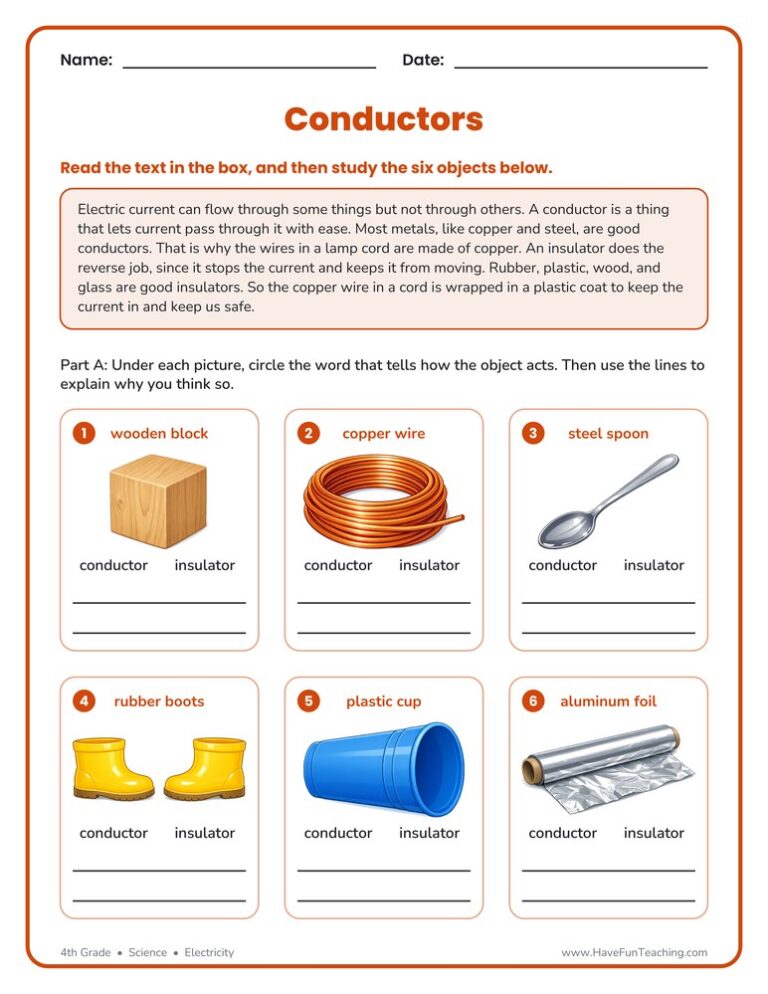
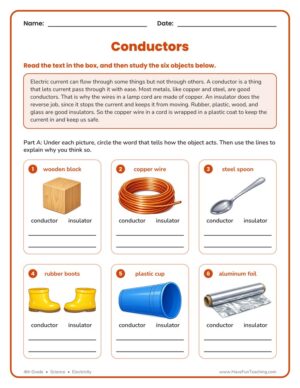
This conductors worksheet has 4th graders read a short passage, sort six objects as conductors or insulators, and explain each choice. An answer key is included for easy checking.

Worksheet
Worksheet4th GradeCircuits Conductors Worksheet

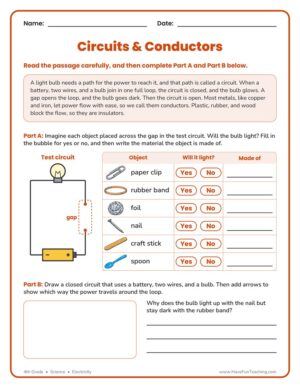
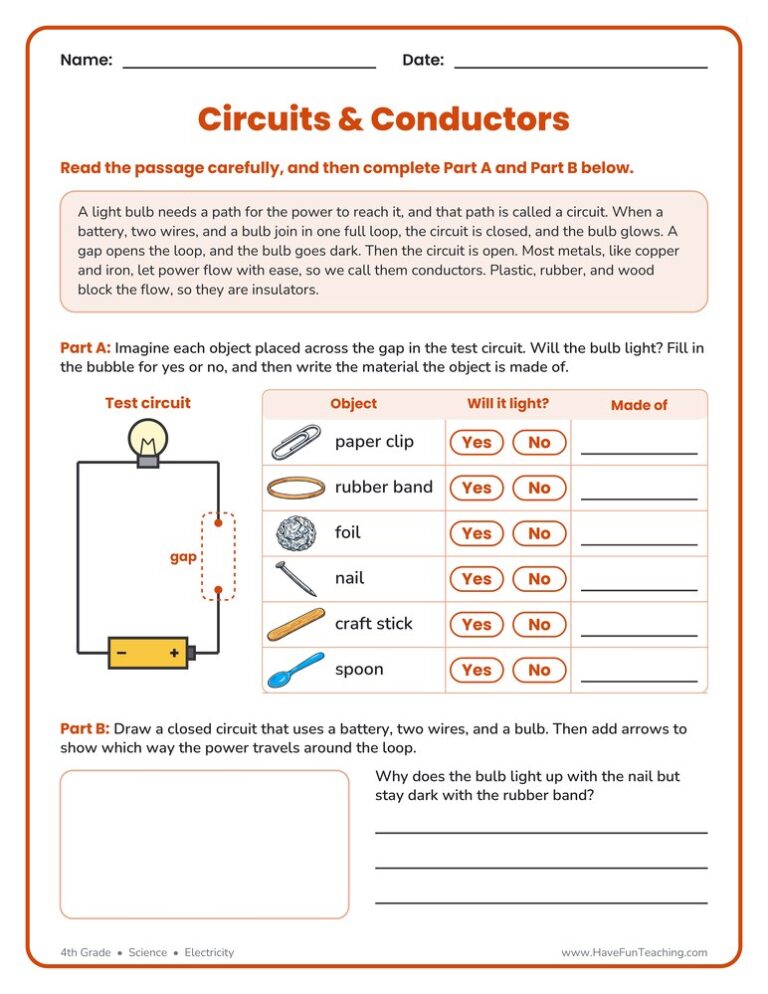
Use this circuits conductors worksheet to help 4th grade students predict which objects light a bulb, draw a closed circuit, and explain conductors and insulators. An answer key is included for quick checking.

Worksheet
Worksheet1st GradeElectricity Writing Paper

This electricity writing paper gives 1st grade students ten roomy lines to write about how they use power, with a bright picture of a battery, wires and a glowing bulb to spark ideas.

From our teachers' playbook

Light it up with a circuit

What do kids learn about electricity?

Kids learn that electricity is energy that flows along a path called a circuit. For a bulb to light, the circuit has to be closed: battery, wire, bulb and back to the battery with no gaps. They test which materials are conductors (like metal) and which are insulators (like rubber, plastic and wood). They also learn how electricity powers our homes and how to stay safe around it. The click is the moment a bulb lights up because they connected the last wire.

How we teach electricity

Electricity is invisible, so we make it visible with hands-on building. These moves work every time.

Build a simple circuit

Give small groups a battery, two wires and a small bulb. Their only challenge: make it light. Then ask them to break the circuit on purpose and explain why it went dark. Trial and error makes "closed circuit" make sense.

Why it works: the U.S. Department of Education's guide for teaching elementary math recommends moving from hands-on objects to drawings to numbers.

Circuits WorksheetTry it withCircuits WorksheetWorksheetsOpen it →
Conductor or insulator?

Before testing, kids predict whether a paper clip, eraser, coin or spoon will let electricity through. Then they test each one in their circuit and record results. Predicting first turns it into a quick self-check.

Why it works: researchers who compared ten study methods found practice testing is one of the two that work best (Dunlosky and colleagues, 2013).

Conductors WorksheetTry it withConductors WorksheetWorksheetsOpen it →

Draw it with symbols

Once kids have built a circuit, show them how scientists draw one with simple symbols for the battery, wire and bulb. Kids draw their own working circuit. Moving from real to drawing deepens understanding.

Why it works: children learn more from words and pictures together than from words alone (Mayer, 2009).

Circuits Conductors WorksheetTry it withCircuits Conductors WorksheetWorksheetsOpen it →

What's on this page

Teacher favorites right now: Circuits Worksheet, Electricity Worksheet and Light Bulb Cut Outs.

Questions parents and teachers ask

How do you explain electricity to kids?

Electricity is energy that moves through wires to power things like lights and TVs. It needs a complete path, called a circuit, to flow.

What is the difference between a conductor and an insulator?

A conductor lets electricity flow through it easily, like metal. An insulator blocks electricity, like rubber or plastic, which is why wires are covered in plastic.

What grade learns about circuits?

Many students build simple circuits in 4th grade, and some explore them as early as 3rd. Electricity comes back again in middle school science.

Is it safe for kids to build circuits?

Yes, with small batteries, wires and bulbs and adult supervision. Kids should never experiment with wall outlets or household electricity.

Keep exploring