Skip to content
Start My 3 Free Days $0 today · cancel anytime

2nd Grade Conjunctions Resources

2 2nd grade conjunctions resources: 2 worksheets. How teachers use these

2nd Grade Conjunctions Resources

2 2nd grade conjunctions resources: 2 worksheets. How teachers use these

Worksheet
Worksheet2nd GradeCombining and Expanding Sentences Worksheet

The Combining and Expanding Sentences Worksheet helps second graders use conjunctions to join sentences and add describing words. Grade 2, answer key included — a simple way to build stronger sentence writing.

Worksheet
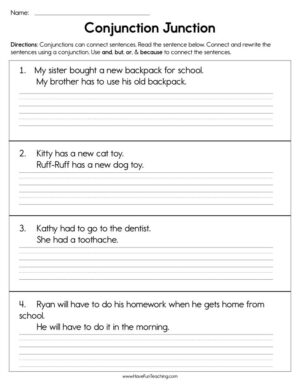
Worksheet2nd GradeConjunction Junction Worksheet

This conjunction junction worksheet helps 2nd Grade writers join two short sentences with and, but, or, or because. An answer key is included, making sentence combining practice simple to check.

From our teachers' playbook

Little words that glue big ideas

What do 2nd graders learn about conjunctions?

Second graders learn that conjunctions are joining words that connect ideas. They focus on and, but, or and so, and use them to combine two short sentences into one longer one: I like dogs. I like cats. → I like dogs and cats. They learn that each conjunction has a job: "and" adds, "but" shows a surprise, "or" gives a choice, and "so" tells a result. The click moment is when choppy writing suddenly starts to sound smooth.

Our favorite ways to teach conjunctions

Kids get conjunctions fastest when they see two sentences become one right in front of them.

Glue two sentences together

Write two short sentences on strips of paper. Kids pick a conjunction card and tape the sentences together with it, crossing out the first period. Building it with their hands shows exactly what a joining word does.

Why it works: the U.S. Department of Education's guide for teaching elementary math recommends moving from hands-on objects to drawings to numbers.

Combining and Expanding Sentences WorksheetTry it withCombining and Expanding Sentences WorksheetWorksheetsOpen it →
Give each conjunction a job

Make an anchor chart with four columns: "and adds," "but surprises," "or chooses," "so explains." Write one silly class example under each, then have students add their own all week.

Why it works: showing first, practicing together, then letting kids try alone is the "gradual release" model teachers have relied on for decades (Pearson and Gallagher, 1983).

Conjunction Junction WorksheetTry it withConjunction Junction WorksheetWorksheetsOpen it →

Which word fits?

Read a sentence with a blank, like "I wanted to play outside, ___ it was raining." Kids hold up the conjunction card that fits. Mixing all four in one round makes them think about meaning, not just pick "and" every time.

Why it works: shuffled practice teaches kids to choose the right strategy, not just repeat one, and it improved test scores in research (Rohrer and Taylor, 2007).

Questions teachers and parents ask

What are conjunctions for 2nd grade?

Conjunctions are joining words that connect words or sentences. Second graders mostly use and, but, or and so. For example: "I was tired, so I went to bed."

How do I teach conjunctions to 2nd graders?

Show two short sentences and join them with a conjunction on the board. Then let students try it with sentence strips. Teach the job of each word so they choose the right one.

What is the difference between and, but and so?

"And" adds more information, "but" shows something different or surprising, and "so" tells what happened because of something. Practicing with real examples helps kids hear the difference.

How can I practice conjunctions at home?

When your child gives a short answer, ask them to add more using "and," "but" or "so." You can also play a quick game of finishing each other's sentences.