Skip to content
Start My 3 Free Days $0 today · cancel anytime

6th Grade Addition Resources

1 6th grade addition resources: 1 activity. How teachers use these

Find the perfect resource in seconds

6th Grade Addition Resources

1 6th grade addition resources: 1 activity. How teachers use these

Activity
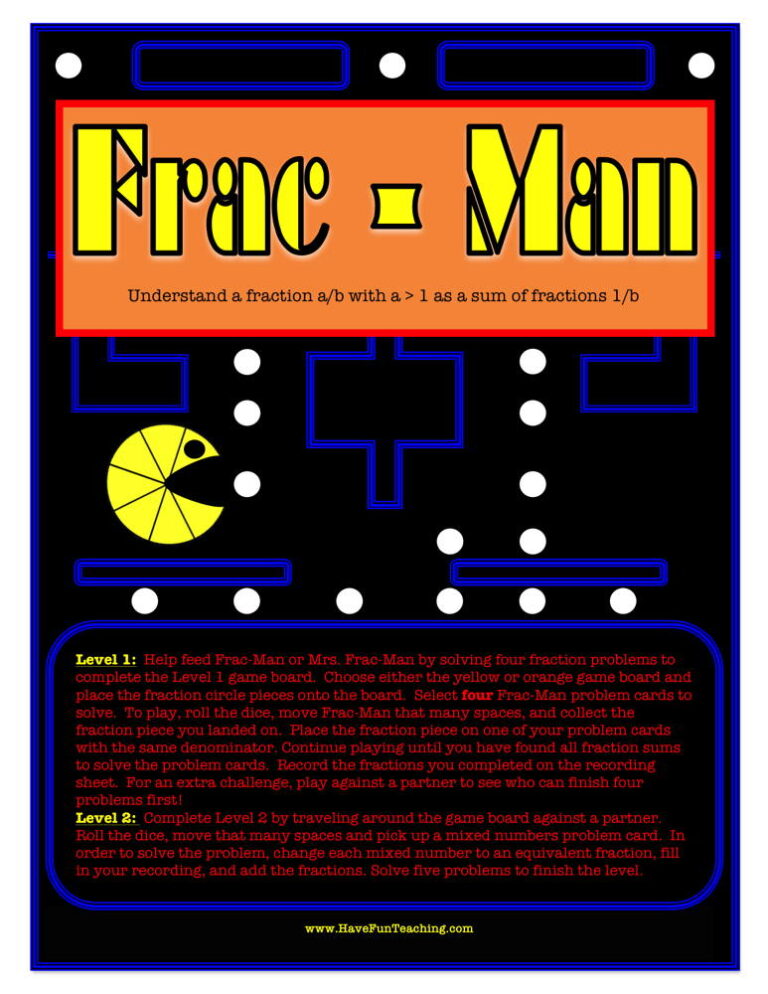
Activity6th GradeFrac-Man Fractions Activity

Using this Frac-Man Fractions Activity, students solve fraction problems to help feed Frac-Man and/or Mrs. Frac-Man.

From our teachers' playbook

Adding up decimals, fractions and more

What do 6th graders learn about addition?

In 6th grade, addition grows up. Students fluently add multi-digit decimals by lining up the decimal points, 12.45 + 3.8 = 16.25, and they add fractions and mixed numbers with unlike denominators by finding a common denominator: 2/3 + 1/4 = 8/12 + 3/12 = 11/12. They also start adding integers, including negatives, on a number line. The click moment is realizing it is all the same idea: you can only add pieces that are the same size.

Our favorite ways to sharpen 6th grade addition

Sixth graders already know how to add. These moves help them add accurately with decimals, fractions and negatives.

Same-size pieces only

Before adding fractions, have students cut or draw the pieces. Thirds and fourths don't match, so they slice both into twelfths. Seeing it once makes common denominators make sense instead of feeling like a rule to memorize.

Why it works: kids understand an idea best when they touch it, then draw it, then write it, the order the U.S. Department of Education recommends for elementary math.

Frac-Man Fractions ActivityTry it withFrac-Man Fractions ActivityActivitiesOpen it →
Mix decimals, fractions and integers

Give a short set where every problem is a different type: a decimal sum, a mixed-number sum, and an integer sum. Students have to decide the strategy first. That choice is exactly what trips kids up on tests.

Why it works: mixing different kinds of problems in one practice set helped students do far better on a later test (Rohrer and Taylor, 2007).

Estimate before you add

Before solving, students say a quick estimate out loud: "2/3 is a little more than a half, 1/4 is a quarter, so my answer is a bit under 1." If the final answer is way off, they catch it themselves.

Why it works: using clear, consistent math words out loud is one of the U.S. Department of Education's recommendations for elementary math.

What's on this page

Teacher favorites right now: Frac-Man Fractions Activity.

Questions teachers and parents ask

What kind of addition do 6th graders do?

Sixth graders add multi-digit decimals, fractions and mixed numbers with unlike denominators, and begin adding positive and negative integers. The focus is on accuracy and choosing the right strategy.

How do you add fractions with different denominators?

Find a common denominator, rewrite each fraction, then add the numerators. For 1/2 + 1/3, use sixths: 3/6 + 2/6 = 5/6. Simplify if you can.

Why does my child get decimal addition wrong?

The most common mistake is not lining up the decimal points. Have them write a zero in empty places, like 3.80, so every number has the same number of digits after the point.

How do I help my 6th grader add negative numbers?

Use a number line or a money story. Owing $5 and earning $3 leaves you owing $2, so -5 + 3 = -2. Real stories make the signs make sense.