Skip to content
Start My 3 Free Days $0 today · cancel anytime

3rd Grade Prefixes Resources

13 3rd grade prefixes resources: 6 worksheets, 5 activities, 1 game and more. How teachers use these

3rd Grade Prefixes Resources

13 3rd grade prefixes resources: 6 worksheets, 5 activities, 1 game and more. How teachers use these

Game
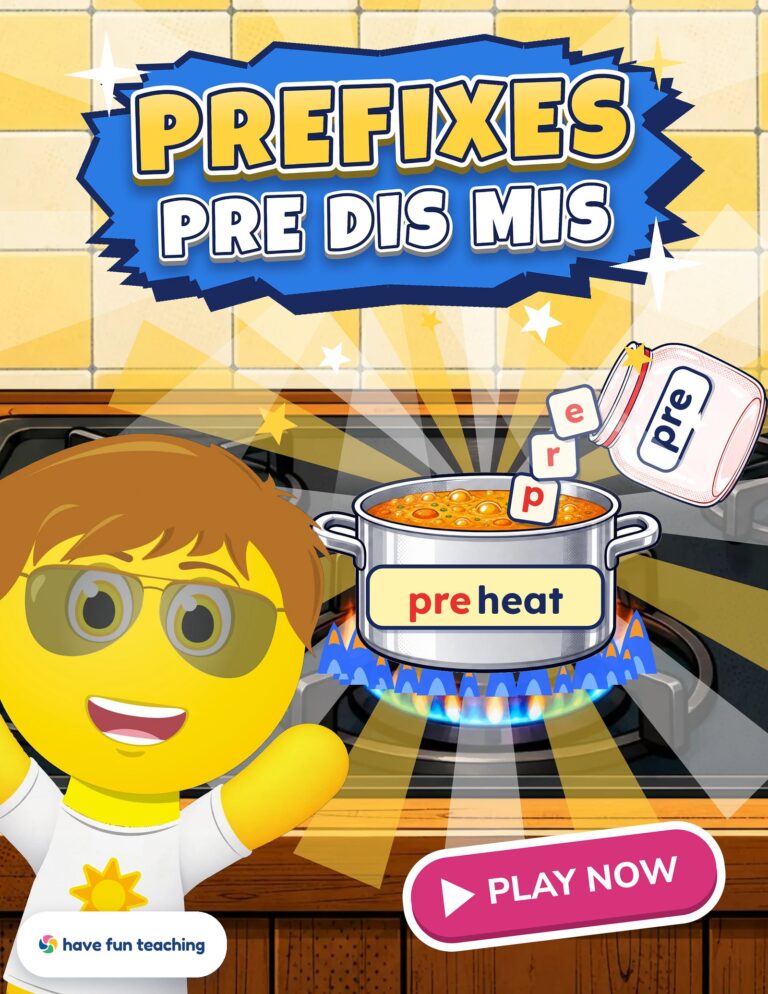
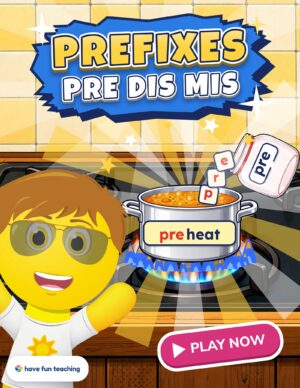
Game3rd GradePrefixes Pre Dis Mis Game

A comic-book cooking game where third grade kids read each order and pour the prefix pre, dis or mis into the pot to cook up words like preheat, dislike and misspell. Play online on any phone, tablet, Chromebook or computer.

Worksheet
Worksheet3rd GradePrefixes and Suffixes Root Words Worksheet

This Prefixes and Suffixes Root Words Worksheet helps 3rd graders underline prefixes and suffixes and identify the root word. Answer key included, making it perfect for no-prep vocabulary and decoding practice.

Worksheet
Worksheet3rd GradePrefixes and Suffixes Worksheet

This prefixes and suffixes worksheet helps 3rd grade students use word parts to find the meaning of new words and build words of their own. An answer key is included for quick checking.

Flash Cards
Flash Cards3rd GradePrefix Flash Cards

These prefix flash cards help kindergarten to 4th grade students learn 24 common prefixes, their meanings and an example word for each. Fold-over cards, a practice page and an answer key are included.

Worksheet
Worksheet3rd GradeNew Words Worksheet

This new words worksheet has 3rd grade students use the prefixes un-, re-, pre- and dis- to find word meanings and build new words. Answer key included.

Activity
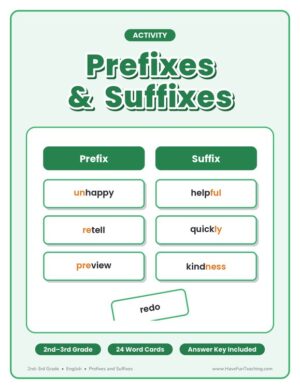
Activity3rd GradePrefixes and Suffixes Sorting Activity

This prefixes and suffixes sorting activity has 2nd and 3rd Grade readers sort 24 word cards by prefix or suffix, with a recording sheet, practice page and answer key included.

Worksheet
Worksheet3rd GradePrefix Fill in the Blank Worksheet

This Prefix Fill in the Blank Worksheet gives 3rd Grade students five prefixes to match, four sentences to complete, and two words to explain. An answer key is included for fast, no-prep word study.

Worksheet
Worksheet3rd GradeWords with Prefixes Worksheet

This words with prefixes worksheet has 3rd graders take the prefix off ten words, write each base word, and match three meanings to words. An answer key is included for easy checking.

Activity
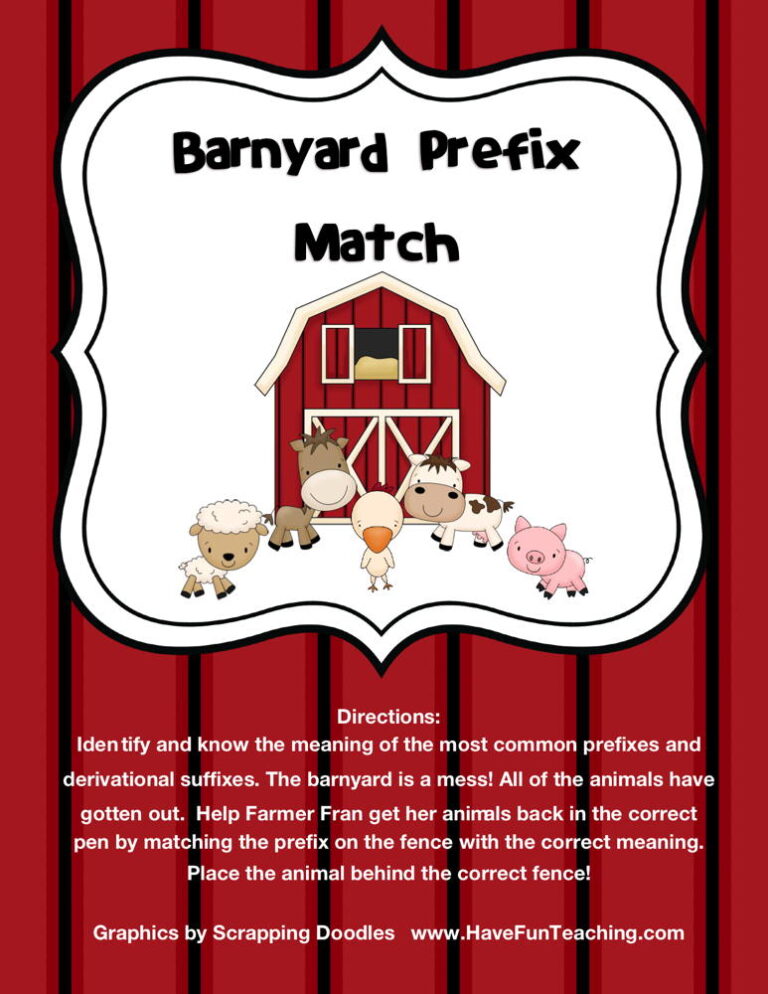
Activity3rd GradeBarnyard Prefix Matching Activity

This barnyard prefix matching activity has 2nd to 4th Grade students sort un-, re-, pre- and mis- word cards into fence pens by meaning. Answer key included.

Activity
Activity3rd GradePrefix Barnyard Matching Activity

This prefix barnyard matching activity lets 2nd and 3rd grade students match fence cards with prefixes to barn cards with their meanings. Answer key included, so new words are easier to read.

Worksheet
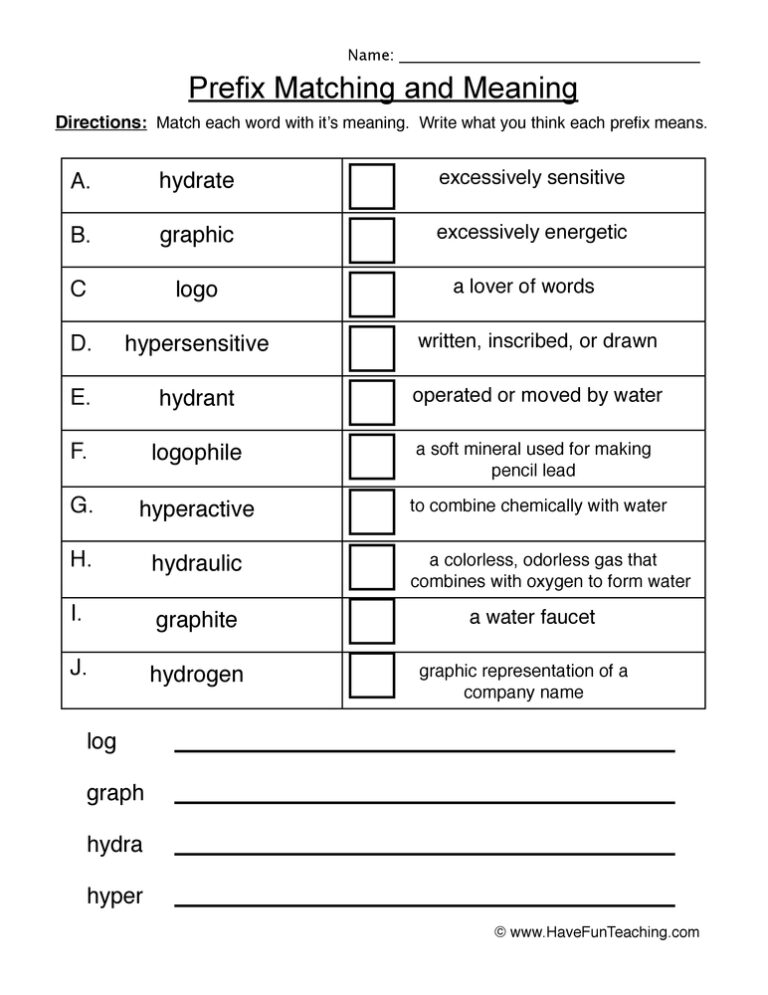
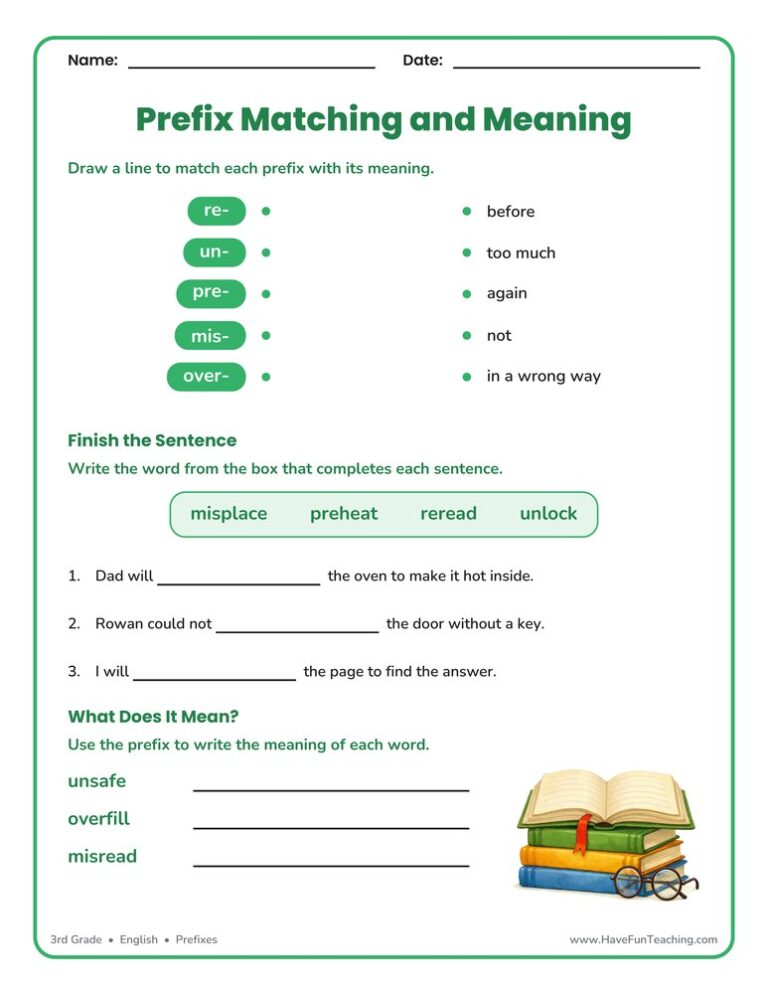
Worksheet3rd GradePrefix Matching and Meaning Worksheet

This prefix matching and meaning worksheet gives 3rd Grade students three quick activities on the prefixes re-, un-, pre-, mis-, and over-. Answer key included, so vocabulary practice is ready to hand out with no prep.

Activity
Activity3rd GradeExplore New Words Prefix Activity

This Explore New Words prefix activity has 2nd and 3rd grade kids join prefixes to base words in self-checking puzzles and write what the new words mean. Answer key included.

Activity
Activity3rd GradeExploring New Words Prefix Activity

Using Exploring New Words Prefix Activity, students will use prefix and base cards to create new words and then define the each new word.

From our teachers' playbook

Tiny word parts, big meaning changes

What do 3rd graders learn about prefixes?

Third graders learn that a prefix is a small chunk added to the front of a word that changes its meaning. The stars of the year are un-, re-, dis-, pre- and mis-: un + happy = not happy, re + read = read again. Kids learn to cover the prefix, read the base word, then put the meaning back together. The click comes when a child meets a brand-new word like "misbehave" and figures it out alone. That's the real payoff: prefixes turn one known word into four or five.

Our favorite ways to teach prefixes

Prefixes stick when kids take words apart and build them back up. These three moves do just that.

One prefix, one card, one meaning

Put each prefix on a flash card with its meaning on the back: re- means "again," dis- means "not" or "opposite." Flash five cards a day, then ask kids to name a word for each one. Fast, daily, and it builds a ready word bank.

Why it works: children learn more from words and pictures together than from words alone (Mayer, 2009).

Prefix Flash CardsTry it withPrefix Flash CardsFlash CardsOpen it →
Pre, dis or mis?

Play a quick round where kids hear a meaning, like "to place wrongly," and pick the right prefix to build "misplace." Mixing three prefixes in one game makes kids think about meaning instead of guessing the one they just practiced.

Why it works: researchers who compared ten study methods found practice testing is one of the two that work best (Dunlosky and colleagues, 2013).

Prefixes Pre Dis Mis GameTry it withPrefixes Pre Dis Mis GameGamesOpen it →

Sort the word parts

Write words on cards, then have partners cut each one into prefix and base word and sort them into piles. When they tape the parts back together, they say the new meaning out loud. Physically splitting the word makes the idea visible.

Why it works: the U.S. Department of Education's guide for teaching elementary math recommends moving from hands-on objects to drawings to numbers.

Prefixes and Suffixes Sorting ActivityTry it withPrefixes and Suffixes Sorting ActivityActivitiesOpen it →

Prefix questions parents and teachers ask

What prefixes do 3rd graders learn?

The most common are un-, re-, dis-, pre- and mis-, with some classes adding non- and over-. Students learn what each means and use it to figure out new words.

How do you explain a prefix to a child?

A prefix is a word part that goes at the front and changes the meaning. Show "happy" and "unhappy" side by side and ask what changed. Kids see right away that un- means "not."

What is the difference between a prefix and a suffix?

A prefix goes at the beginning of a word and a suffix goes at the end. Both change meaning: "replay" means play again, and "player" means someone who plays.

How can I practice prefixes at home?

Play "prefix hunt" while reading together and jot down any words that start with un-, re- or dis-. Ask what the word means without the prefix. A few minutes a day builds a lot of vocabulary.