Skip to content
Start My 3 Free Days $0 today · cancel anytime

3rd Grade Capacity Resources

2 3rd grade capacity resources: 2 worksheets. How teachers use these

3rd Grade Capacity Resources

2 3rd grade capacity resources: 2 worksheets. How teachers use these

Worksheet
Worksheet3rd GradeDensity and Volume in Metric Worksheet

This Density and Volume in Metric Worksheet asks 3rd graders to choose the best metric unit—grams, kilograms, milliliters, or liters—for ten everyday objects. Answer key included for fast, no-prep measurement practice.

Worksheet
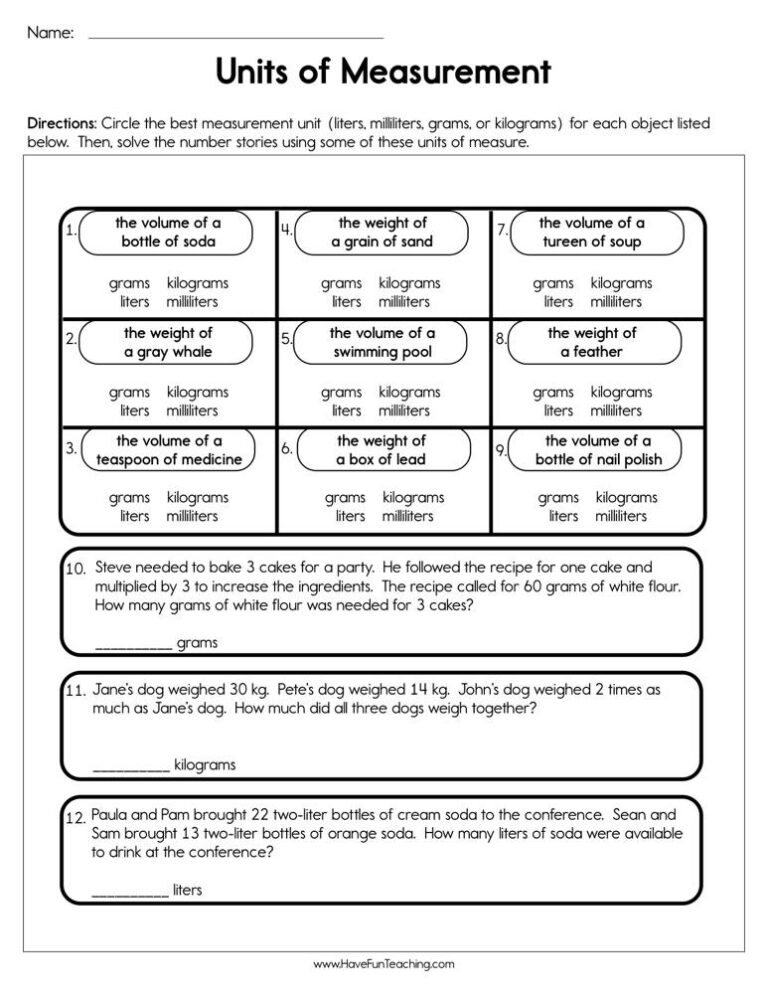
Worksheet3rd GradeUnits of Measurement Worksheet

A units of measurement worksheet where 3rd graders choose grams, kilograms, milliliters, or liters for everyday objects, then solve two metric number stories. Answer key included for fast, no-prep practice.

From our teachers' playbook

How much will it hold?

What do 3rd graders learn about capacity?

Capacity is how much a container can hold. In 3rd grade, students measure and estimate liquid volume in liters and milliliters, and solve word problems about adding, subtracting, multiplying or dividing amounts of liquid. They build a sense of size: a 1 liter water bottle, a 5 mL spoonful of medicine. They also compare containers and learn that a tall, skinny glass might hold less than a short, wide bowl. The click comes when kids pour water from one container into another and see that the amount did not change, only the shape did.

How we teach capacity

Capacity is best learned with real water and real containers. These moves start hands-on and move to paper.

Pour, predict, measure

Set out three different containers and ask kids which holds the most. Have them predict, then fill each one and pour it into a measuring cup to check. The surprise when the "smallest" one wins is what makes them trust measuring over guessing.

Why it works: the U.S. Department of Education's guide for teaching elementary math recommends moving from hands-on objects to drawings to numbers.

Density and Volume in Metric WorksheetTry it withDensity and Volume in Metric WorksheetWorksheetsOpen it →

Pick the right unit

Show pictures of a bathtub, a spoon, a juice box and a swimming pool. Kids decide if each one is better measured in liters or milliliters and explain why. Choosing units builds number sense before kids do any calculating.

Why it works: children learn more from words and pictures together than from words alone (Mayer, 2009).

Units of Measurement WorksheetTry it withUnits of Measurement WorksheetWorksheetsOpen it →

Liquid word problems

Give one or two short word problems a day, like "A jug holds 4 liters. How much do 3 jugs hold?" Kids draw a quick picture before solving. A little practice every day helps them see capacity problems as regular math.

Why it works: pulling an answer out of memory makes it stick far better than rereading it, one of the strongest findings in learning research (Dunlosky and colleagues, 2013).

Measurement Conversion ActivityTry it withMeasurement Conversion ActivityActivitiesOpen it →

What's on this page

Teacher favorites right now: Density and Volume in Metric Worksheet and Units of Measurement Worksheet.

Questions parents and teachers ask

What is capacity in 3rd grade math?

Capacity is the amount a container can hold, usually liquid. Third graders measure it in liters and milliliters and solve one-step word problems with those units.

What is the difference between capacity and volume?

They are closely related. Capacity is how much a container can hold, while volume is how much space something takes up. In 3rd grade, the two words are often used together when measuring liquids.

How many milliliters are in a liter?

There are 1,000 milliliters in 1 liter. A big water bottle is about 1 liter, and a teaspoon is about 5 milliliters, which gives kids handy benchmarks.

How can I teach capacity at home?

Measure water in the kitchen! Let your child fill cups, bottles and bowls, read the measuring cup, and compare which holds more. Bath time and cooking are perfect chances to practice.