
Skip to content
Start My 3 Free Days $0 today · cancel anytime

3rd Grade Estimation Worksheets

11 3rd grade estimation worksheets. Teacher favorites: Adding and Estimation Worksheet and Rounding to the Nearest Ten Worksheet. How teachers use these

3rd Grade Estimation Worksheets

11 3rd grade estimation worksheets. Teacher favorites: Adding and Estimation Worksheet and Rounding to the Nearest Ten Worksheet. How teachers use these

Worksheet
Worksheet3rd GradeAdding and Estimation Worksheet

Third graders round three-digit numbers to the nearest hundred to estimate each sum on this Adding and Estimation Worksheet, then add to find the actual total. Includes an answer key—great for quick, no-prep math practice.

Worksheet
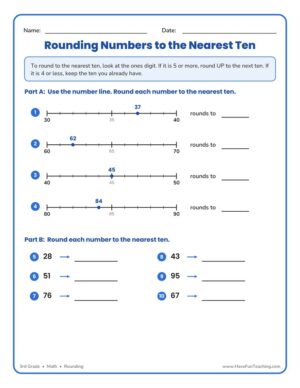
Worksheet3rd GradeRounding to the Nearest Ten Worksheet

Help 3rd graders master rounding with this rounding to the nearest ten worksheet, featuring guided number lines and quick practice. Answer key included—an easy, no-prep way to build number sense and estimation skills.

Worksheet
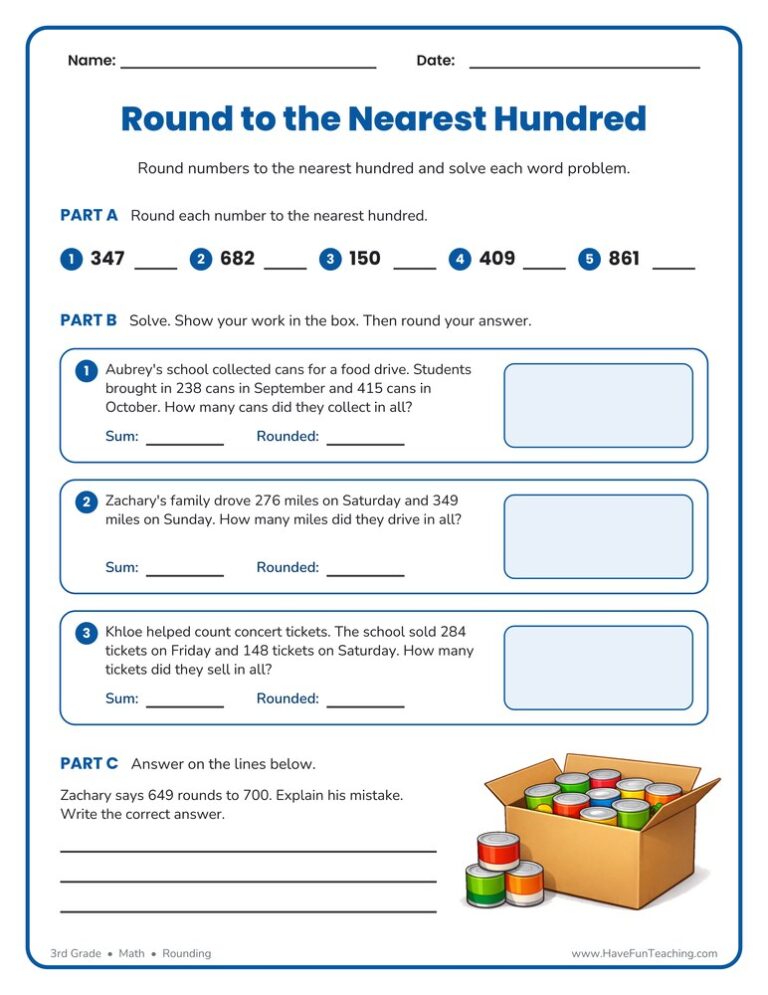
Worksheet3rd GradeRound to the Nearest Hundred Word Problems Worksheet

This round to the nearest hundred word problems worksheet gives 3rd Grade students five rounding items, three add-and-round word problems, and a written explanation task. An answer key is included so checking work is quick.

Worksheet
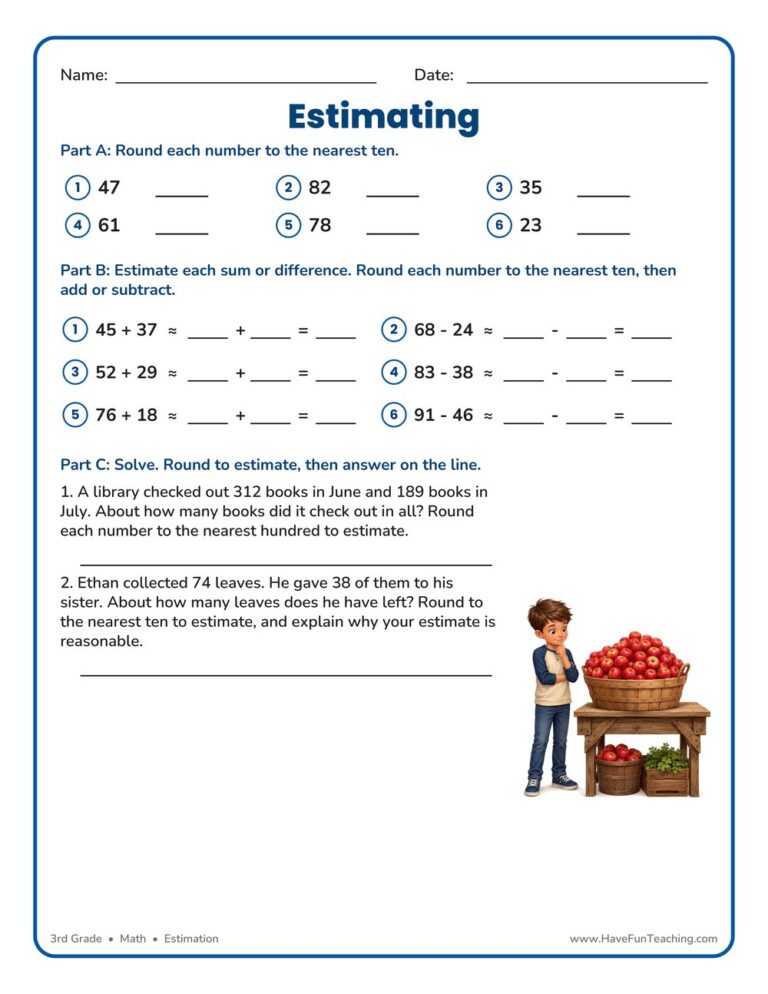
Worksheet3rd GradeAdd/Subtract Estimation Worksheet

This add/subtract estimation worksheet helps 3rd graders round to the nearest ten and hundred to estimate sums and differences. Includes an answer key for quick, no-prep rounding and estimation practice.

Worksheet
Worksheet3rd GradeRound to the Nearest Ten Word Problems Worksheet

This round to the nearest ten word problems worksheet gives 3rd graders four problems to solve and round, plus one written explanation. An answer key is included, so it prints and goes.

Worksheet
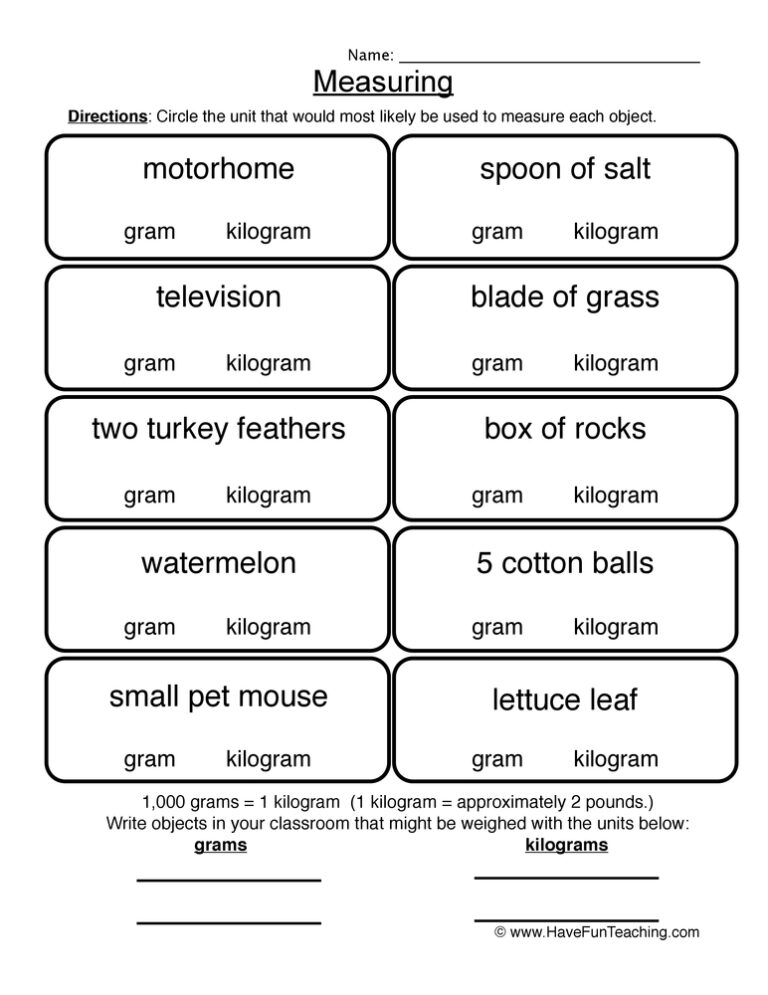
Worksheet3rd GradeGram Kilogram Worksheet

This gram kilogram worksheet gives 3rd graders practice choosing metric units, converting grams to kilograms, and explaining a comparison. Answer key included, so measurement practice is ready to print and go.

Worksheet
Worksheet3rd GradeRounding to Hundreds Worksheet

This rounding to hundreds worksheet gives 3rd graders nine rounding problems, a number line activity, and word problems to explain. An answer key is included, so estimation practice is ready in one print.

Worksheet
Worksheet3rd GradeRound to the Nearest Ten Worksheet

This round to the nearest ten worksheet gives 3rd grade students ten rounding problems and three word problems, with an answer key included, so rounding becomes quick and automatic.

Worksheet
Worksheet3rd GradeTime Estimation Worksheet

This time estimation worksheet helps 3rd grade students pick the better estimate for everyday activities and add estimated minutes. An answer key is included, so checking work takes seconds.

Worksheet
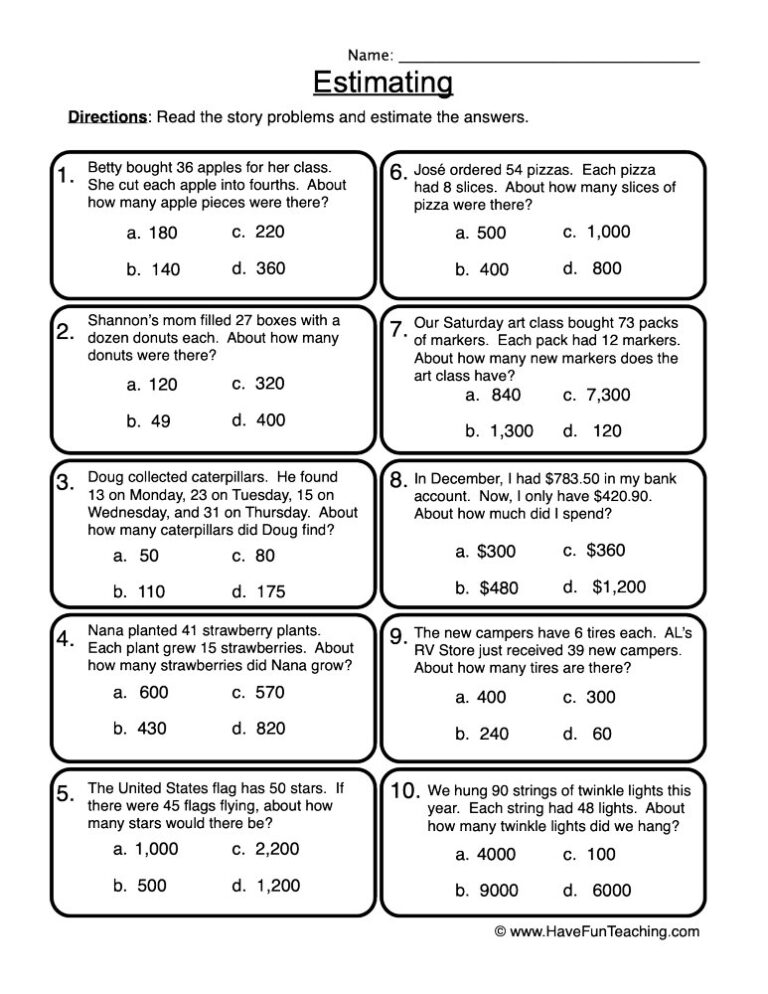
Worksheet3rd GradeEstimation Multiple Choice Worksheet

This estimation multiple choice worksheet has 3rd graders round to the nearest ten to estimate sums and differences in five bubble-answer story problems, plus two write-and-explain items. Answer key included for fast checking.

Worksheet
Worksheet3rd GradeRound to the Nearest Hundred Worksheet

This Round to the Nearest Hundred Worksheet has 3rd Grade students name both neighboring hundreds before rounding, plus a word problem and an answer key so rounding finally makes sense.

From our teachers' playbook

Close enough is a superpower

What do 3rd graders learn about estimation?

Third graders learn that a good estimate is a smart guess that's close to the real answer. They round numbers to the nearest 10 or 100: 347 ≈ 350 or 347 ≈ 300. Then they use rounding to estimate sums and differences and check if an answer makes sense. They also estimate measurements like length, mass and time. The click moment is when a child solves 498 + 302, gets 1,100, and says, "Wait, that should be about 800. I made a mistake!"

Our favorite ways to make estimation stick

Estimation is all about number sense. These moves help kids see why it matters.

Rounding on the number line

Draw a number line from 40 to 50 and place 47. Ask, "Is it closer to 40 or 50?" Kids can see the answer. Seeing the distance makes the "5 or more, round up" rule make sense.

Why it works: pairing a picture with each word gives kids two ways to remember it, a well-tested principle of how people learn (Mayer, 2009).
Rounding to the Nearest Ten WorksheetTry it withRounding to the Nearest Ten WorksheetWorksheetsOpen it →

Estimate, then solve

On every addition and subtraction problem, kids write an estimate first, then the exact answer, then circle whether they're close. Mixing both steps catches errors and builds a habit kids will use for life.

Why it works: mixing different kinds of problems in one practice set helped students do far better on a later test (Rohrer and Taylor, 2007).

Add/Subtract Estimation WorksheetTry it withAdd/Subtract Estimation WorksheetWorksheetsOpen it →

Guess, then measure

Kids estimate the length of their desk, a book and the door, then measure. Keep a chart: estimate, actual, difference. Watching their estimates get closer over a week is very motivating.

Why it works: kids understand an idea best when they touch it, then draw it, then write it, the order the U.S. Department of Education recommends for elementary math.

Estimate and Measure ActivityTry it withEstimate and Measure ActivityActivitiesOpen it →

Questions teachers and parents ask

What is estimation in 3rd grade?

It's finding an answer that's close to the exact answer, usually by rounding to the nearest 10 or 100. Third graders use estimation to check if their addition and subtraction answers make sense.

How do you teach rounding?

Use a number line so kids can see which ten or hundred a number is closer to. Then teach the rule: look at the digit to the right, 5 or more rounds up, 4 or less rounds down.

Why is estimation important?

Estimation helps kids catch mistakes and make quick decisions in real life, like guessing a total at the store or how long a trip will take.

How can I practice estimation at home?

At the grocery store, have your child round prices and estimate the total. Ask them to guess how many minutes something will take, then check.



