
Skip to content
Start My 3 Free Days $0 today · cancel anytime

3rd Grade Probability Resources

2 3rd grade probability resources: 2 worksheets. How teachers use these

3rd Grade Probability Resources

2 3rd grade probability resources: 2 worksheets. How teachers use these

Worksheet
Worksheet3rd GradeHeads or Tails Probability Worksheet

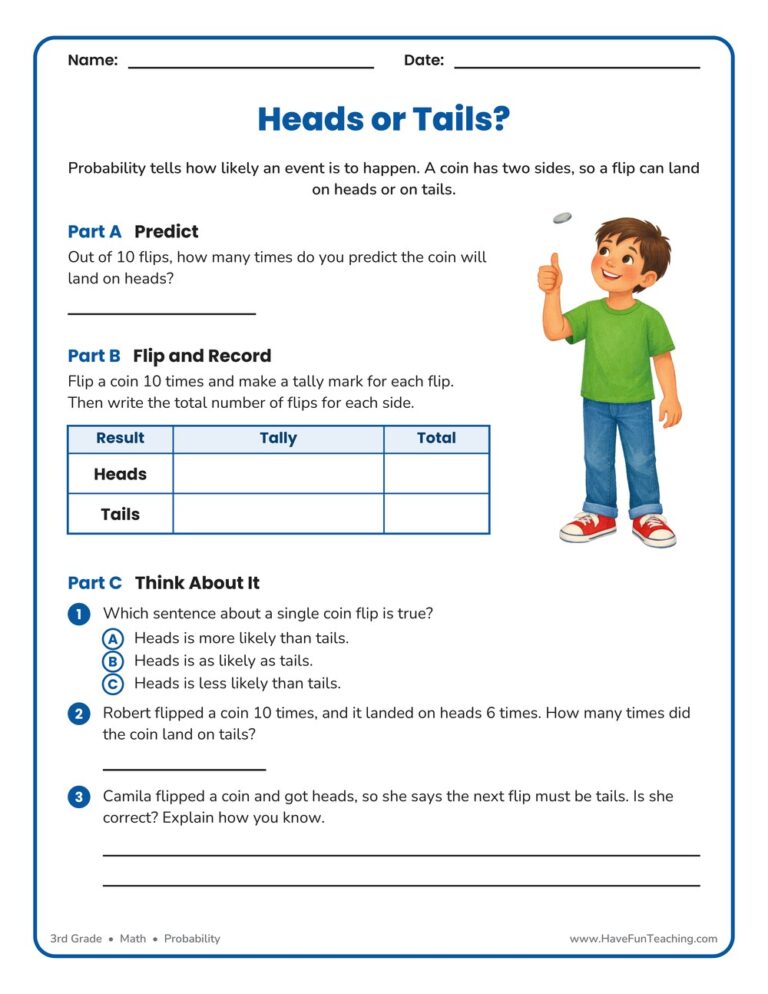
This Heads or Tails Probability Worksheet has 3rd graders predict, flip a coin ten times, and tally the results, then explain why each flip is equally likely. Answer key included.

Worksheet
Worksheet3rd GradeAre You Certain? Probability Worksheet

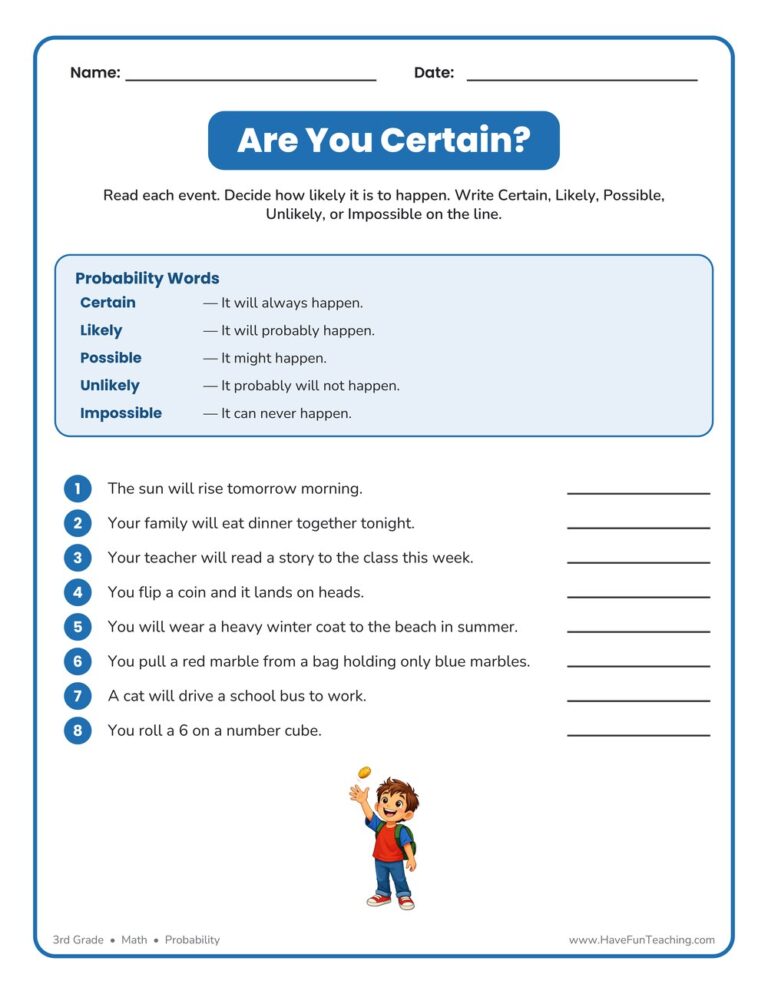
The Are You Certain? Probability Worksheet gives 3rd graders playful, real-world practice deciding whether everyday events are certain, likely, possible, unlikely, or impossible. Includes a complete answer key for fast, no-prep probability review.

From our teachers' playbook

Certain, likely or no way?

What do 3rd graders learn about probability?

Third graders learn to describe how likely something is to happen using words: certain, likely, equally likely, unlikely and impossible. Will the sun rise tomorrow? Certain! Will it snow in July in Florida? Impossible! They flip coins, spin spinners and pull colored cubes from bags, then record results in tally charts. Many start to describe chances with simple fractions, like 1 out of 2 for heads. The click moment is predicting which color will win a spinner game, then testing it.

Our favorite ways to teach probability in 3rd grade

Probability is best learned by predicting, testing and talking about what happened.

The likelihood line

Draw a line on the board from impossible to certain. Read events aloud and have kids place sticky notes where they belong: "A dog will talk," "We will have lunch today." Arguing about the middle spots is where the best thinking happens.

Why it works: children learn more from words and pictures together than from words alone (Mayer, 2009).
Are You Certain? Probability WorksheetTry it withAre You Certain? Probability WorksheetWorksheetsOpen it →
Flip and tally

Partners predict how many heads they'll get in 20 coin flips, then flip and tally. Combine the whole class's results on one chart. Kids see that more flips get closer to half, which is a big idea.

Why it works: the U.S. Department of Education's guide for teaching elementary math recommends moving from hands-on objects to drawings to numbers.

Heads or Tails Probability WorksheetTry it withHeads or Tails Probability WorksheetWorksheetsOpen it →

Is it fair?

Show two spinners: one with equal parts and one with a giant red section. Ask, "Which spinner is fair? How do you know?" Partners explain their reasoning before you reveal results.

Why it works: using clear, consistent math words out loud is one of the U.S. Department of Education's recommendations for elementary math.

Questions parents and teachers ask

What is probability in 3rd grade?

It's describing how likely something is to happen, using words like certain, likely, unlikely and impossible. Kids test their predictions with coins, spinners and dice.

How do you explain probability to a child?

Ask how likely something is: "Will it rain today?" Use a scale from impossible to certain. Games with coins and dice make it concrete.

What does equally likely mean?

It means two outcomes have the same chance. Heads and tails on a coin are equally likely.

Is probability taught in 3rd grade?

Many schools introduce probability words and simple experiments in 3rd grade, often within data and graphing units. Number-based probability comes later in middle school.


