It’s the night before your measurement unit starts, and the textbook wants kids converting units by page three. Half your class still isn’t sure whether a gram is heavy or light. That’s exactly when metric system activities earn their keep. They give kids something to hold, pour, and weigh before anyone moves a decimal point.
Here’s the good news. The metric system is the friendliest measurement system kids will ever learn, because everything is built on tens. Once they can feel how big a gram, a liter, and a meter really are, the rest is a pattern. The eight ideas below use water bottles, paper clips, and a meter stick, and most take ten minutes or less.
The short version
3 days free
Ready for the whole library?
You’ve had your freebie — but members download 10,000+ resources for every grade, all year long. Try it free — $0 today, cancel anytime.
Free for teachers
Pick your grade. We’ll send 10 free resources.
Worksheets, activities and a video — picked for your classroom, ready to print tonight.
One free bundle per teacher. We’ll also send free teaching ideas each week — unsubscribe anytime.



- Start with benchmarks kids can feel: a paper clip weighs about 1 gram, a liter bottle of water weighs about 1 kilogram, and a meter is a little longer than a yardstick.
- The whole system runs on tens, so teach the pattern of prefixes (kilo, centi, milli) before any conversion rules.
- Hands-on metric system activities come first. Worksheets lock in the learning afterward.
- Grams and kilograms measure mass. Milliliters and liters measure liquid volume. Keep those two families separate early on.
- Estimate first, then measure. The guessing is where the number sense grows.
Why the Metric System Trips Kids Up (and Why It Doesn’t Have To)
Most kids don’t struggle with the metric system because it’s hard. They struggle because they meet the words before the sizes. “Kilogram” is just a funny-sounding word until a child has held one in her hands.
In the United States there’s a second problem. Kids don’t see metric units much at home. Milk comes by the gallon and height comes in feet, so grams and liters feel like a foreign language. The fix is exposure. The more often kids handle real metric amounts, the less mysterious they get.
Underneath it all is a lovely pattern. Every prefix means the same thing no matter the unit, so kilo always means 1,000 and milli always means one-thousandth. The metric prefix chart from the National Institute of Standards and Technology lays out the whole family. It’s worth keeping on your own desk, even if kids never see it.
How Do You Teach the Metric System to Kids?
Teaching metrics goes best in two steps: feel the sizes, then find the pattern. Skip the first step and conversions turn into memorized tricks that fall apart by spring.
Step 1: Build benchmarks kids can feel
A benchmark is a familiar object that’s about one unit. A paper clip or a dollar bill weighs about 1 gram. A liter bottle of water weighs about 1 kilogram. A teaspoon holds about 5 milliliters, and a fingernail is roughly 1 centimeter wide.
Pass the objects around and let kids really feel them. Once they own a benchmark, estimation gets real. Is this apple closer to 2 grams or 200 grams? Nobody who has held a paper clip will guess 2.
Step 2: Show the pattern of ten
Line up a centimeter cube, a 10-centimeter paper strip, and a meter stick on the rug. Ten cubes make a strip, and ten strips make a meter. Then say it out loud: kilo means a thousand, so a kilometer is 1,000 meters and a kilogram is 1,000 grams.
For 4th and 5th graders, this is when conversions start to click. Moving from a bigger unit to a smaller one means you need more of them, so the number grows. That one sentence prevents most decimal disasters.
8 Metric System Activities Kids Ask to Do Again
Every one of these works at a kitchen table or on a classroom rug. Pick one a day for a measurement week, or save them as metrics games for an indoor recess.
- Gram Hunt. Give each kid a paper clip and a paper plate. Their mission: find five things that feel about as light as the clip. Then check a few on a kitchen scale. Kids are always surprised by how many things weigh only a few grams.
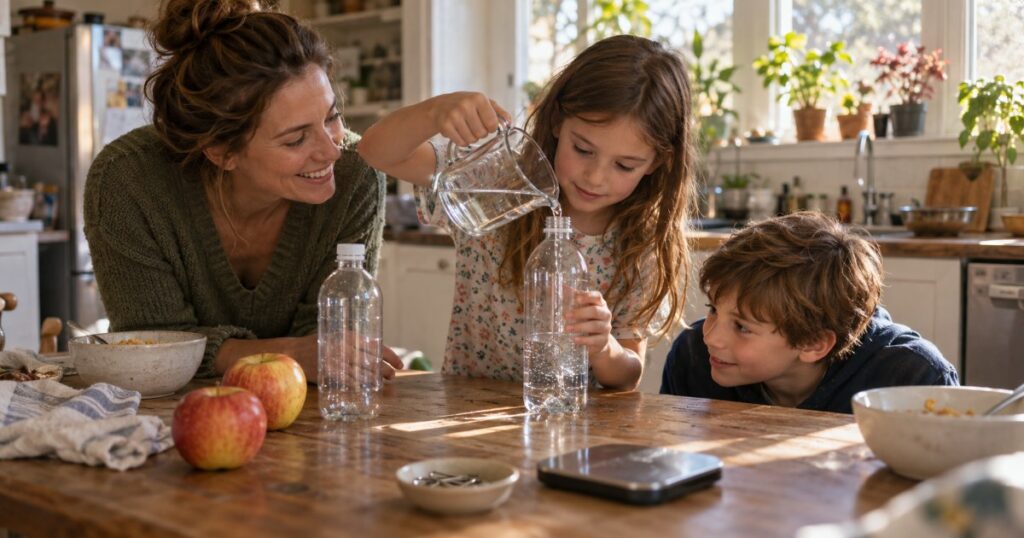
- The Liter Pour. Set out an empty liter bottle and a 250-milliliter measuring cup. How many cups will fill it? Kids predict, pour, and count. Four cups later, they’ve discovered that 1,000 milliliters make a liter, and nobody had to tell them.
- Metric Olympics. Paper plate discus, cotton ball shot put, and a standing long jump. Kids estimate each distance first, then measure in centimeters or meters and record both numbers. The gap between the guess and the measurement shrinks every round, which is the whole point.
- Mystery Bags. Fill paper bags with rice or dried beans at different masses, like 100 grams, 500 grams, and 1 kilogram. Kids lift each one and put them in order from lightest to heaviest. Then they check their order on a scale. Label nothing until everyone has guessed.
- Meter Scavenger Hunt. Cut a piece of string exactly 1 meter long for each small group. Kids hunt for things shorter than, longer than, and about the same as their string. Desks, bookshelves, and a friend lying on the rug all get measured.
- Kitchen Label Detectives. Collect a bag of empty food packages. Cereal boxes, juice bottles, and soup cans list grams or milliliters right on the label. Kids sort them by unit, then order each pile from least to most.
- The King Henry Staircase. For 5th and 6th graders, the old mnemonic still works: King Henry Died By Drinking Chocolate Milk, for kilo, hecto, deka, base unit, deci, centi, milli. Draw the prefixes as a staircase on the board. Each step down is ten times smaller, so kids can walk a number down the stairs.
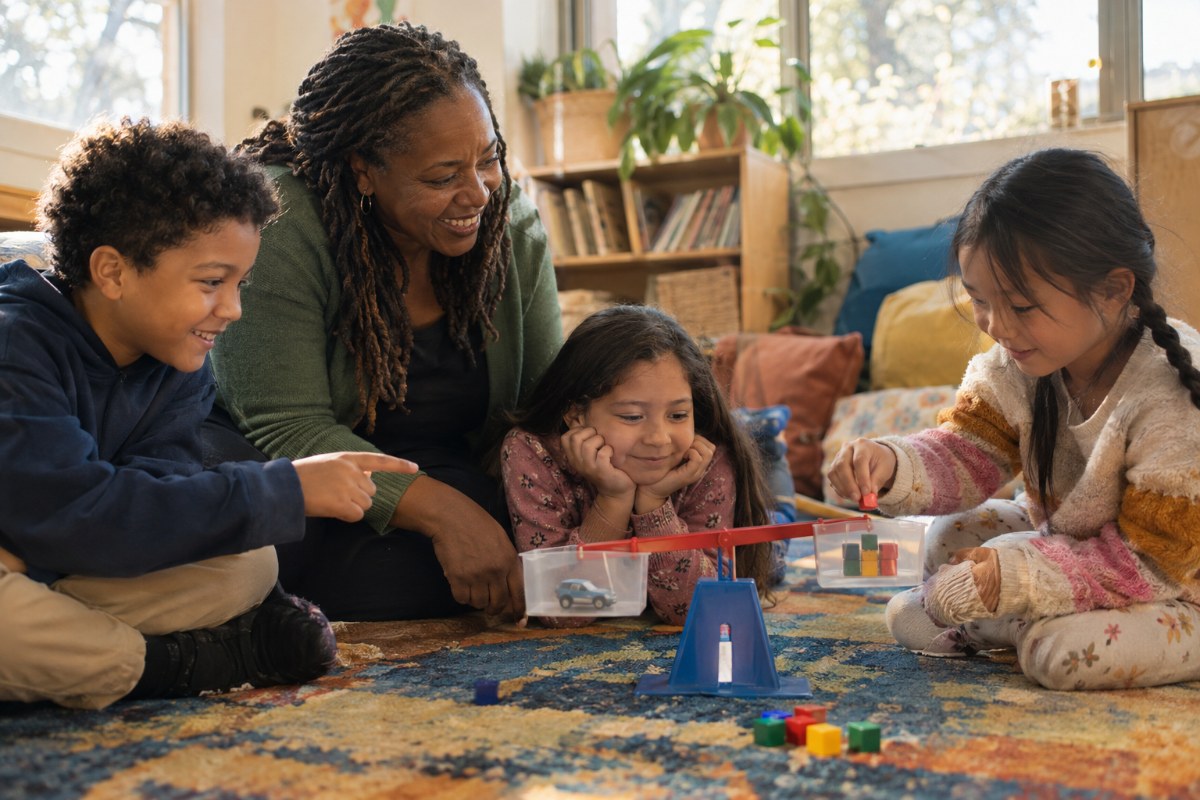
- Balance It Out. Pair kids up with a simple balance scale and a tub of plastic centimeter cubes, which weigh about a gram each. One partner loads a mystery object on one side, and the other balances it with cubes. Then they swap. It’s a quiet game that builds a feel for mass fast.
Metric Worksheets and Activities to Print After the Hands-On Fun
Hands-on work builds the sense. Printables give kids the practice. These all come from the Have Fun Teaching metrics resource collection, and each one pairs nicely with an activity above.
-

1st–3rd Grade · Math
Estimating Measurement in Meters Worksheet
Kids fill a web with things that could be measured in meters. Do the Meter Scavenger Hunt first, and they’ll have real answers from the room.
-

3rd Grade · Math
Units of Measurement Worksheet
Kids choose grams, kilograms, milliliters, or liters for everyday objects, then solve two metric number stories. An answer key is included.
-
3rd Grade · Math
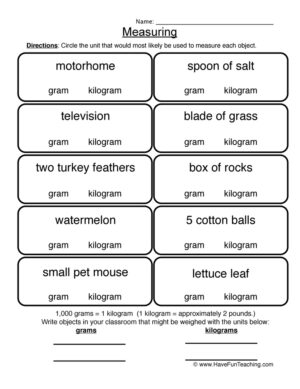
Practice choosing between grams and kilograms, converting grams to kilograms, and explaining a comparison in words. Answer key included.
-
3rd Grade · Math
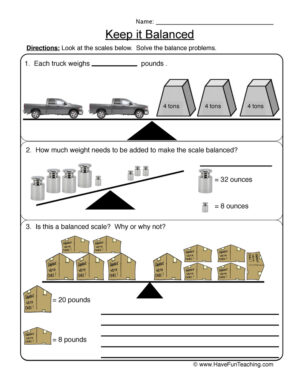
Kids read four balance scales in grams and kilograms to find each missing weight. It’s the perfect follow-up to Mystery Bags.
-

3rd–5th Grade · Math
Students measure and estimate masses of objects using grams, kilograms, and liters. It slides right into a hands-on measurement week.
-

4th Grade · Math
Choosing Milliliter or Liter Worksheet
Kids pick the right metric unit for six everyday containers and convert between liters and milliliters. Try it right after The Liter Pour.
-
4th Grade · Math
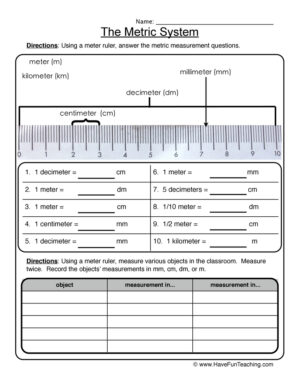
Ruler reading, unit conversions, and a word problem, all on one page. An answer key is included.
-

4th Grade · Math
Measuring Metric Word Problems Worksheet
Five real-world word problems using grams, kilograms, milliliters, and liters. Great for checking whether the benchmarks really stuck.
-

3rd–5th Grade · Math
Metric System vs US Standard Measurement Worksheet
Kids weigh objects to compare metric units with U.S. standard units. It answers the question every class asks: why are there two systems?
Teacher tip: Build a benchmark box. Toss in a paper clip, a centimeter cube, an empty liter bottle, a teaspoon, and a meter of string. Pull it out whenever a metric unit shows up in math, a science experiment, or a recipe. Five objects used all year do more than a single week-long unit.
Ready-to-print
Metric Worksheets and Activities, Ready When You Are
Grams, kilograms, liters, milliliters, and meters, with practice for 1st through 6th grade. Everything in the metrics collection prints in seconds.
Get the Metrics Resources Browse free resourcesNo login needed to browse · Preschool–6th · Print in seconds
Common Metric Mix-Ups (and Quick Fixes)
Even with great activities, a few mistakes show up in almost every class. Here’s what to watch for.
- Mixing up mass and volume. “How many grams of juice?” sounds reasonable to an eight-year-old. Keep two lists on the board, one for how heavy and one for how much liquid, and sort every new unit into a column.
- Moving the decimal the wrong way. Asked to change 3 meters into centimeters, some kids write 0.03. Ask the benchmark question: is a centimeter bigger or smaller than a meter? Smaller units mean more of them, so the answer is 300.
- Starting the ruler at 1. Kids line objects up with the 1 instead of the 0. Have them put a finger on zero before they measure anything.
- Guessing wildly. Estimates without benchmarks turn into random numbers. Send kids back to the paper clip and the liter bottle, and the guesses get sensible fast.
Once kids can feel a gram in their hand, they stop guessing and start reasoning. That’s the whole unit in one sentence.
How Have Fun Teaching Helps With Teaching Metrics
You don’t have to build a measurement unit from scratch. If you want more metrics ideas for kids, the measurement activities collection adds hands-on practice with length, weight, and capacity. Here’s what else makes planning easier:
- Printables for every stage, from estimating in meters to multi-step word problems.
- Answer keys on many worksheets, so checking takes seconds instead of a whole evening.
- 100 math songs, plus videos and games, for the days everyone needs a change of pace.
Metric System Activities FAQ
What grade do kids learn the metric system?
Kids usually start measuring in centimeters and meters in 2nd grade. In 3rd grade they estimate and measure mass in grams and kilograms and liquid volume in liters. Converting between units, like meters to centimeters, comes in 4th and 5th grade. Hands-on metric system activities work at every one of those stages.
What are easy benchmarks for metric units?
A paper clip weighs about 1 gram, and a liter bottle of water weighs about 1 kilogram. A teaspoon holds about 5 milliliters. A fingernail is roughly 1 centimeter wide, and a meter is a little longer than a yardstick. Keep these objects handy so kids can check their estimates against something real.
How can I make teaching metrics fun at home?
Use the kitchen. Read grams and milliliters off food labels, measure ingredients for a simple recipe, and pour water between cups and bottles. Measure everyone's height in centimeters and track it on a door frame. Short, real tasks like these feel like play, and they build more number sense than a page of conversions.
What is the trick for converting metric units?
Each step between metric prefixes is a factor of ten. Going from a bigger unit to a smaller one, the number gets bigger. Going from a smaller unit to a bigger one, the number gets smaller. Older kids can use the King Henry mnemonic (kilo, hecto, deka, base, deci, centi, milli) to count the steps.
Are there metric worksheets with answer keys?
Yes. Several worksheets in the Have Fun Teaching metrics collection include answer keys, including the Units of Measurement Worksheet, the Gram Kilogram Worksheet, and The Metric System Worksheet. They cover 1st through 6th grade and pair well with hands-on activities, so kids practice right after they measure.
Make Measurement Week the One They Remember
Get every metrics worksheet, activity, and answer key, plus thousands more resources for Preschool through 6th grade. Try it all free for three days.
- 10,000+ ready-to-teach resources
- Preschool–6th grade
- Loved by 2M+ teachers & homeschoolers
No card required to start · Cancel anytime
3 days free
Ready for the whole library?
You’ve had your freebie — but members download 10,000+ resources for every grade, all year long. Try it free — $0 today, cancel anytime.
Free for teachers
Pick your grade. We’ll send 10 free resources.
Worksheets, activities and a video — picked for your classroom, ready to print tonight.
One free bundle per teacher. We’ll also send free teaching ideas each week — unsubscribe anytime.