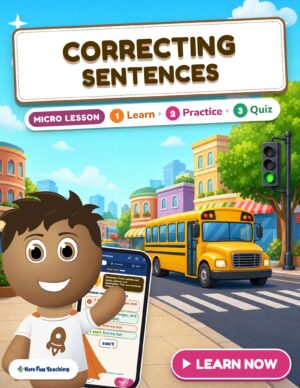
“my dog max can run fast.” Most second graders can read that sentence. Far fewer can spot the three things wrong with it. That gap is the whole reason a correcting sentences lesson matters: kids know the rules when you ask, but they don’t see them in their own writing yet.
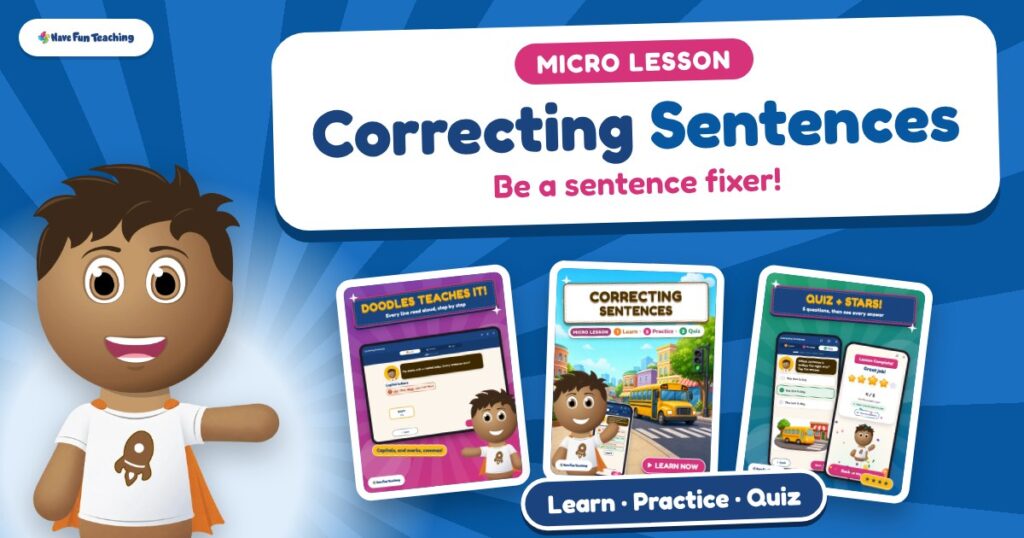
That’s why we made the Correcting Sentences Micro Lesson. Doodles, one of our Funzy friends, takes kids to Busy City to become sentence fixers. He shows a sentence with mistakes, reads it out loud, then fixes it one step at a time, so every child can follow along.
Below you’ll find what’s inside, a quick video tour, a mini-quiz your kids can try right now, and easy ways to use it in class or at home.
- One skill, start to finish: finding and fixing the mistakes in a sentence.
- Four fixes: capital letters, the right end mark, commas in a list, and the apostrophe in can’t.
- Three short parts: Learn, Practice (with hints that explain why), and a 5-question Quiz with stars at the end.
- Doodles reads directions, questions and answer choices aloud.
- Included with a Have Fun Teaching membership. Assign it in HFT Classroom and quiz scores come right back to you.
What is a Micro Lesson?
A Micro Lesson is a short, complete lesson on one skill. It teaches first, lets kids try with support, and then checks what stuck. Every part is narrated, so a child can work through it on their own while you pull a small group.
Learn
Doodles shows the wrong sentence next to the fixed one. Each change lights up as he explains it, and kids can tap the cards to hear them again.
Practice
Kids tap the words that need capitals, sort sentences by end mark and pick the right commas. A wrong answer gets a hint that explains why.
Quiz
Five questions in mixed styles, then a stars screen and a look back at every answer.
HFT Classroom
Assign it to your class and every quiz score is sent back to you automatically.
Inside this correcting sentences lesson for kids
Learn starts with capital letters. Doodles reads “my dog max can run fast.” and asks kids what’s missing. Then he fixes it: My starts the sentence, and Max is a name. A second sentence, “sam and i swim on monday in june.”, adds the rest of the capital rules: names, the word I, and days and months.
Next come end marks. A period ends a telling sentence, a question mark ends an asking sentence, and an exclamation mark shows strong feeling. Last of all, kids learn to put commas between things in a list and watch two words, can and not, slide together into can’t with an apostrophe.
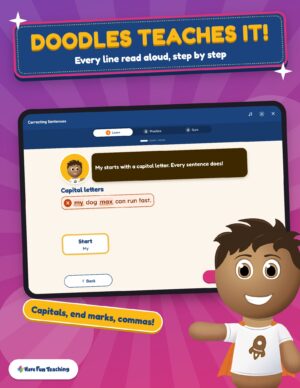 Part 1 · LearnLearn the fixesCapitals, end marks, commas and can’t.
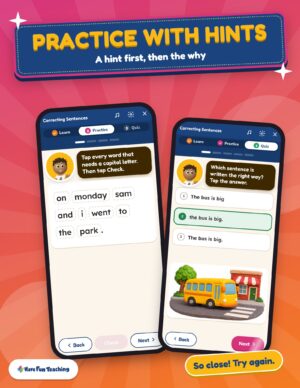 Part 2 · PracticePractice with hintsTap, sort, fill in and choose, with help after every miss.
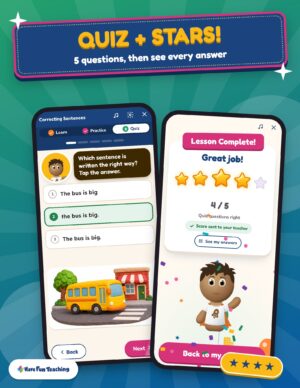 Part 3 · Quiz5-question QuizAll four fixes, then stars and every answer explained.
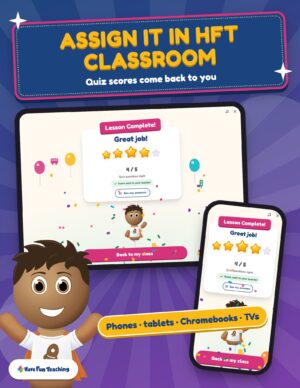 For teachersScores in HFT ClassroomSee each student’s quiz score and their answers in words.
Practice keeps the support on. Kids tap every word in a sentence that needs a capital, then drag sentences into three boxes for period, question mark and exclamation mark, and watch the end mark appear as each one lands. They drag can’t into a sentence from a word bank and pick the sentence with the commas in the right places. Pick the wrong answer and Doodles doesn’t just say “try again.” He explains which rule fits and why.
The quiz mixes question styles: choose the correct sentence, pick the words that need capitals, tap the word that needs an apostrophe, decide true or false about an end mark, and choose the right end mark for a big, exciting fire truck. Then the stars come out.
See it in action (video)
This quick tour shows each part of the lesson, from Busy City to the stars screen.

Try it: a correcting sentences mini-quiz for kids
Read each sentence with your child or your class, find the mistake, then tap to check the answer. No peeking!
1. Fix it: “on friday we went to the zoo.”
On Friday we went to the zoo. On starts the sentence, and Friday is a day of the week, so both get a capital letter.
2. Which end mark goes here? “Do you like pizza”
A question mark (?) — this sentence is asking something, so it ends with a question mark.
3. Where do the commas go? “I packed apples pears and grapes.”
I packed apples, pears, and grapes. Put a comma after each thing in the list, before the word and.
4. True or false: when the word I is by itself, it is lowercase.
False! The word I is always a capital letter, even in the middle of a sentence: “Mom and I baked cookies.”
5. Challenge: put is and not together with an apostrophe.
Isn’t! The apostrophe takes the place of the missing letter o, just like can’t.
How do you teach correcting sentences to 2nd graders?
Second graders learn to fix sentences fastest when they fix one kind of mistake at a time and hear the sentence out loud. Here’s a simple order that works, with or without the Micro Lesson.
Read it out loud
Kids hear a missing end mark long before they see it. Read the sentence, then ask, “Does it sound done?”
Start with capitals
Check the first word, then names, then the word I, then days and months. Four quick checks.
Match the end mark
Telling gets a period, asking gets a question mark, strong feeling gets an exclamation mark.
Count the list
Three or more things in a row? Put a comma after each one before the word and.
Squish two words
Write can and not on two cards, slide them together and cover the o with an apostrophe.
Check it
A short quiz shows who has every fix and who needs another look at commas.
Ways to use it in class and at home
Small-group rotation
One station runs the Micro Lesson on tablets while you work with a group at the table.
Whole-class mini-lesson
Put the Learn pages on the board and let kids call out each mistake before Doodles fixes it.
Homework or homeschool
Every word is read aloud, so kids can do it at the kitchen table without a grown-up reading to them.
Before writing time
Assign it in HFT Classroom as a five-minute warm-up, then have kids check their own journal sentences.
Members: assign it in HFT Classroom
With a Have Fun Teaching membership, Micro Lessons are included. Assign this correcting sentences lesson to your class, and students join with a class link and a picture, with no student emails. When they finish the quiz, you see each score and their answers in words. See how HFT Classroom works.
Want the standard behind it? Capitalization, end punctuation, commas in a series and apostrophes in contractions are part of the second grade language standards (L.2.2), building on the first grade rules for names, dates and end marks.
More correcting sentences practice: printables and a game
The Micro Lesson teaches the fixes. These resources give kids more practice on paper and on screen.
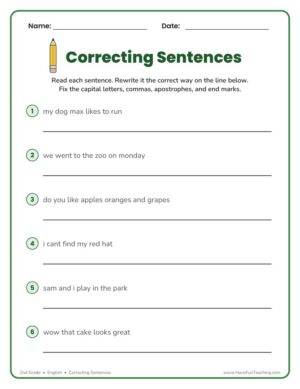 WorksheetCorrecting Sentences WorksheetFind the mistakes and rewrite each sentence.
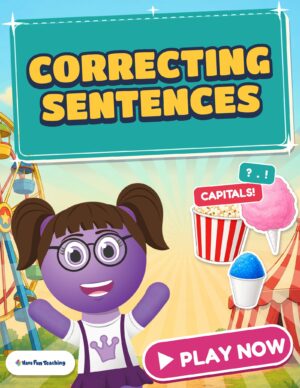 GameCorrecting Sentences GamePlay and fix sentences on any device.
 WorksheetFixing Capitalization ErrorsSpot the words that need capital letters.
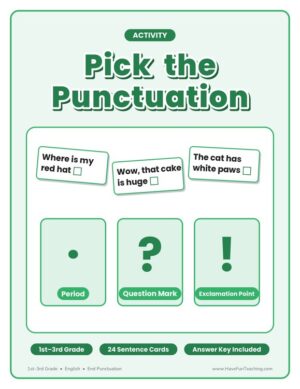 ActivityPick the PunctuationChoose the right end mark for each sentence.
You’ll find even more on the capitalization resources page and the punctuation resources page.
More Micro Lessons
We’re building a whole library of Micro Lessons, one skill at a time, each with its own Funzy teacher.
 English · Micro LessonSorting Plural NounsAdd -s, add -es, or change the word, in the Gem Mine.
 English · Micro LessonUse the PrepositionsWords that tell where, in a treehouse club.
 Reading · Micro LessonIdentifying Cause and EffectWhat happened, and why? Learn, practice and a quiz.
Keep exploring
Get it included with a membership
Every Micro Lesson, plus 6,600+ resources
Members get every Micro Lesson, game, printable, song and video. Try it free for 3 days.
- The Correcting Sentences Micro Lesson, included
- Every printable, song and video, Preschool–6th
- Assign Micro Lessons and games in HFT Classroom
- Unlimited downloads, new resources added every week
Correcting sentences lesson: questions teachers ask
What grade is the Correcting Sentences Micro Lesson for?
It is made for 2nd grade, where capitals, end marks, commas in a list and apostrophes in contractions come together. It also works for 1st graders who are ready for commas and as a quick review for 3rd graders. Doodles reads everything aloud, so kids who are still growing as readers can follow along.
What does the lesson teach kids to fix?
Four things. Capital letters at the start of a sentence, on names, on the word I, and on days and months. The right end mark for telling, asking or strong feeling. Commas between things in a list. And the apostrophe that turns can not into can’t. Each fix is shown on a real sentence, before and after.
Is the Micro Lesson included in a Have Fun Teaching membership?
Yes. Micro Lessons are included with every Have Fun Teaching membership, along with games, printables, songs and videos. Members can start the lesson right away and assign it in HFT Classroom. You can open a free preview first, and memberships start with 3 free days.
How does HFT Classroom show me my students’ scores?
Assign the Micro Lesson to your class in HFT Classroom. Students join with a class link and a picture, with no student emails. When a student finishes the quiz, the score is sent back to you, and you can see each answer in words, so you know which fix needs another look.
What devices does the Micro Lesson work on?
It runs in the web browser on phones, tablets, Chromebooks, laptops and interactive whiteboards, with nothing to install. The read-aloud voice works on every device, so kids can use headphones at a center or the whole class can listen together on the board.
Let Doodles teach sentence fixing this week.
Open the free preview tonight, or start the full lesson with your membership.