
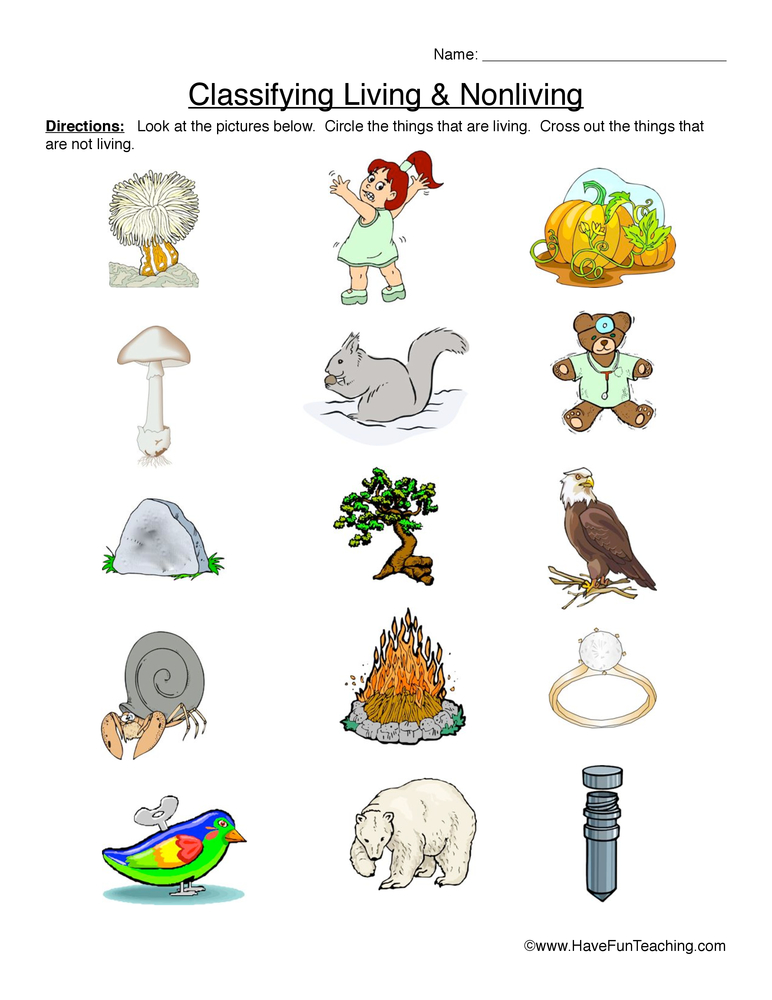
Classifying Living and Nonliving Things Primary Version Worksheet
The Classifying Living and Nonliving Things Primary Version Worksheet asks Kindergarten students to sort six familiar pictures into living and nonliving groups. An answer key is included, so this hands-on science practice takes no prep at all.
$6.97
Or free with a membership — members pay $3.33/mo for all 10,000+ resources. See plans
Want this one free?
Tell us where to send it and it’s yours — no card, no catch.
One free resource per teacher. We’ll also send free teaching ideas each week — unsubscribe anytime.
Teaching is easier with a membership
Unlimited printables, games & videos for PreK–6th — for your classroom or homeschool. Cancel anytime.
Start your 3-day free trial$0 today · cancel anytime · Instant access to 10,000+ resources
About this resource
Description
Every young scientist begins by noticing what is alive and what is not. Living things grow, need food and water, and change over time, while nonliving things stay the same unless something acts on them. This Classifying Living and Nonliving Things Primary Version Worksheet gives Kindergarten students a gentle first sort of the world around them, using familiar pictures instead of dense text so the science idea, and not the reading, is what the child works on.
This kindergarten classification worksheet puts six crayon-style pictures on the page: a butterfly, a rock, a puppy, a ball, a chair, and a sunflower. Each picture sits in its own numbered card, so a child can name it out loud, decide whether it is living or nonliving, and then write that card’s number in the correct box at the bottom of the page. Because the response is a single digit rather than a written word, emerging writers can show what they know about living things without stalling on spelling. Read the directions aloud, work the first card together, and let students finish the rest on their own or with a partner.
What’s Included
- 1 print-ready PDF worksheet
- Answer key
- 6 numbered picture cards and a two-column living and nonliving sort
There are three reasons this Classifying Living and Nonliving Things Primary Version Worksheet helps children learn. First, it uses concrete everyday objects a five-year-old already knows, so the child practices the classifying skill rather than decoding unfamiliar vocabulary. Second, sorting the pictures into two labeled boxes makes the categories visible, so students can see three things in each group and check their own thinking. Third, writing the numbers adds quick number-formation practice alongside the science, and the included answer key lets a teacher or parent check the page in seconds.
Keep the learning going away from the page. Take a short walk around the classroom, yard, or neighborhood and have students point out one living thing and one nonliving thing at every stop. Sort a basket of small objects and toy animals into two hoops on the floor, then ask children to explain each choice using the words grow, eat, and drink. Plant a bean seed in one cup and drop a plastic bead in another, water both, and check them each morning to see which one changes. Picture books about animals, plants, and seasons pair naturally with this skill, and a quick living-or-nonliving guessing game makes an easy transition activity.
Related Resources
What teachers say
Reviews
1 review for Classifying Living and Nonliving Things Primary Version Worksheet
You must be logged in to post a review.

This Grouping into Categories Worksheet asks kindergarten students to sort eight pictures into fruit, animals, plants, and shapes by writing each one's category number. Includes an answer key for fast, no-prep classification practice.

This Sorting Objects Worksheet has kindergarten students sort twelve pictures into animals, plants, vehicles, and people, then count each group. Includes an answer key — a no-prep way to build classification and early counting skills.
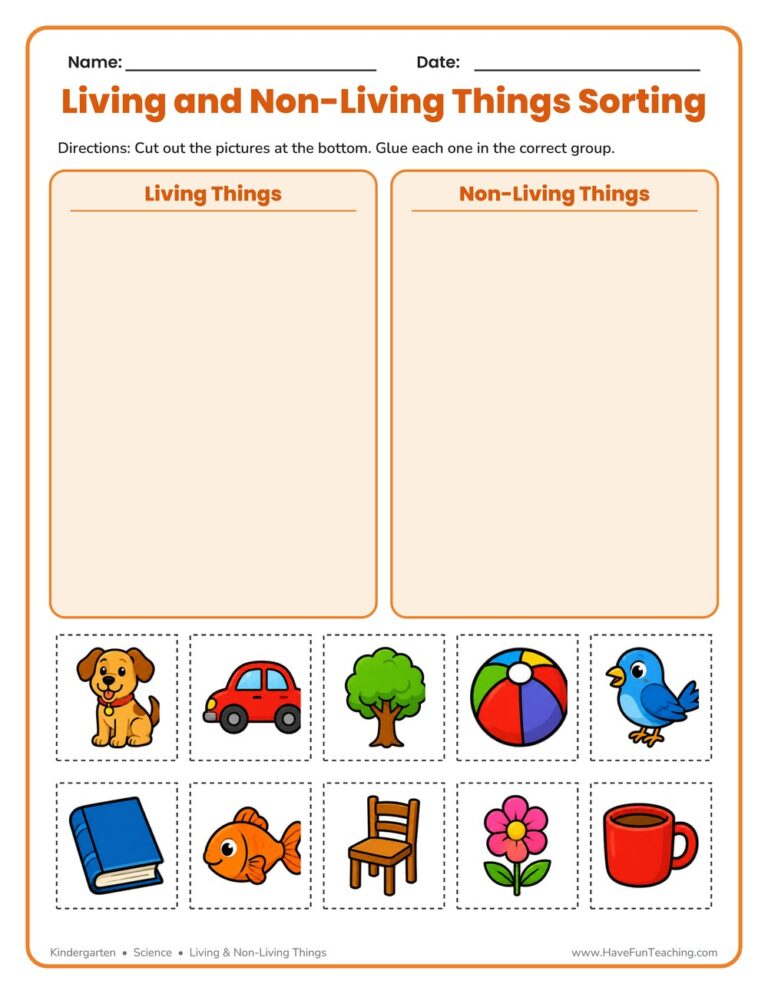
This Living Things and Non Living Things Sorting Worksheet has kindergarten students cut out ten pictures and sort them into living and non-living groups. Answer key included for quick, hands-on science practice.

Using this Animal Song (Animated Music Video), your students learn about different types of animals and their sounds by watching this fun, catchy video.

This Classify Count and Sort By Color Worksheet asks Kindergarten students to sort six colorful pictures into green, red, and yellow boxes, then count each group. An answer key is included, so checking work takes seconds.

This matching words that go together worksheet gives Kindergarten students five picture-and-word pairs to connect, building early classification and vocabulary skills. An answer key is included, so checking takes seconds.

Using this Size Activity, students play Categories to practice identifying the sizes tall, short, big and small.

This Sort Classify and Count Worksheet asks kindergartners to sort twelve mixed shapes, count each kind, and answer three questions about which has the most and fewest. Answer key included.

Using this Counting and Sorting Pictures Activity, students match the pictures to their correct categories to find similarities between items in a group.
Using Things That Grow Activity, students play UNO to practice classifying things that grow into four categories.

Using We Go Together Activity, students play a picture card match game to pair items that are related.
Using Living and Nonliving Activity, students first sort the pictures on the sorting mat and then play Tic-Tac-Toe!
Ruth Melendez (verified owner) –