
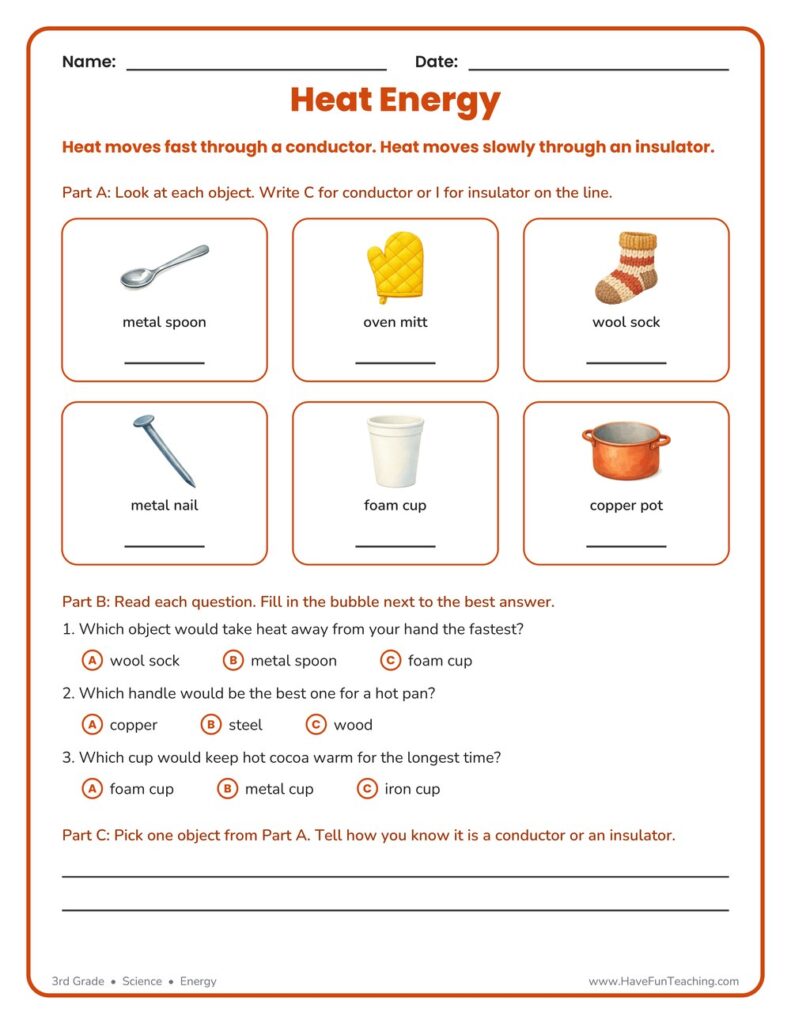
Conductors and Insulators Heat Energy Worksheet
This Conductors and Insulators Heat Energy Worksheet helps 3rd grade students sort everyday objects, answer applied questions, and explain their thinking. Answer key included, so checking work takes seconds.
$6.97
Or free with a membership — members pay $3.33/mo for all 10,000+ resources. See plans
Want this one free?
Tell us where to send it and it’s yours — no card, no catch.
One free resource per teacher. We’ll also send free teaching ideas each week — unsubscribe anytime.
Teaching is easier with a membership
Unlimited printables, games & videos for PreK–6th — for your classroom or homeschool. Cancel anytime.
Start your 3-day free trial$0 today · cancel anytime · Instant access to 10,000+ resources
About this resource
Description
Heat energy moves from warmer things to cooler things, and the material an object is made of decides how quickly that happens. Metals let heat travel through them easily, so scientists call them thermal conductors. Cloth, wool, foam, and wood slow heat down, so scientists call them thermal insulators. The Conductors and Insulators Heat Energy Worksheet gives third grade students a clear, hands-on way to tell the two apart using objects they already know from the kitchen, the classroom, and their own closet.
This 3rd grade energy worksheet moves from pictures to reasoning in three short parts. Students begin by looking at six familiar objects and writing C for conductor or I for insulator on the line under each one. Next they fill in the bubble for three questions that put the idea to work: which object pulls heat away from a hand fastest, which handle is safest on a hot pan, and which cup keeps cocoa warm the longest. Finally they choose one object and write a sentence explaining how they know what it is. Print the page, hand out pencils, and it is ready to teach.
What’s Included
- A one-page printable worksheet in PDF format, ready to print
- Part A: six labeled pictures to classify as a conductor or an insulator
- Part B: three fill-in-the-bubble questions that apply the skill to real objects
- Part C: a short written explanation that asks students to justify their thinking
- A complete answer key with a sample written response
There are three reasons this page helps students learn. First, every item is a real object a child has touched, so the science attaches to something familiar instead of a definition to memorize. Second, the worksheet asks students to apply the idea rather than simply label it, which is exactly what state science assessments expect at this grade. Third, the written explanation in Part C builds the habit of supporting an answer with evidence, a skill that carries into every other science unit of the year.
Teachers and parents can stretch the Conductors and Insulators Heat Energy Worksheet in a few easy ways. Try a touch test first: let students feel a metal spoon and a wooden spoon that have been sitting in the same room and talk about why the metal feels colder. Send students on a hunt around the classroom or the kitchen for two more conductors and two more insulators to add to the back of the page. Wrap ice cubes in foil and in a wool sock and check which one melts first. Finish by asking students to design the safest lunch box they can, naming the material they would choose and telling why.
Related Resources
What teachers say
Reviews
You must be logged in to post a review.
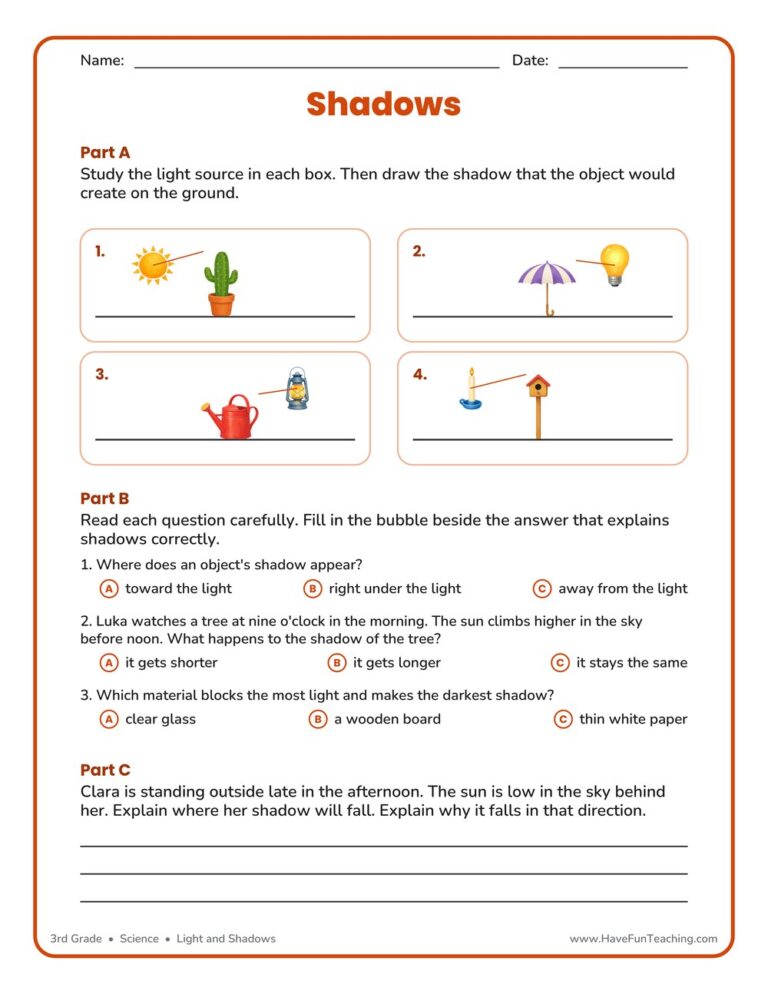
A shadows drawing worksheet where 3rd graders study four light sources, draw the shadow each object casts, and explain why it falls where it does. Answer key included for quick, no-prep science practice.
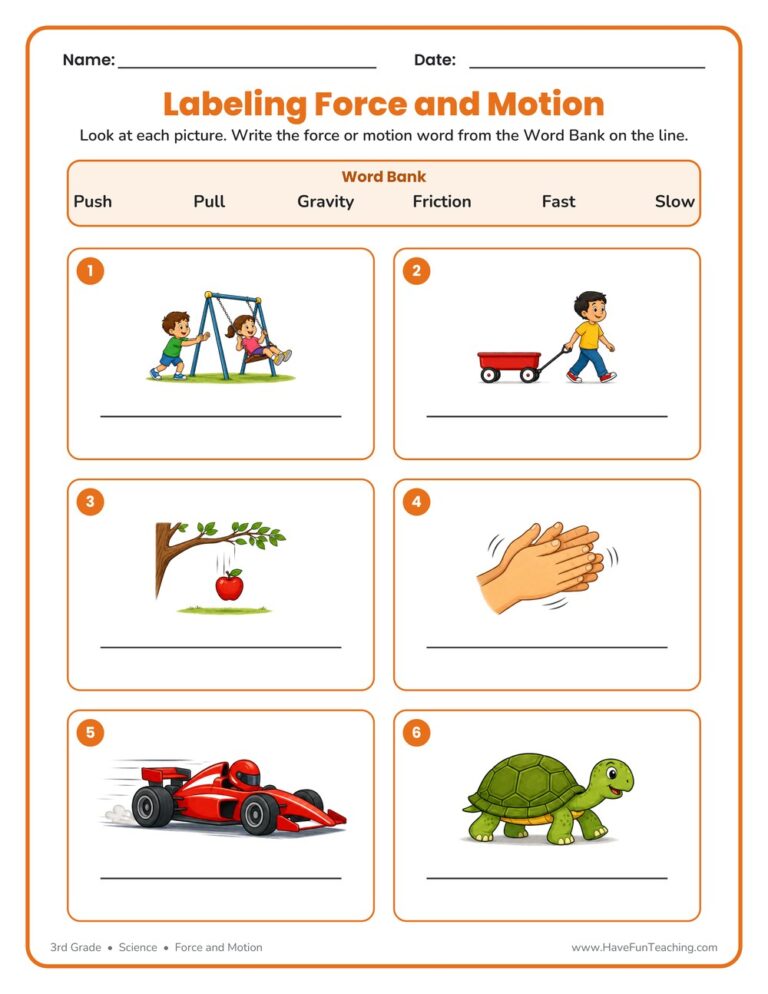
The Labeling Force and Motion Worksheet has 3rd graders label six pictures with push, pull, gravity, friction, fast, and slow from a word bank. Includes an answer key for easy, no-prep science practice.
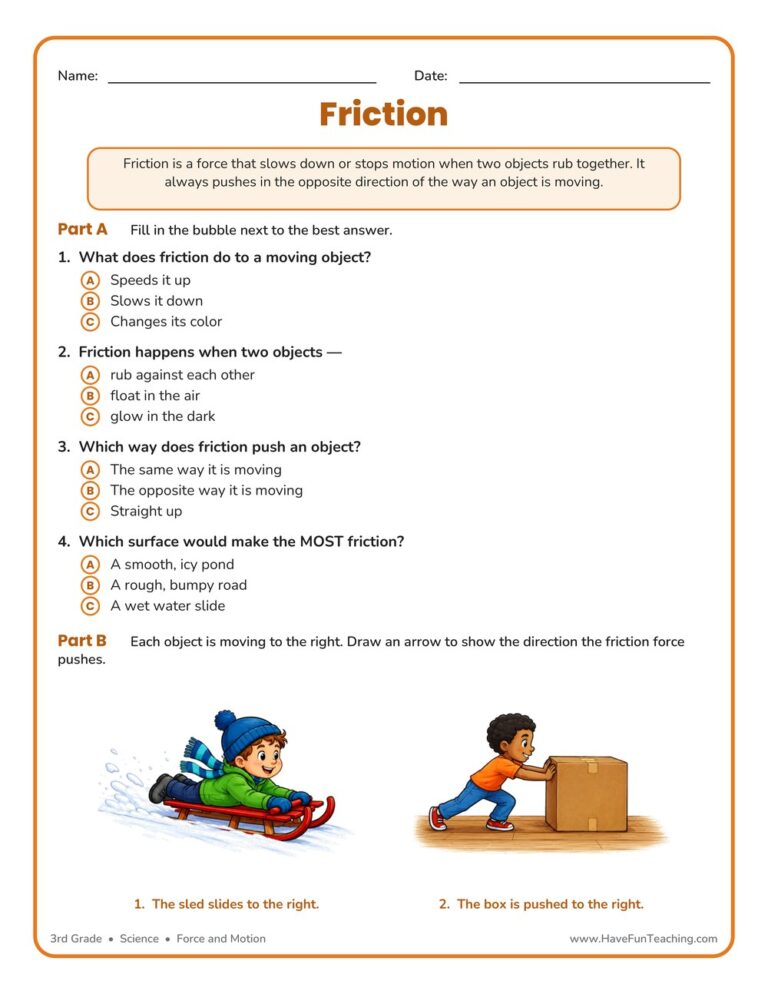
This drawing friction worksheet lets 3rd graders explore force and motion by answering questions and drawing arrows to show which way friction pushes. Answer key included for quick, no-prep science practice.
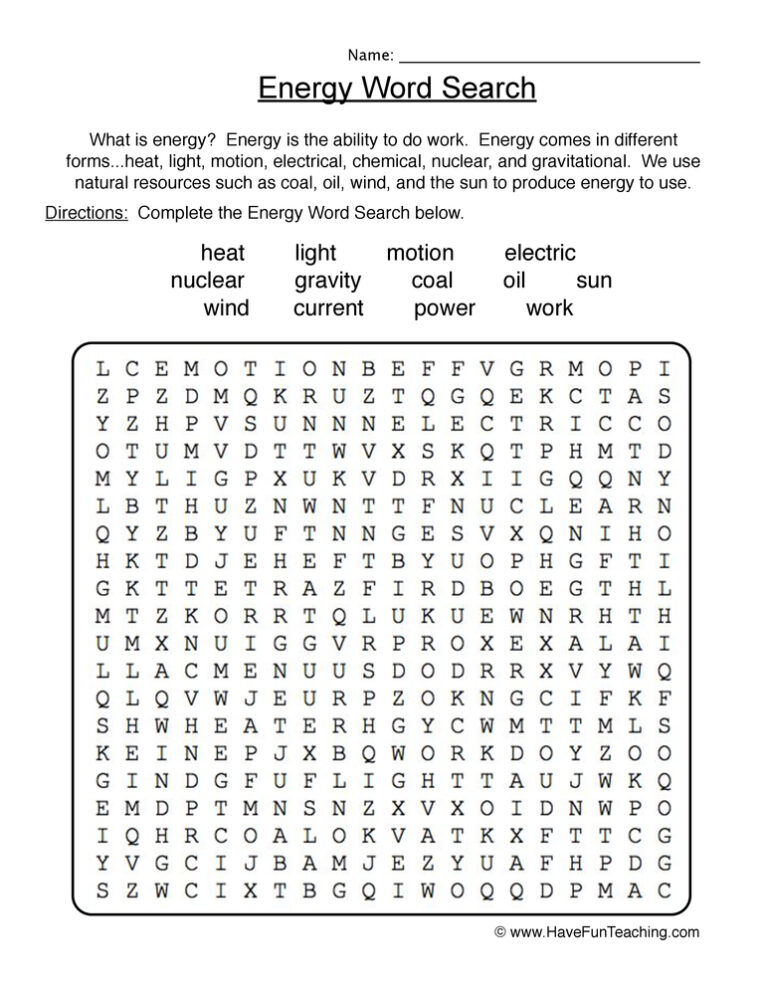
A ten-word Energy Wordsearch Worksheet that helps 3rd graders name the forms and sources of energy, then use one in a sentence of their own. Answer key included for fast, no-prep science review.
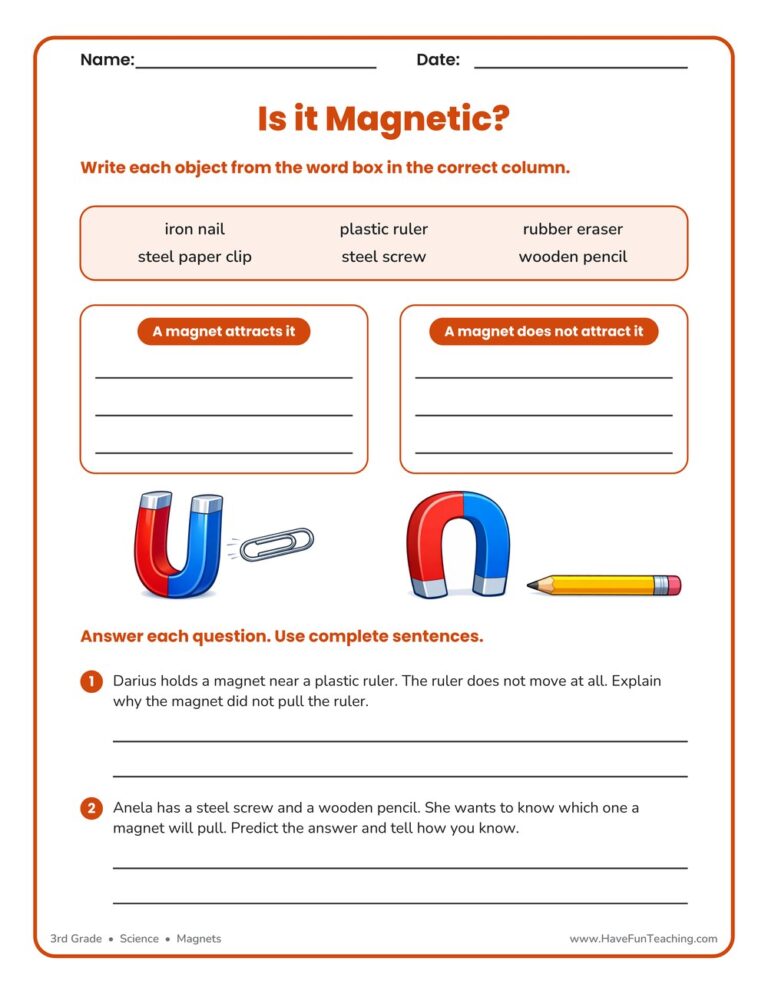
This Is it Magnetic Worksheet has 3rd Grade students sort six classroom objects by the material they are made of, then explain two predictions in writing. Answer key included, so checking work takes seconds.

This Sound Pitch Worksheet helps 3rd grade students use sound waves and real instruments to tell whether a vibration makes a high or low pitch. An answer key is included, so science practice takes minutes to set up.

This friction drawing worksheet sends 3rd graders hunting for four real places where surfaces rub together. They sketch each one and write about it, turning an abstract force into something they can point to.

This Drawing Heat Energy Worksheet gives 3rd Grade students four picture cards for tracing where heat energy comes from and where it goes, plus an answer key, so heat transfer practice is ready to print.
This shadows movement worksheet asks 3rd graders to sort eight light positions into longer and shorter shadows, then name what the light and the shadow did. Answer key included for no-prep science practice.

This magnetism experiment worksheet has 3rd graders sort eight objects by material, decide whether magnet poles attract or repel, and explain why steel is pulled and plastic is not. Answer key included for fast, no-prep science practice.

These Light Bulb Cut Outs quickly give you templates that can be easily cut and applied for classroom decoration or student activities about electricity.

Using Drawing Light Objects Worksheet,students draw objects that give off light to show their understanding energy.

Reviews
There are no reviews yet