
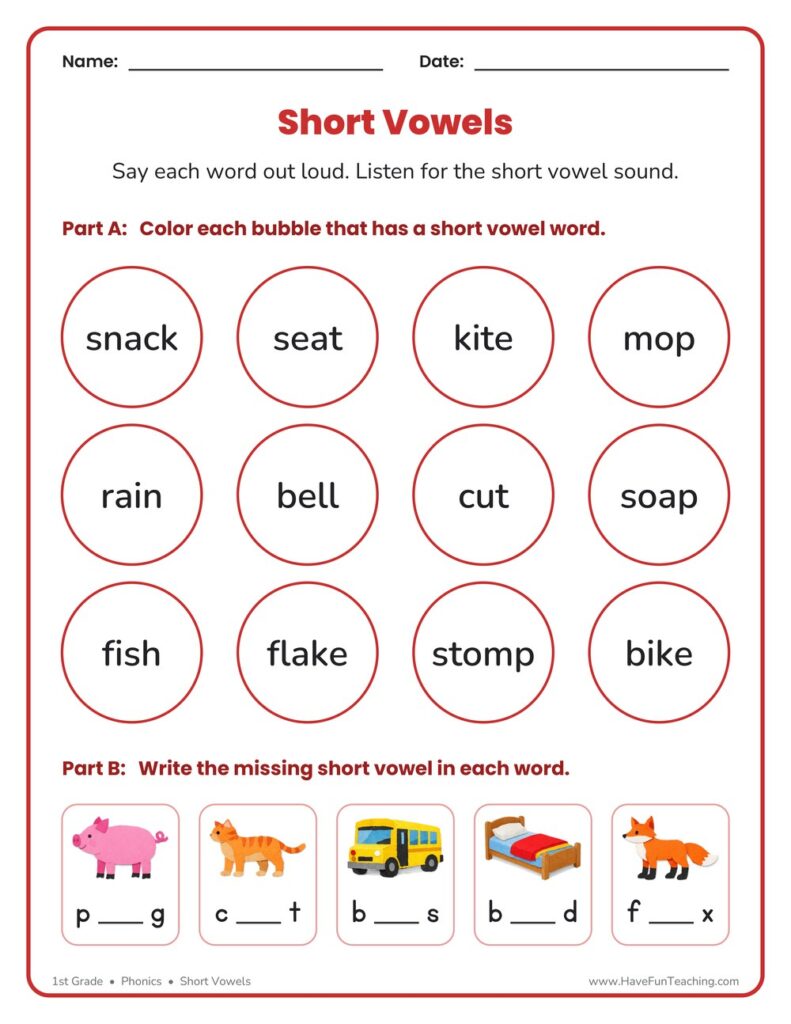
Short Vowels Coloring Worksheet
This Short Vowels Coloring Worksheet gives 1st Grade readers hands-on practice hearing short a, e, i, o, and u. Color the short vowel bubbles, then spell five picture words. Answer key included, so checking work takes seconds.
$6.97
Or free with a membership — members pay $3.33/mo for all 10,000+ resources. See plans
Want this one free?
Tell us where to send it and it’s yours — no card, no catch.
One free resource per teacher. We’ll also send free teaching ideas each week — unsubscribe anytime.
Teaching is easier with a membership
Unlimited printables, games & videos for PreK–6th — for your classroom or homeschool. Cancel anytime.
Start your 3-day free trial$0 today · cancel anytime · Instant access to 10,000+ resources
About this resource
Description
Short vowels are the quick sounds a, e, i, o, and u make in words like snack, bell, fish, mop, and cut. Learning to hear and name those sounds is one of the first big steps in reading, because almost every early decodable word depends on them. This Short Vowels Coloring Worksheet gives first graders focused practice listening for the short vowel sound in a word and telling it apart from a long vowel sound.
This short vowels coloring worksheet is a two-part activity. In Part A, students read twelve words inside big, easy-to-color bubbles and color only the bubbles that hold a short vowel word, leaving the long vowel words white. In Part B, students look at five pictures, say each picture name out loud, and write the missing short vowel that completes the word. Print the page, hand out crayons or colored pencils, and let students work on their own or with a partner. A full answer key is included on the second page.
What’s Included
- One printable 1st Grade short vowel worksheet in PDF format
- Part A: twelve bubble words to sort by short and long vowel sound
- Part B: five picture cards with a blank for the missing short vowel
- All five short vowel sounds practiced on one page: a, e, i, o, and u
- A complete answer key on the final page
Three reasons this worksheet helps kids. First, coloring gives young readers a hands-on way to commit to an answer, which keeps them engaged far longer than circling does. Second, pairing pictures with letters in Part B moves students from hearing a sound to writing the letter that spells it, closing the gap between phonemic awareness and spelling. Third, mixing short vowel words with long vowel words forces students to listen carefully instead of guessing, so the practice builds a skill they can carry into any new word.
Teachers and parents can stretch the activity further. Read the bubble words aloud as a class and have students give a thumbs up for a short vowel sound before anyone picks up a crayon. Send the page home as review after a phonics lesson, use it in a small reading group, or slip it into a literacy center. You can also ask students to write one more short vowel word of their own on the back of the page.
Related Resources
What teachers say
Reviews
You must be logged in to post a review.

The Baby Shark Alphabet Song (Animated Music Video) will help students learn letter names and sounds by listening to the catchy lyrics and colorful video.
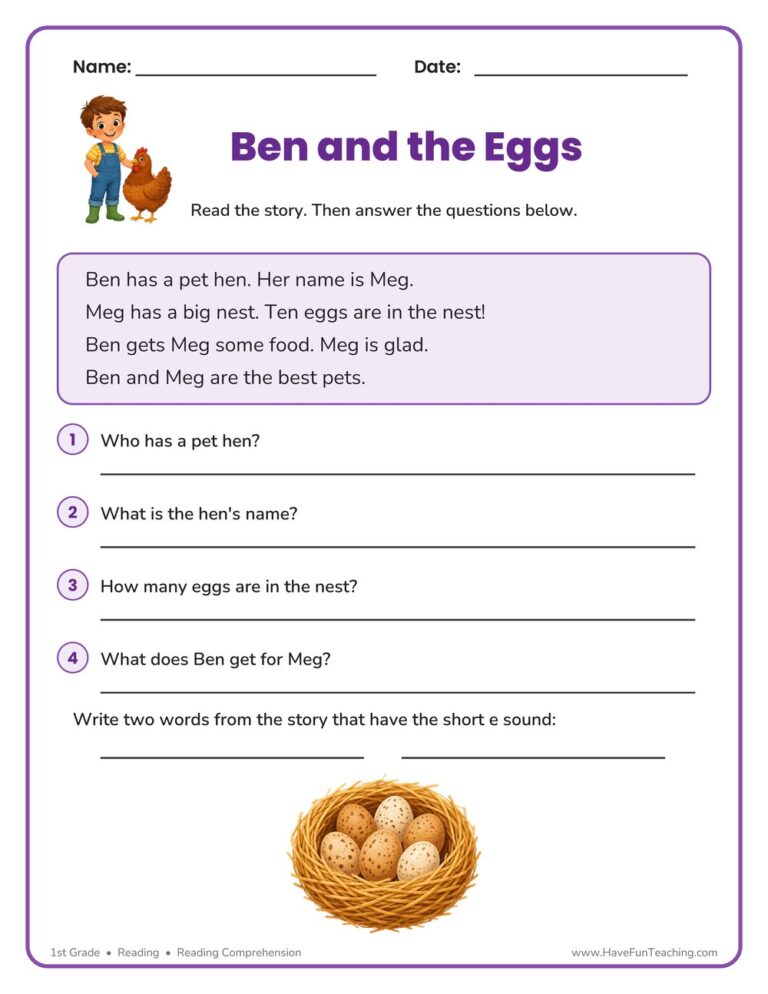
A short vowel E reading comprehension story worksheet starring Ben and his hen. 1st graders read the decodable story and answer questions. Includes a complete answer key — great for quick, no-prep phonics and reading practice.
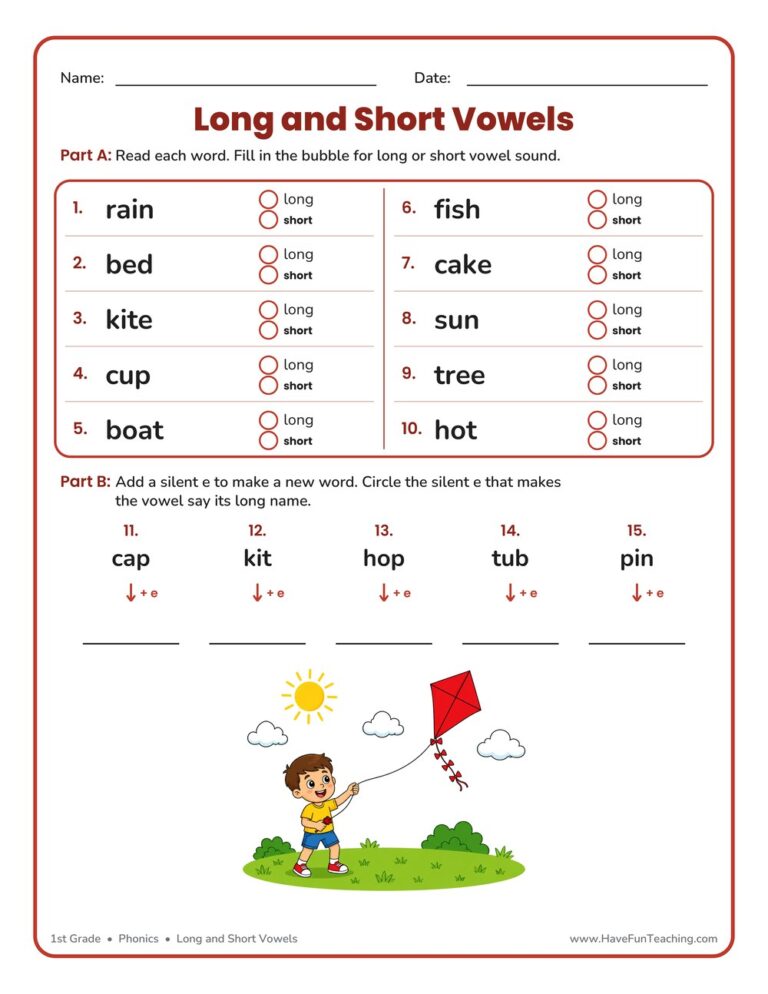
This Long and Short Vowels Worksheet helps 1st graders identify long and short vowel sounds and practice silent-e words. Answer key included, making it perfect for quick, no-prep phonics practice at home or school.
This Alphabet Micro Lesson is a short 3 minute video that teaches all about the Alphabet, including letter recognition, consonants, and vowels.

This Two Syllable Words Reading Words Worksheet gives 1st Grade readers hands-on practice splitting words into syllables and spotting two-syllable words, with an answer key included so checking work takes seconds.
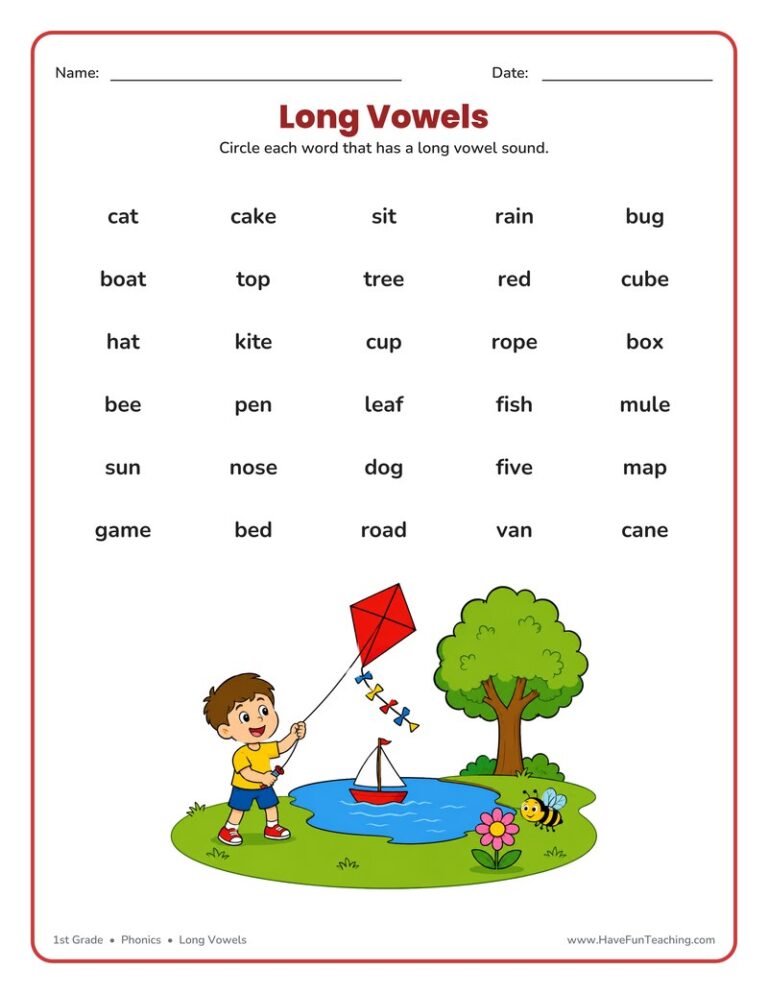
This Long Vowels Circling Worksheet gives 1st graders a 30-word grid where they circle every word that has a long vowel sound. Answer key included — perfect for quick, no-prep phonics practice at home or school.
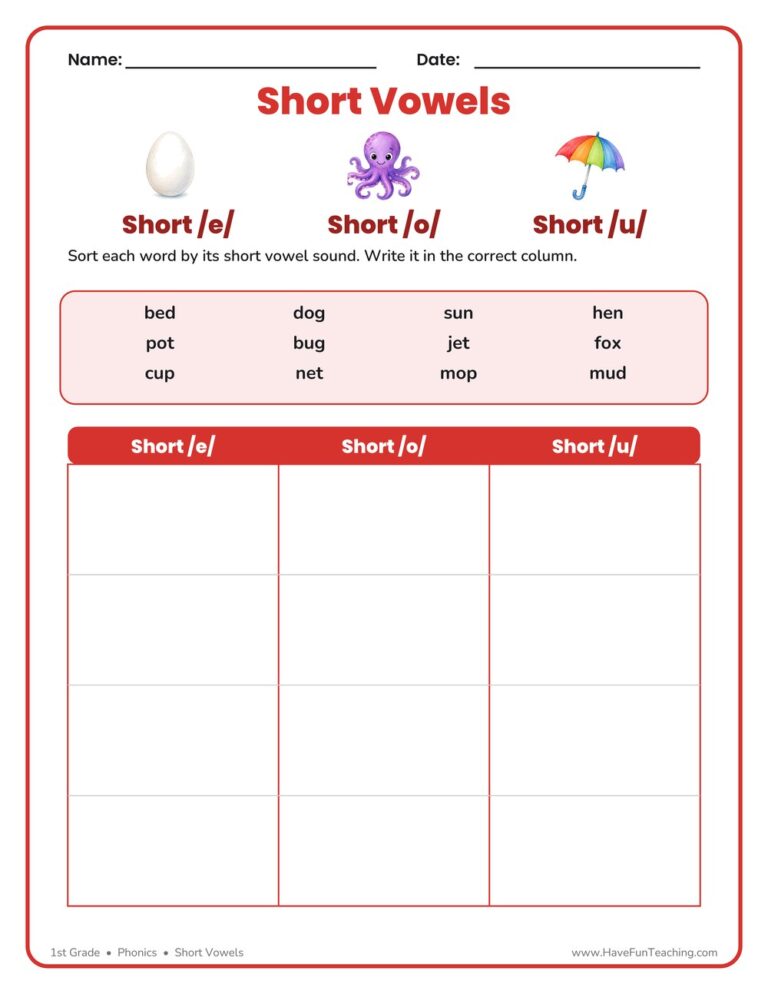
This e, o, u short vowels worksheet has 1st graders sort twelve words by their short /e/, /o/, and /u/ sound. Includes an answer key for fast, no-prep phonics practice.

The Letter Z Song teaches the Letter Z Sound, uppercase and lowercase Letter Z, vocabulary words with the Letter Z sound, and Letter Z handwriting practice.

This Alphabet Song A will help your students learn all about the Letter A. This Letter A song teaches the Letter A sounds, including the short A sound and long A sound, as well as uppercase and lowercase letter A recognition.

The Letter P Song teaches the Letter P Sound, uppercase and lowercase Letter P, vocabulary words with the Letter P sound, and Letter P handwriting practice.

The Pie Guy Phonics Reading Comprehension Story Worksheet - Long Vowel I Sound gives 1st graders a fun, decodable long-I story with five comprehension questions and a complete answer key for quick, no-prep reading practice.

This is the Alphabet Song by Have Fun Teaching offers a fun and engaging way to learn the alphabet. This song helps children master their ABCs with a catchy tune and memorable lyrics. The repetition and rhythm make it easier for kids to remember the alphabet letters. Teachers and parents…
Reviews
There are no reviews yet