
Skip to content
Start My 3 Free Days $0 today · cancel anytime

5th Grade Angles Resources

4 5th grade angles resources: 4 activities. How teachers use these

5th Grade Angles Resources

4 5th grade angles resources: 4 activities. How teachers use these

Activity
Activity5th GradeMeasuring Monstrous Angles Activity

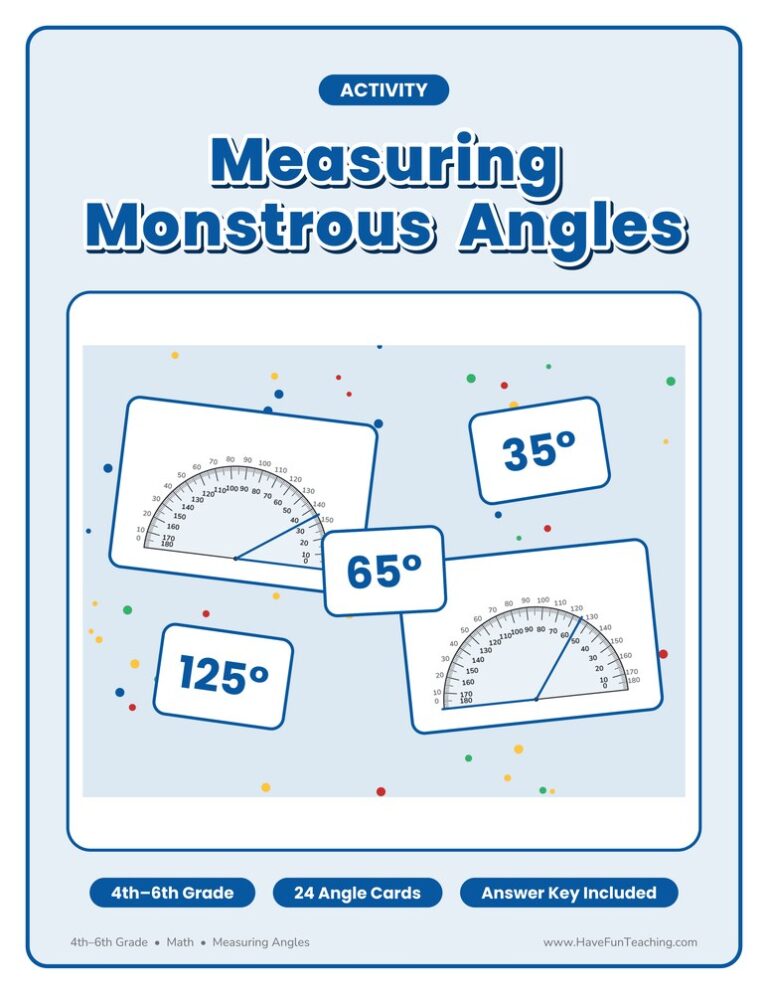
This measuring monstrous angles activity helps 4th to 6th grade students read a protractor and match angles to their measures. Answer key included for quick checking at a math center.

Activity
Activity5th GradeStar Wars Rays and Angles Edition Activity

In this Star Wars Rays and Angles Activity, students recognize angles as obtuse, acute or right by playing War!

Activity
Activity5th GradeUp, Up, and Away! Measuring Angles Activity

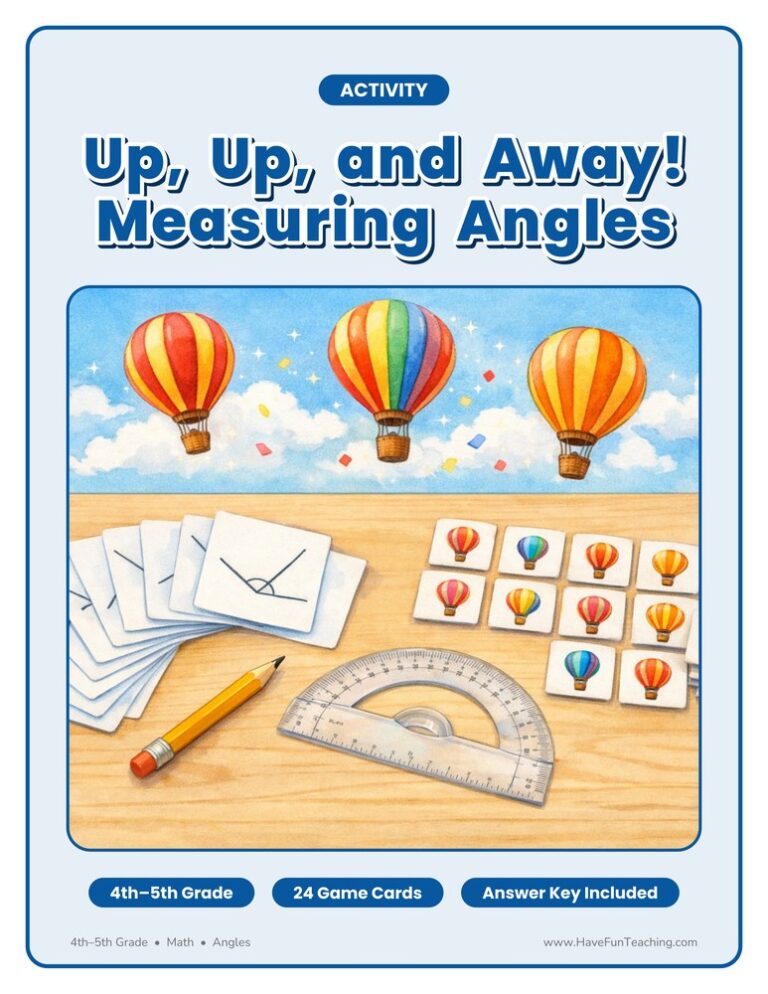
This measuring angles activity has 4th and 5th grade students add or subtract angle parts to find missing angles and match them to balloon cards. Answer key included.

Activity
Activity5th GradeBaking with Geometry Activity

This baking with geometry activity helps 4th and 5th grade students sort points, lines, line segments, rays and angles on a fun bake sale mat. A practice page and an answer key are included.

From our teachers' playbook

Acute, obtuse and totally right

What do 5th graders learn about angles?

Fifth graders use what they learned about angles in 4th grade to classify and measure them with confidence. They name angles as acute (less than 90°), right (exactly 90°), obtuse (between 90° and 180°) and straight (180°), and use a protractor to measure to the nearest degree. They use angle facts to classify triangles and other shapes. The click comes when kids see that angles add up: two 45° angles side by side make a right angle, 45° + 45° = 90°.

Our favorite ways to teach angles

Angles are easy to see once kids know where to look. These moves build both vocabulary and protractor skills.

Arm angles

Kids use their arms to make acute, right, obtuse and straight angles while you call them out. Then give a degree, like 120°, and they make their best guess before you check with a protractor.

Why it works: kids understand an idea best when they touch it, then draw it, then write it, the order the U.S. Department of Education recommends for elementary math.
Up, Up, and Away! Measuring Angles ActivityTry it withUp, Up, and Away! Measuring Angles ActivityActivitiesOpen it →
Protractor step by step

Model three steps every time: line up the center hole on the vertex, line up the zero line on one ray, read the number where the other ray crosses. Kids say the steps aloud while they measure.

Why it works: handing over the work step by step, from teacher to student, is one of the most widely used teaching frameworks (Pearson and Gallagher, 1983).

Measuring Monstrous Angles ActivityTry it withMeasuring Monstrous Angles ActivityActivitiesOpen it →

Rays, lines and angles

Mix angle types with rays and line segments on one page so kids have to name each one. Sorting the vocabulary together prevents mix-ups later.

Why it works: shuffled practice teaches kids to choose the right strategy, not just repeat one, and it improved test scores in research (Rohrer and Taylor, 2007).

Star Wars Rays and Angles Edition ActivityTry it withStar Wars Rays and Angles Edition ActivityActivitiesOpen it →

Angles questions, answered

What are the types of angles 5th graders learn?

Acute angles are less than 90°, right angles are exactly 90°, obtuse angles are between 90° and 180°, and straight angles are exactly 180°.

How do you use a protractor?

Place the center point on the angle's vertex, line up the zero mark with one ray, then read the degree where the second ray crosses the scale. Check whether you are reading the inner or outer numbers.

Why do kids read the wrong number on a protractor?

Protractors have two scales. Have kids decide first whether the angle is acute or obtuse, so they know if the answer should be less or more than 90°.

How do angles help classify triangles?

A triangle with a right angle is a right triangle, one with an obtuse angle is obtuse, and one with three acute angles is acute. All three angles always add up to 180°.