Skip to content
Start My 3 Free Days $0 today · cancel anytime

5th Grade Base 10 Resources

4 5th grade base 10 resources: 3 Common Core Lessons and 1 activity. How teachers use these

5th Grade Base 10 Resources

4 5th grade base 10 resources: 3 Common Core Lessons and 1 activity. How teachers use these

Common Core Lesson
Common Core Lesson5th Grade5.NBT.3 Fifth Grade Common Core Lesson

In this 5.NBT.3 Fifth Grade Common Core Lesson, studentsread, write, and compare decimals to the thousandths place in expanded form, number form, and base ten numerals.

Common Core Lesson
Common Core Lesson5th Grade5.NBT.1 Fifth Grade Common Core Lesson

In this 5.NBT.1 Fifth Grade Common Core Lesson, students recognize that in a multi-digit number, a digit in one place represents 10 times as muchto its right and 1/10 to its left.

Common Core Lesson
Common Core Lesson5th Grade5.NBT.2 Fifth Grade Common Core Lesson

In this 5.NBT.2 Fifth Grade Common Core lesson, studentsexplain patterns in the number of zeros in products when multiplying and dividing by powers of 10.

Activity
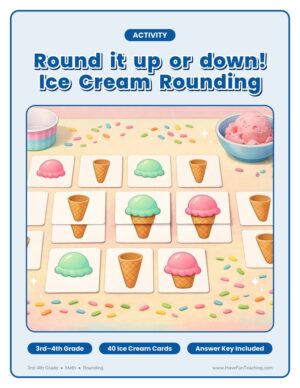
Activity5th GradeScooping Up Hundreds Rounding Activity

In this Scooping Up Hundreds Rounding Activity, students use place value understanding to round whole numbers to the nearest 100.

From our teachers' playbook

Times ten, divide by ten, repeat!

What do 5th graders learn about base 10?

Fifth graders discover the secret pattern of our number system: each place is 10 times the place to its right and one tenth of the place to its left. That pattern works for decimals too! They multiply and divide by powers of 10 and notice the digits shift places: 3.4 × 100 = 340. They write powers of ten with exponents, like 10³ = 1,000, and read, write and compare decimals to the thousandths. The click is when kids see that the digits don't change, only their places do.

How we teach base 10 in 5th grade

Place value gets powerful in 5th grade. These moves make the patterns pop.

Slide the digits

Draw a big place value chart from thousands to thousandths. Write 4.56 and multiply by 10: kids physically slide the digit cards one place to the left. Seeing the digits move, not the decimal point, clears up a classic misconception.

Why it works: children learn more from words and pictures together than from words alone (Mayer, 2009).

5.NBT.1 Fifth Grade Common Core LessonTry it with5.NBT.1 Fifth Grade Common Core LessonCommon Core LessonsOpen it →

Spot the pattern out loud

Write 7 × 10, 7 × 100, 7 × 1,000 on the board and model your noticing: "Each time, one more zero, and the 7 moves over one place." Then show 10², 10³, 10⁴. Kids predict the next one before you write it.

Why it works: handing over the work step by step, from teacher to student, is one of the most widely used teaching frameworks (Pearson and Gallagher, 1983).

5.NBT.2 Fifth Grade Common Core LessonTry it with5.NBT.2 Fifth Grade Common Core LessonCommon Core LessonsOpen it →

Compare with mixed forms

Give kids pairs of decimals written different ways: standard form, word form, expanded form. They compare using greater than or less than. Mixing forms forces them to think about place value instead of guessing by length.

Why it works: mixing different kinds of problems in one practice set helped students do far better on a later test (Rohrer and Taylor, 2007).

5.NBT.3 Fifth Grade Common Core LessonTry it with5.NBT.3 Fifth Grade Common Core LessonCommon Core LessonsOpen it →

Questions parents and teachers ask

What is base 10 in 5th grade?

Base 10 means each place in a number is worth 10 times the place to its right. In 5th grade, kids use this pattern with decimals and powers of 10.

What happens when you multiply a decimal by 10?

Each digit moves one place to the left, so the number gets 10 times bigger. For example, 0.35 × 10 = 3.5.

What does 10 to the 3rd power mean?

It means 10 × 10 × 10, which equals 1,000. The exponent tells how many tens are multiplied together.

How do you compare decimals?

Line them up by the decimal point and compare digits from left to right. The first place where they're different tells you which is bigger.