Skip to content
Start My 3 Free Days $0 today · cancel anytime

1st Grade Inference Resources

5 1st grade inference resources: 5 activities and 1 graphic organizer. How teachers use these

1st Grade Inference Resources

5 1st grade inference resources: 5 activities and 1 graphic organizer. How teachers use these

Activity
Activity1st GradeReading Between The Lines Inference Activity

This reading between the lines inference activity lets 1st to 3rd grade students use story clues to figure out how a character feels. An answer key is included for easy checking.

Activity
Activity1st GradeMaking Inferences Pictures Activity

This making inferences pictures activity has 1st to 3rd Grade readers use tool clues to infer which community helper uses them. Includes a record sheet, practice page and answer key.

Activity
Activity1st GradeUse the Text to Make Inferences Activity

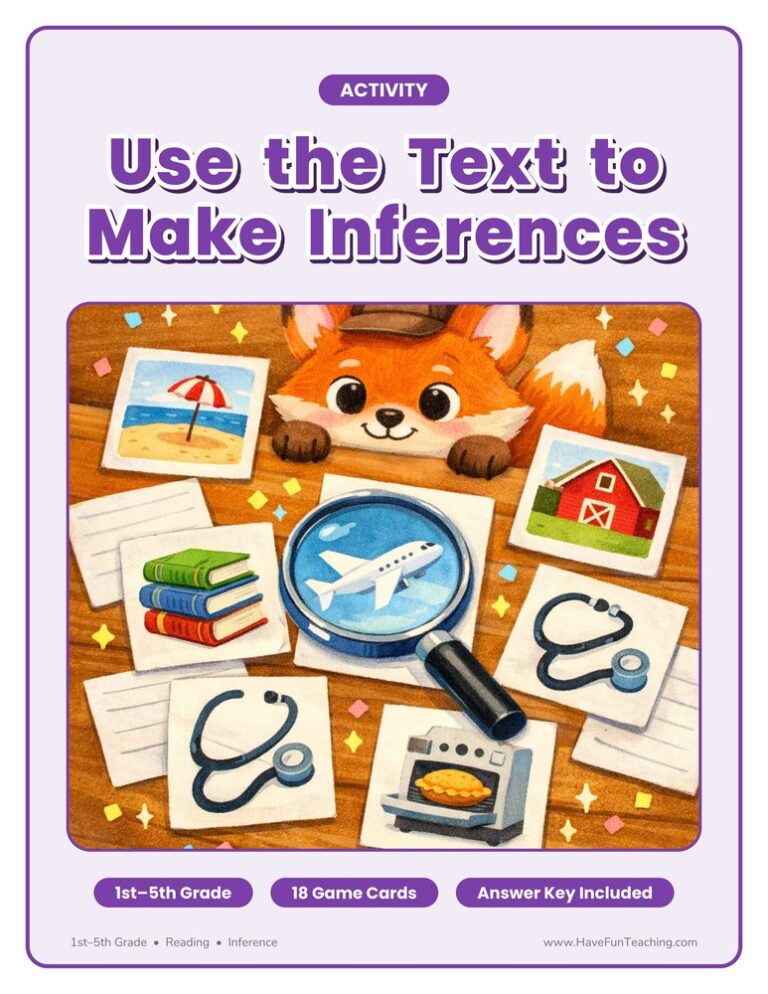
In this use the text to make inferences activity, 1st to 5th grade students read short clue stories, infer the place, and name the text clues. Answer key included.

Activity
Activity1st GradeMaking Inferences Activity

This making inferences activity has 1st to 3rd grade students match picture clue cards to what happened and record the clues they used. Answer key included.

Activity
Activity1st GradeTo Infer or not to Infer Inferences Activity

Using To Infer or not to Infer Inferences Activity, students use clues from the picture and your own knowledge to build inference skills. This is perfect for making inferences and drawing conclusions.

From our teachers' playbook

Be a reading detective

What do 1st graders learn about inference?

First graders learn that authors don't tell us everything. Readers use clues from the words and pictures, plus what they already know, to figure out the rest. If a picture shows a child in a coat holding an umbrella, we can infer it is cold and rainy, even though the book never says so. We teach it with a simple recipe: clue + what I know = inference. The click is when kids realize they make inferences all day long without noticing.

Our favorite ways to teach inference

Inference sounds big, but first graders are natural detectives. These moves make it concrete.

Start with pictures

Show a picture with no words, like a muddy dog next to a bathtub, and ask, "What do you think happened?" Then ask, "What clue told you?" Pictures take the reading load off so kids can focus on thinking.

Why it works: children learn more from words and pictures together than from words alone (Mayer, 2009).

Making Inferences Pictures ActivityTry it withMaking Inferences Pictures ActivityActivitiesOpen it →

Detective think-aloud

Read a sentence and think out loud: "It says Max's face was red and his fists were tight. I know people look like that when they're mad. So I infer Max is angry." Then let kids try the next one.

Why it works: showing first, practicing together, then letting kids try alone is the "gradual release" model teachers have relied on for decades (Pearson and Gallagher, 1983).

Reading Between The Lines Inference ActivityTry it withReading Between The Lines Inference ActivityActivitiesOpen it →

Point to the proof

When a child makes an inference, ask them to point to the words that gave them the idea. This keeps inferences grounded in the text, not wild guesses.

Why it works: the U.S. Department of Education's guide for teaching elementary math recommends moving from hands-on objects to drawings to numbers.

Use the Text to Make Inferences ActivityTry it withUse the Text to Make Inferences ActivityActivitiesOpen it →

Inference questions, answered

What is an inference for 1st graders?

An inference is a smart conclusion you make using clues from the story plus what you already know. It is figuring out something the author didn't say outright.

How do you explain inference to a 6-year-old?

Say it is like being a detective. You look for clues, think about what you already know and solve the mystery. Use pictures first, then short sentences.

What is the difference between an inference and a guess?

A guess can be random. An inference always has a clue behind it. If a child can't point to a clue, help them find one.

How can I practice inference at home?

While reading together, pause and ask, "How do you think she feels? How do you know?" Everyday moments work too: "Your brother is yawning. What can we infer?"