Skip to content
Start My 3 Free Days $0 today · cancel anytime

1st Grade Force Resources

5 1st grade force resources: 3 activities and 2 worksheets. How teachers use these

1st Grade Force Resources

5 1st grade force resources: 3 activities and 2 worksheets. How teachers use these

Worksheet
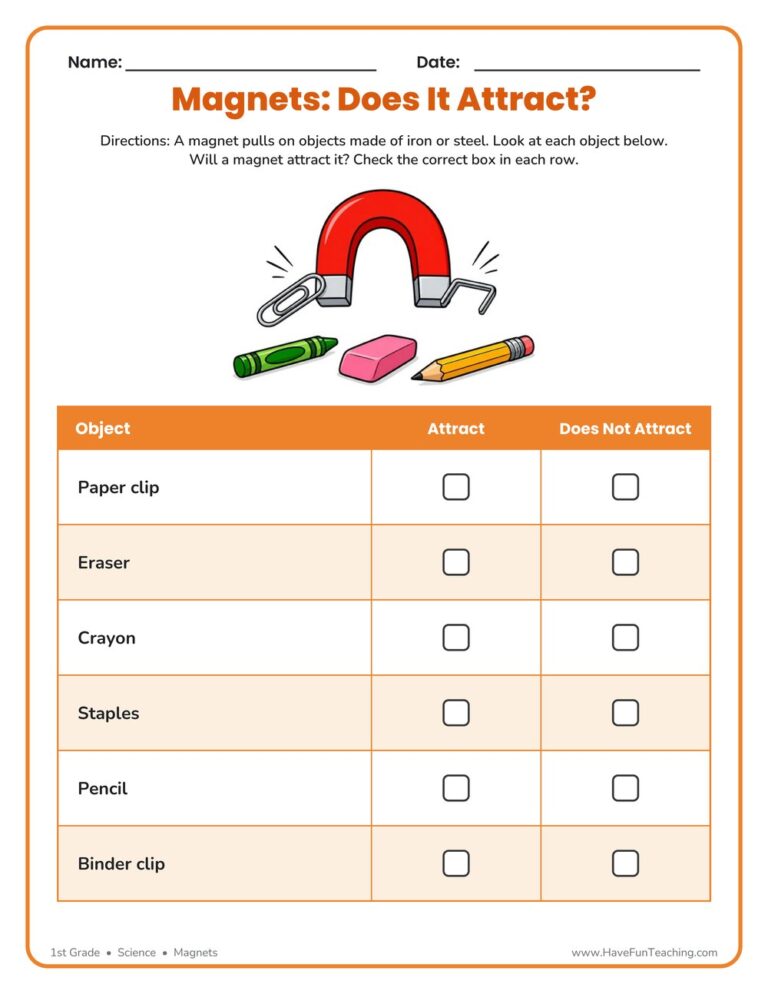
Worksheet1st GradeClassroom Objects Magnet Attraction Worksheet

This first grade classroom objects magnet attraction worksheet has students sort six everyday items into attract or does-not-attract columns as they explore magnetism. Answer key included — a quick, hands-on way to practice physical science.

Worksheet
Worksheet1st GradeMagnetic Objects Worksheet

This magnetic objects worksheet lets 1st graders circle pictures and words to show which things a magnet will pull. An answer key is included for quick checking.

Activity
Activity1st GradeMagnet Activity

This magnet activity has kindergarten to 3rd grade students sort picture cards into things a magnet will pull and things it will not, with a sorting mat, practice page and answer key.

Activity
Activity1st GradeSink or Float Activity

This sink or float activity has kindergarten and 1st grade scientists predict and sort 12 picture cards on a Float and Sink mat, then circle new floating objects. Answer key included.

Activity
Activity1st GradeFun with Magnets Science Activity

This fun with magnets science activity has 1st to 3rd grade students predict, sort and check whether magnet poles attract or repel. Answer key included.

From our teachers' playbook

Push it, pull it, stick it!

What do 1st graders learn about force?

First graders learn that a force is a push or a pull, and forces make things start, stop, speed up or change direction. A gentle push rolls a ball slowly, and a big push sends it zooming. Kids also explore magnets, which can pull some objects without even touching them! They test which things a magnet attracts, like paper clips and nails, and which it does not, like wood, plastic and paper. The surprise moment: not every metal sticks. A soda can usually will not!

Our favorite ways to teach force

Force is best learned by testing, so we keep these lessons hands-on and full of predictions.

Predict, test, record

Before trying a magnet on an object, kids predict "stick" or "no stick" and mark it on their sheet. Then they test and record what happened. Comparing predictions with results is the heart of being a scientist.

Why it works: going from real objects to pictures to symbols is a core recommendation of the U.S. Department of Education's elementary math guide.
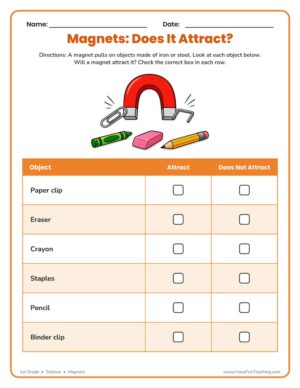
Classroom Objects Magnet Attraction WorksheetTry it withClassroom Objects Magnet Attraction WorksheetWorksheetsOpen it →

Magnet treasure hunt

Give small groups a magnet and a tray of mixed objects. Kids sort them into "attracted" and "not attracted" piles, then look for what the stuck ones have in common. Let them discover that many, but not all, metals stick.

Why it works: in a well-known study, a few short sessions of a simple number board game measurably boosted young children's number skills (Ramani and Siegler, 2008).

Magnet ActivityTry it withMagnet ActivityActivitiesOpen it →

Draw the push or pull

Kids draw a picture of a push or pull they did today: kicking a ball, opening a door, pulling a wagon. They add an arrow showing the direction of the force. Arrows turn an invisible idea into something they can see.

Why it works: children learn more from words and pictures together than from words alone (Mayer, 2009).

Magnetic Objects WorksheetTry it withMagnetic Objects WorksheetWorksheetsOpen it →

Questions about teaching force in 1st grade

What is force for 1st graders?

A force is a push or a pull. Forces can make an object move, stop, speed up, slow down or change direction.

What objects are attracted to magnets?

Magnets attract objects made of iron or steel, like paper clips, nails and many keys. They do not attract wood, plastic, paper, glass, or most aluminum and copper.

How do I teach push and pull at home?

Point out pushes and pulls during the day, like pushing a swing or pulling a door. Ask your child to name which one it was and what happened to the object.

Is a magnet a force?

A magnet creates a force. It can push or pull other magnets and pull objects made of iron, even without touching them.