
Skip to content
Start My 3 Free Days $0 today · cancel anytime

Sink or Float Resources

2 sink or float resources: 1 activity and 1 worksheet. How teachers use these

Sink or Float Resources

2 sink or float resources: 1 activity and 1 worksheet. How teachers use these

Activity
ActivityKindergartenSink or Float Activity

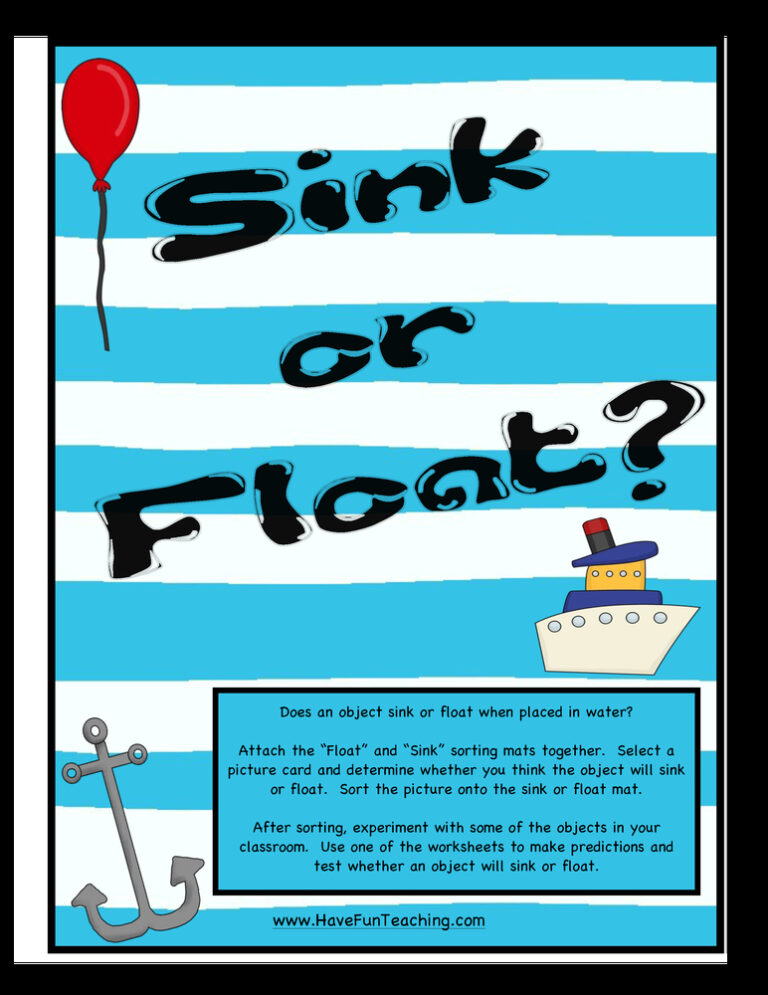
This sink or float activity has kindergarten and 1st grade scientists predict and sort 12 picture cards on a Float and Sink mat, then circle new floating objects. Answer key included.

Worksheet
Worksheet3rd GradeSink Float Examples Worksheet

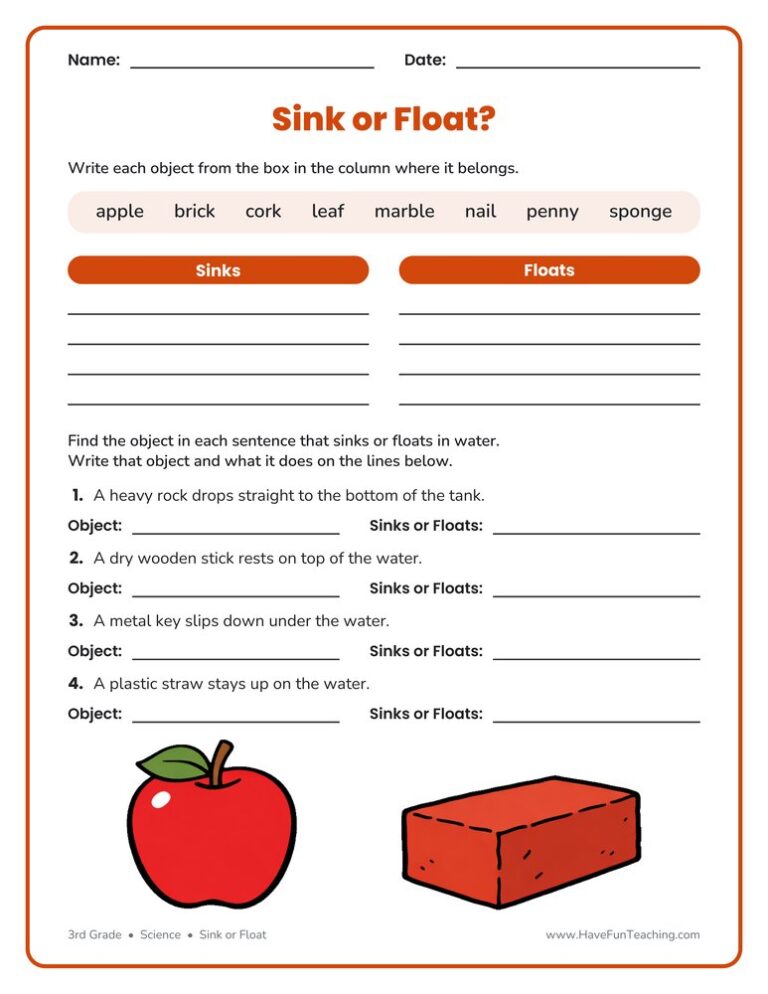
This Sink Float Examples Worksheet has 3rd graders sort eight everyday objects into Sinks and Floats columns, then name the object in four sentences. Answer key included for hands-on science practice.

From our teachers' playbook

Splash! Predict, test, and find out

What do kids learn about sink or float?

Sink or float is often a child's very first science experiment. Kids learn to make a prediction, test it in water, and record what happens. Younger children discover that size doesn't decide it: a big log floats while a tiny pebble sinks. Older students learn it depends on how heavy something is for its size (its density) compared to water, and that shape matters too, which is why a ball of clay sinks but a clay boat can float. The click moment is when a child predicts a big apple will sink, drops it in, and gasps when it bobs up.

Our favorite ways to explore sink or float

All you need is a tub of water and curious kids. These moves turn splashing into real science.

Predict, then test

Before anything goes in the water, kids sort objects into "I think it will sink" and "I think it will float." Then test one at a time and move each to where it really belongs. The surprises are the best teaching moments.

Why it works: going from real objects to pictures to symbols is a core recommendation of the U.S. Department of Education's elementary math guide.

Sink or Float ActivityTry it withSink or Float ActivityActivitiesOpen it →
Draw what happened

Kids draw each object either at the bottom of the tub or on top of the water. Pictures give younger kids a way to record results before they can write, and they make patterns easy to see.

Why it works: children learn more from words and pictures together than from words alone (Mayer, 2009).

Sink Float Examples WorksheetTry it withSink Float Examples WorksheetWorksheetsOpen it →

Make the clay boat

Drop a ball of clay in the water so it sinks. Then challenge kids to reshape the same clay so it floats. When a flat boat finally bobs on top, they discover that shape matters, not just weight.

Why it works: handing over the work step by step, from teacher to student, is one of the most widely used teaching frameworks (Pearson and Gallagher, 1983).

What's on this page

Teacher favorites right now: Sink or Float Activity and Sink Float Examples Worksheet.

Questions parents and teachers ask

Why do some things sink and others float?

It depends on density: how heavy something is for its size compared to water. Things that are less dense than water float, and things that are more dense sink. Shape matters too, because spreading out lets an object push aside more water.

What age is sink or float for?

It works from preschool through elementary school. Little ones predict and test, while older kids measure, record data and explain density and buoyancy.

What objects are good for a sink or float experiment?

Try a mix of surprising items: an apple, a coin, a cork, a crayon, a rock, a sponge, a plastic spoon and a leaf. Include some big things that float and small things that sink.

Why does a peeled orange sink?

The peel is full of tiny air pockets that help the orange float. Without the peel, the orange is denser than water and sinks.

Keep exploring



