
Skip to content
Start My 3 Free Days $0 today · cancel anytime

3rd Grade Density Resources

2 3rd grade density resources: 2 worksheets. How teachers use these

3rd Grade Density Resources

2 3rd grade density resources: 2 worksheets. How teachers use these

Worksheet
Worksheet3rd GradeDensity and Volume in Metric Worksheet

This Density and Volume in Metric Worksheet asks 3rd graders to choose the best metric unit—grams, kilograms, milliliters, or liters—for ten everyday objects. Answer key included for fast, no-prep measurement practice.

Worksheet
Worksheet3rd GradeSink Float Examples Worksheet

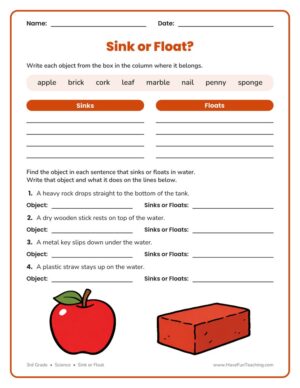
This Sink Float Examples Worksheet has 3rd graders sort eight everyday objects into Sinks and Floats columns, then name the object in four sentences. Answer key included for hands-on science practice.

From our teachers' playbook

Why does a huge log float but a tiny pebble sink?

What do 3rd graders learn about density?

Third graders learn that whether something sinks or floats is not about how big it is, it is about how tightly packed its material is. That packed-ness is density. A big log floats because wood is less dense than water, while a small pebble sinks because rock is denser. Kids test objects, predict, record results and start measuring mass and volume in metric units like grams and milliliters. The click is when a student stops saying "heavy things sink" and starts saying "it depends what it is made of."

Our favorite ways to make density stick

Density is one of those ideas kids have to see to believe. These moves get the water out.

Predict, drop, record

Fill a tub with water and line up objects: a crayon, a coin, an apple, a key, a cork. Kids predict sink or float on a chart, test each one, then circle the surprises. The surprises, like the big apple floating, are where the real thinking starts.

Why it works: the U.S. Department of Education's guide for teaching elementary math recommends moving from hands-on objects to drawings to numbers.
Sink Float Examples WorksheetTry it withSink Float Examples WorksheetWorksheetsOpen it →

Same size, different stuff

Hold up two blocks the same size, one wood and one clay, and think aloud: "Same size. But this one feels heavier. More stuff is packed inside." Drop them both in water. Showing one variable at a time makes density click.

Why it works: showing first, practicing together, then letting kids try alone is the "gradual release" model teachers have relied on for decades (Pearson and Gallagher, 1983).

Density and Volume in Metric WorksheetTry it withDensity and Volume in Metric WorksheetWorksheetsOpen it →

Sink or float flash round

Show pictures of everyday objects and kids vote sink or float with a thumbs up or down, then give a reason. Quick recall rounds help the idea move from the tub into their heads.

Why it works: researchers who compared ten study methods found practice testing is one of the two that work best (Dunlosky and colleagues, 2013).

What's on this page

Teacher favorites right now: Density and Volume in Metric Worksheet and Sink Float Examples Worksheet.

Questions teachers and parents ask about 3rd grade density

How do you explain density to a 3rd grader?

Density is how tightly packed the stuff inside an object is. If two things are the same size and one feels heavier, the heavier one is denser. Things denser than water sink, and things less dense float.

Why does a big log float but a small rock sink?

Size does not decide it. Wood is less dense than water, so even a huge log floats. Rock is denser than water, so even a tiny pebble sinks.

What is a simple density experiment for kids?

Fill a bowl with water and test household objects for sink or float. Have your child predict first, then test. An orange with and without its peel is a favorite surprise.

Is density taught in 3rd grade?

Many 3rd grade science units explore sinking and floating and measuring mass and volume, which builds the idea of density. The formal formula usually comes later, in middle school.



