This possessive pronouns worksheet gives 2nd graders eight sentences for practicing her, its, our, their, and your. An answer key is included, so families and teachers can check the work in seconds.
This Writing Personal Pronouns Worksheet has second graders swap an underlined noun for the pronoun that fits, using each word once. Answer key included, so practice checks itself.
This 2nd grade Choosing Pronouns Worksheet gives students fun fill-in-the-blank practice picking the right subject and object pronouns, with an answer key included for fast grading and confident grammar skills.
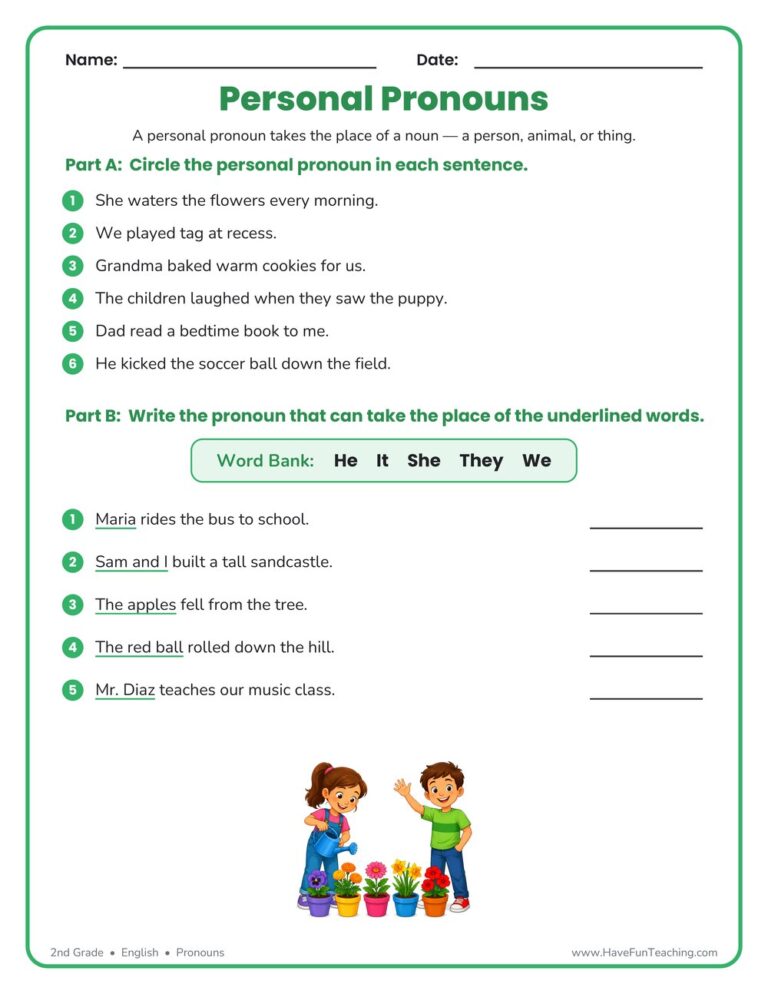
This personal pronouns worksheet gives 2nd graders practice circling pronouns and swapping nouns for the right pronoun using a word bank. An answer key is included to make grammar review simple.
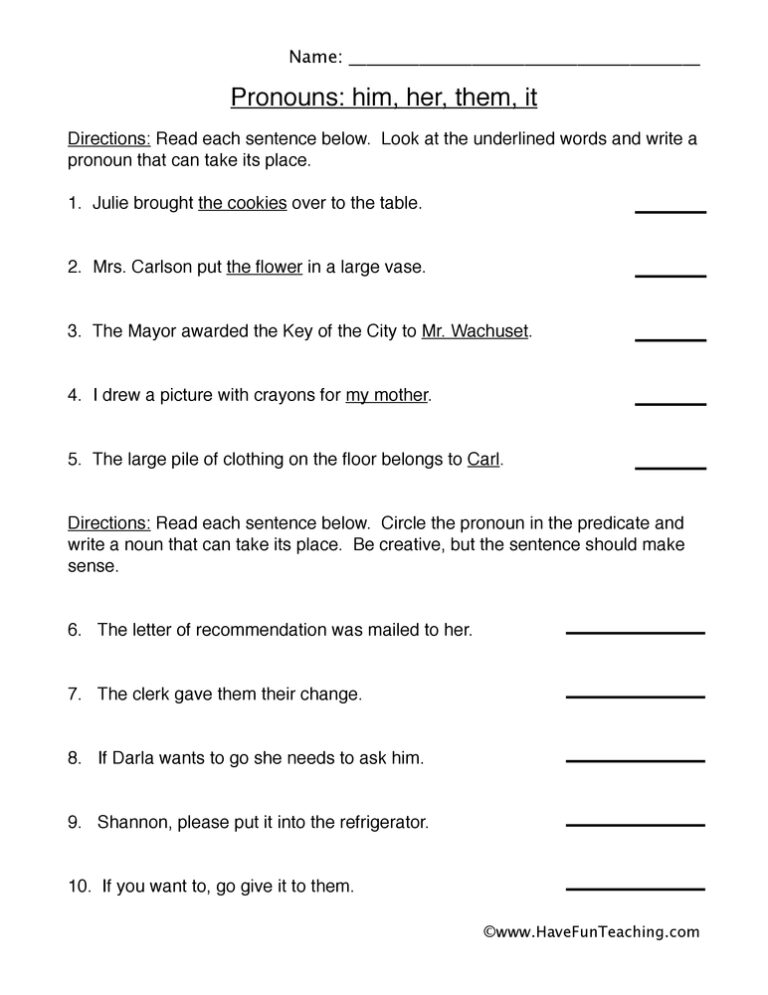
This Him Her Them It Pronoun Worksheet gives 2nd graders practice swapping naming words for the right pronoun, then naming the noun each pronoun stands for. Answer key included for quick, no-prep grammar review.
This Pronouns Dialogue Worksheet helps 2nd Grade students replace bold nouns with the right pronoun and rewrite sentences using one. An answer key is included, so practice is quick to check and easy to reuse.
This He She They It Pronoun Worksheet gives 2nd Grade students practice swapping naming words for he, she, they, and it, using both sentences and pictures. An answer key is included, so checking work takes seconds.
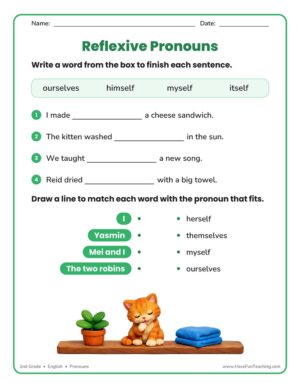
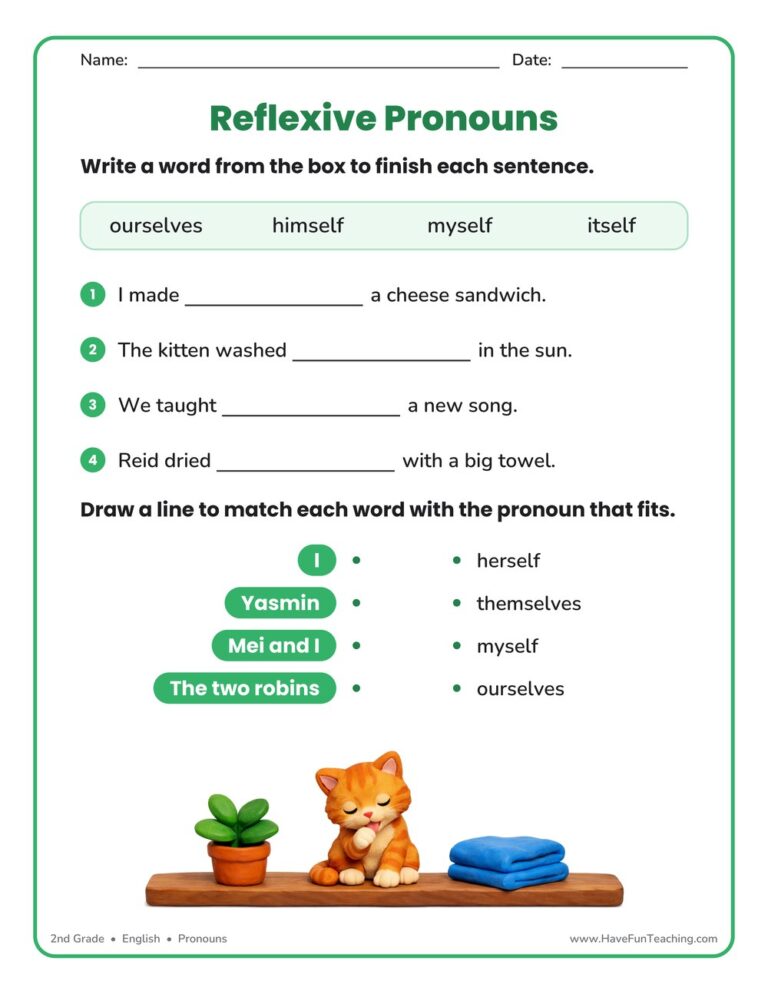
This Reflexive Pronouns Worksheet gives 2nd Grade students focused practice writing and matching myself, itself, ourselves, himself, herself, and themselves. Answer key included, so grammar review stays quick and easy.
This replacing with pronouns worksheet gives 2nd Grade students eight sentences to rewrite with the right subject and object pronouns. Answer key included, so pronoun practice takes no prep at all.
This Writing Sentences with Pronouns Worksheet gives 2nd Grade students six sentences to rewrite with the right pronoun plus a write-your-own item, and an answer key is included so checking work takes seconds.
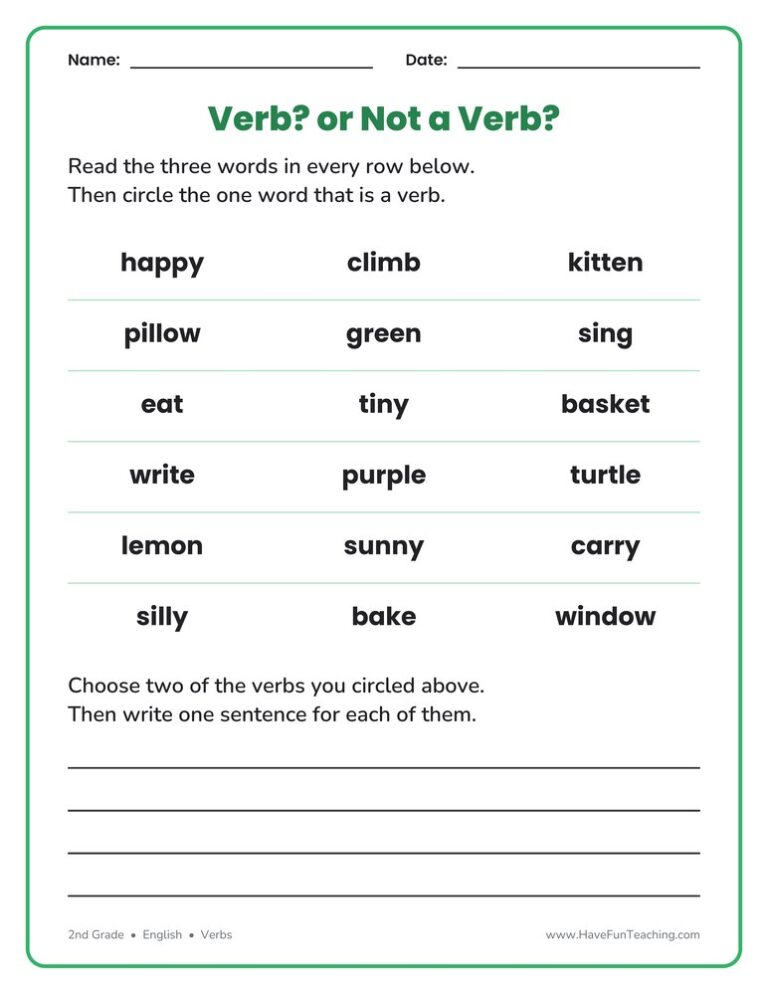
This verb or not a verb worksheet has 2nd grade students circle the one action word in each row, then write sentences with two verbs. An answer key is included for quick checking.
Pronouns are words that take the place of nouns so we don't repeat the same name over and over. Second graders learn personal pronouns like he, she, it, they, we and possessive pronouns like his, her, their. A big 2nd grade skill is reflexive pronouns: I made it myself. They cleaned up by themselves. Kids practice replacing nouns with the right pronoun and making sure it matches. The click moment is when a student rereads "Max said Max lost Max's hat" and laughs at how silly it sounds without pronouns.
Our favorite ways to teach pronouns
Pronouns make writing smoother. These moves help kids pick the right one every time.
Swap the name
Write a sentence that repeats a name three times. Read it out loud with a silly voice, then cross out the repeated names and replace them with pronouns. Kids practice the same swap on the worksheet.
Why it works: handing over the work step by step, from teacher to student, is one of the most widely used teaching frameworks (Pearson and Gallagher, 1983).
Give sentences with two pronoun choices, like "(He/Him) ran fast." Kids choose, then read the sentence aloud to check if it sounds right. Ears are great grammar checkers!
Why it works: pulling an answer out of memory makes it stick far better than rereading it, one of the strongest findings in learning research (Dunlosky and colleagues, 2013).
Reflexive pronouns are new in 2nd grade. Mix singular and plural examples, like myself, himself, ourselves and themselves, so kids notice the -self versus -selves pattern.
Why it works: mixing different kinds of problems in one practice set helped students do far better on a later test (Rohrer and Taylor, 2007).
Pronouns are words that replace nouns, like he, she, it, they, we and you. Second graders also learn possessive pronouns like his and their, and reflexive pronouns like myself and themselves.
What is a reflexive pronoun?
A reflexive pronoun ends in -self or -selves and refers back to the subject, like "She drew it herself." Kids learn them in 2nd grade.
Why do kids say "him and me went"?
It's common in everyday speech. Teach them to try each part alone: "Him went?" sounds wrong, but "He went" sounds right, so it's "He and I went."
How can I practice pronouns at home?
Tell a story about a family member and have your child replace the names with pronouns. Make it silly by repeating names until they jump in.
Written by the Have Fun Teaching team of elementary teachers and homeschoolers. Research: Pearson, P. D., & Gallagher, M. C. (1983). The instruction of reading comprehension. Contemporary Educational Psychology, 8(3). Dunlosky, J., Rawson, K. A., Marsh, E. J., Nathan, M. J., & Willingham, D. T. (2013). Improving Students' Learning With Effective Learning Techniques. Psychological Science in the Public Interest, 14(1). Rohrer, D., & Taylor, K. (2007). The shuffling of mathematics problems improves learning. Instructional Science, 35(6).
3 days free
2:39Ready to print!
Printables · Songs · Games
Loved by 2 million teachers & families
Where learning feels like play.
Printables, songs and games for every subject, Preschool through 6th. Ready to teach today, and kids beg for more.
$0due today
then $39.97$35.97for your first year, and $39.97 a year after that.







 Try it withReplacing with Pronouns WorksheetWorksheetsOpen it →