
Skip to content
Start My 3 Free Days $0 today · cancel anytime

3rd Grade Rhyming Resources

5 3rd grade rhyming resources: 5 worksheets. How teachers use these

3rd Grade Rhyming Resources

5 3rd grade rhyming resources: 5 worksheets. How teachers use these

Worksheet
Worksheet3rd GradeRhythm and Rhyme Worksheet

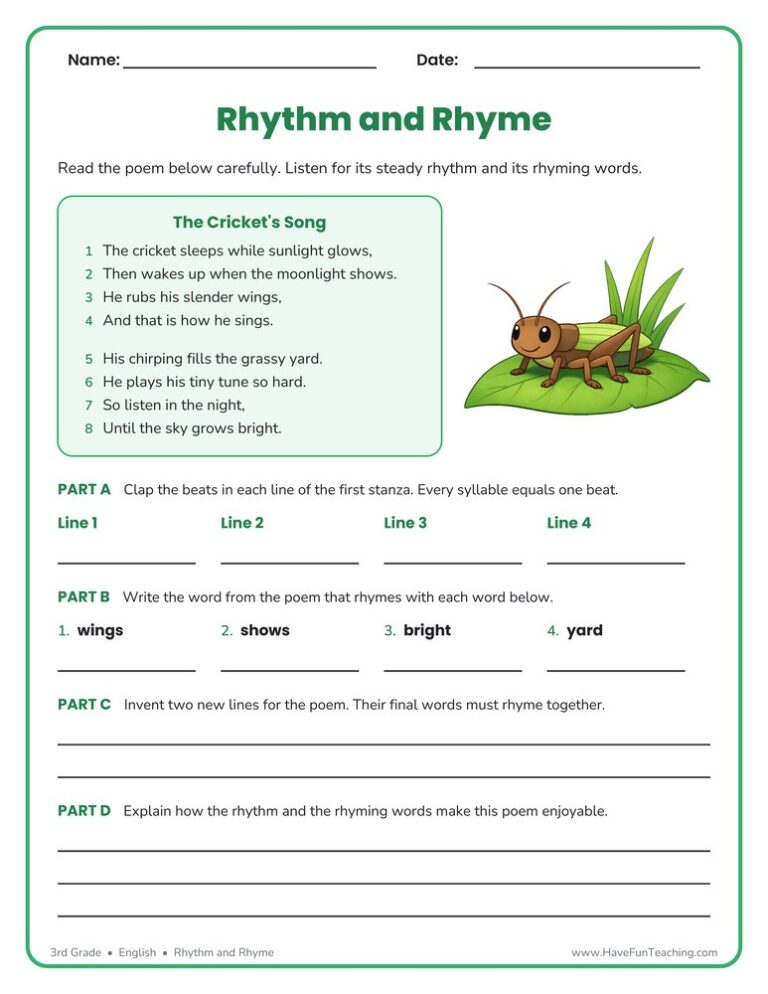
This rhythm and rhyme worksheet gives 3rd grade students an original cricket poem, beat counting, rhyming pairs, and a write-your-own couplet. Answer key included, so poetry practice is ready to print.

Worksheet
Worksheet3rd GradeFinding Rhyming Words Worksheet

The Finding Rhyming Words Worksheet has 1st grade students match five long vowel words to their rhyme families, then write each word in a sentence. An answer key is included.

Worksheet
Worksheet3rd GradeRhyme and Rhythm Worksheet

This rhyme and rhythm worksheet gives 3rd grade students a short granite poem to read aloud, count beats in, and mine for rhyming pairs. An answer key is included, so poetry practice takes minutes to check.

Worksheet
Worksheet3rd GradeRhyming Matching Worksheet

This rhyming matching worksheet gives 3rd grade students practice pairing words that sound alike but are spelled differently, with a word box, sentence writing, and a full answer key for easy checking.

Worksheet
Worksheet3rd GradeSt. Patrick's Day Limerick Worksheet

A St. Patrick’s Day Limerick Worksheet where 3rd graders label a poem’s rhyme pattern, match rhyming words, and write a limerick of their own. Answer key included, so poetry practice ends in a laugh instead of a blank page.

From our teachers' playbook

Rhythm, rhyme and poetry time

What do 3rd graders learn about rhyming?

By 3rd grade, rhyming moves into poetry. Kids find rhyming words and notice that they don't always look the same: bear / chair / where all rhyme with different spellings. They learn rhyme schemes like AABB and ABAB, tap out the rhythm of a line, and write their own poems, from couplets to silly limericks. Rhyming also helps with spelling, because many word families share the same ending. The click moment is when kids hear how rhythm and rhyme make a poem bounce.

Our favorite ways to teach rhyming in 3rd grade

Rhyme is music for words. These moves help kids hear it, see it and write it.

Clap the rhythm

Read a short poem aloud while kids clap each beat. Then they find the words that rhyme at the ends of lines. Hearing and feeling the rhythm helps kids write poems that sound just right.

Why it works: words set to a repeating melody are easier to recall than the same words spoken (Wallace, 1994).

Rhythm and Rhyme WorksheetTry it withRhythm and Rhyme WorksheetWorksheetsOpen it →

Color the rhyme scheme

Give kids a poem and have them highlight each pair of rhyming words in a different color, then label the pattern AABB or ABAB. Seeing the colors makes rhyme schemes jump off the page.

Why it works: pairing a picture with each word gives kids two ways to remember it, a well-tested principle of how people learn (Mayer, 2009).

Rhyme and Rhythm WorksheetTry it withRhyme and Rhythm WorksheetWorksheetsOpen it →

Write a limerick together

Write a silly limerick as a class, thinking out loud about the AABBA pattern and the bouncy beat. Then kids write their own. Modeling the tricky parts first helps everyone feel ready to try.

Why it works: handing over the work step by step, from teacher to student, is one of the most widely used teaching frameworks (Pearson and Gallagher, 1983).

St. Patrick's Day Limerick WorksheetTry it withSt. Patrick's Day Limerick WorksheetWorksheetsOpen it →

Questions parents and teachers ask

What do 3rd graders learn about rhyming?

They find rhyming words, learn rhyme schemes like AABB and ABAB, and write their own poems. They also learn that rhyming words can have different spellings, like bear and chair.

What is a rhyme scheme?

A rhyme scheme is the pattern of rhymes at the ends of lines in a poem. Lines that rhyme get the same letter, so AABB means the first two lines rhyme and the next two lines rhyme.

What is a limerick?

A limerick is a funny five-line poem. Lines 1, 2 and 5 rhyme, and lines 3 and 4 rhyme, giving it an AABBA pattern with a bouncy rhythm.

How does rhyming help kids read and spell?

Rhyming helps kids notice word patterns. Once they can spell "cake," they can figure out "lake" and "bake," which builds both reading and spelling skills.



