

Counting in Sequence Assessment Worksheet
A counting in sequence assessment worksheet for 1st grade: seven number rows, counting by ones and skip counting, with 21 missing numbers to write. Answer key included, so checking takes a minute.
$6.97
Or free with a membership — members pay $3.33/mo for all 10,000+ resources. See plans
Want this one free?
Tell us where to send it and it’s yours — no card, no catch.
One free resource per teacher. We’ll also send free teaching ideas each week — unsubscribe anytime.
Teaching is easier with a membership
Unlimited printables, games & videos for PreK–6th — for your classroom or homeschool. Cancel anytime.
Start your 3-day free trial$0 today · cancel anytime · Instant access to 10,000+ resources
About this resource
Description
Counting on from a number that is not one is a bigger leap than it looks, and this counting in sequence assessment worksheet is built to show you exactly where a child stands. A first grader who can rattle off “one, two, three” from the start is not necessarily able to begin at 46 and keep going, because reciting the count and understanding the count are two different things. Each row here drops the child into the middle of a sequence, hands them a few of the numbers, and asks for the ones that are missing — so the page reports on real number-sequence knowledge rather than on memory of a song.
This first grade counting worksheet gives seven boxed number rows. The first four count forward by ones from 5, 27, 46 and 68, with three numbers missing from each row in a different pattern, so a child cannot fall into a rhythm and fill the same position every time. The last three rows skip count — by twos, by fives, and by tens starting at 23, off the decade, so the tens row asks for ten more than any number instead of the ten-times table. Print it, read the two direction lines aloud, and let the child write each missing number in its box. It works as a beginning-of-year baseline, a mid-unit check, a math-centre task, or a quick reteach page before a test.
What’s Included
- 1 print-ready PDF worksheet
- Answer key
- 7 number rows with 21 missing numbers to write
There are three reasons this counting in sequence assessment worksheet helps a child learn the skill. First, every row starts somewhere new, so the child has to find their place in the number system each time rather than counting up from one. Second, the missing numbers sit in a different pattern in every row — sometimes first, sometimes last, sometimes two in a row — which means a child has to count both forward and backward from the numbers they were given. Third, putting counting by ones and skip counting on one page makes the comparison visible: the child sees that the same kind of row can step by one, by two, by five or by ten, and that noticing the step is the first thing to do.
Teachers and parents can get a lot of mileage out of these rows. Read a completed row aloud together and clap on every number so the pattern is heard as well as seen. Cover a row with a strip of paper and ask what comes next, or what came just before. Use a hundred chart alongside the page for a child who is still unsure, then take it away and try the next row without it. Grade it as a quick check and note which step size slowed the child down — that one number is usually the whole lesson plan for the next day.
Related Resources
What teachers say
Reviews
You must be logged in to post a review.
Using the Counting Songs (Classic Video Collection), students practice skip counting by all of the numbers by singing and counting along to these thirteen videos.
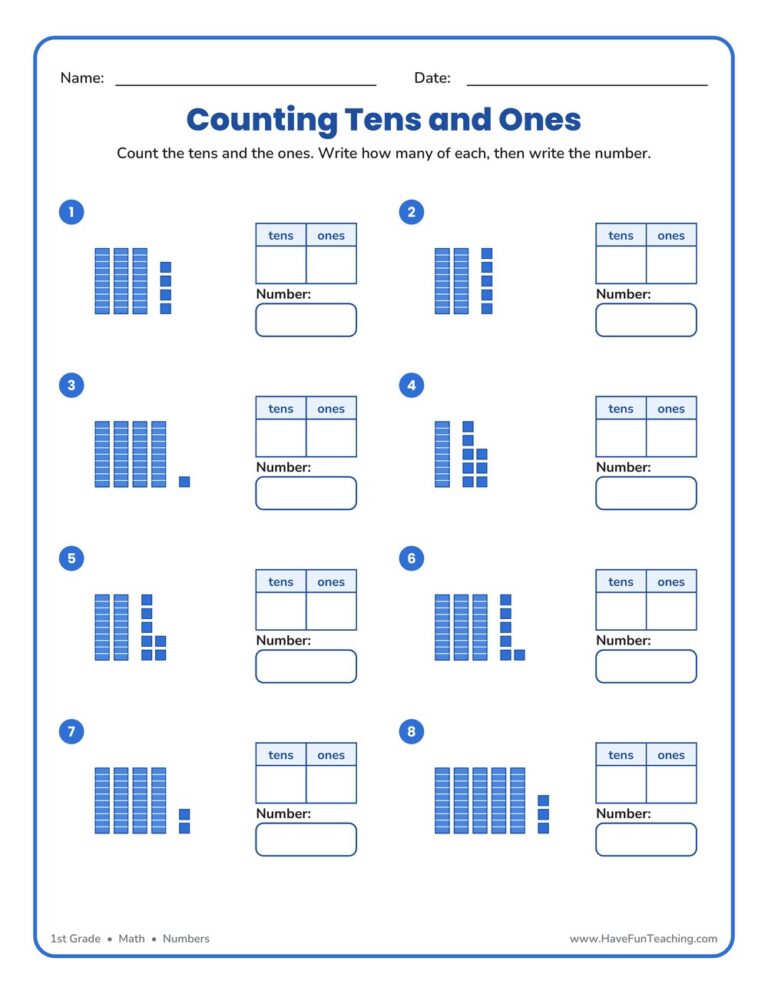
This Counting Tens Ones Worksheet helps first graders count base-ten blocks, record the tens and ones, and write each two-digit number. Includes a complete answer key for quick, no-prep place value practice at home or school.
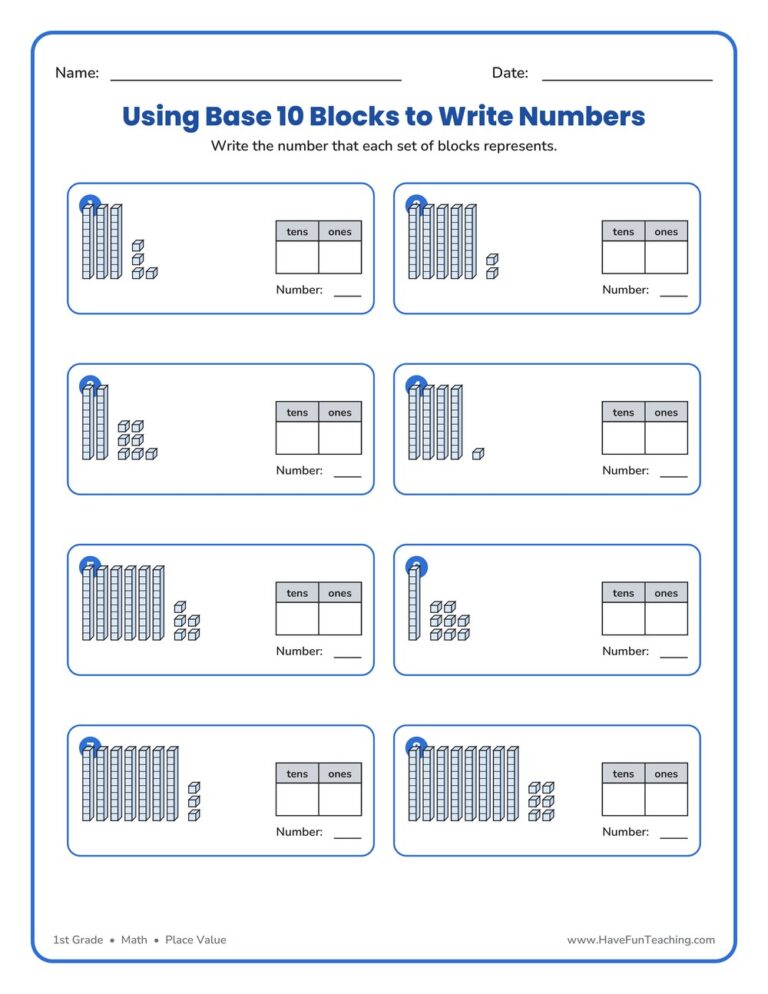
This Using Base 10 Blocks to Write Numbers Worksheet helps 1st graders count tens rods and ones cubes, then record each two-digit number in a place value chart. Includes an answer key for quick, no-prep practice.

This counting on to add worksheet helps 1st graders start from the bigger number and count forward on a number line to twenty. An answer key is included, so checking work takes seconds.

Using the Counting By Fives Song (Original Music Video), students practice skip counting by 5s by singing and counting along to this fun and engaging video!
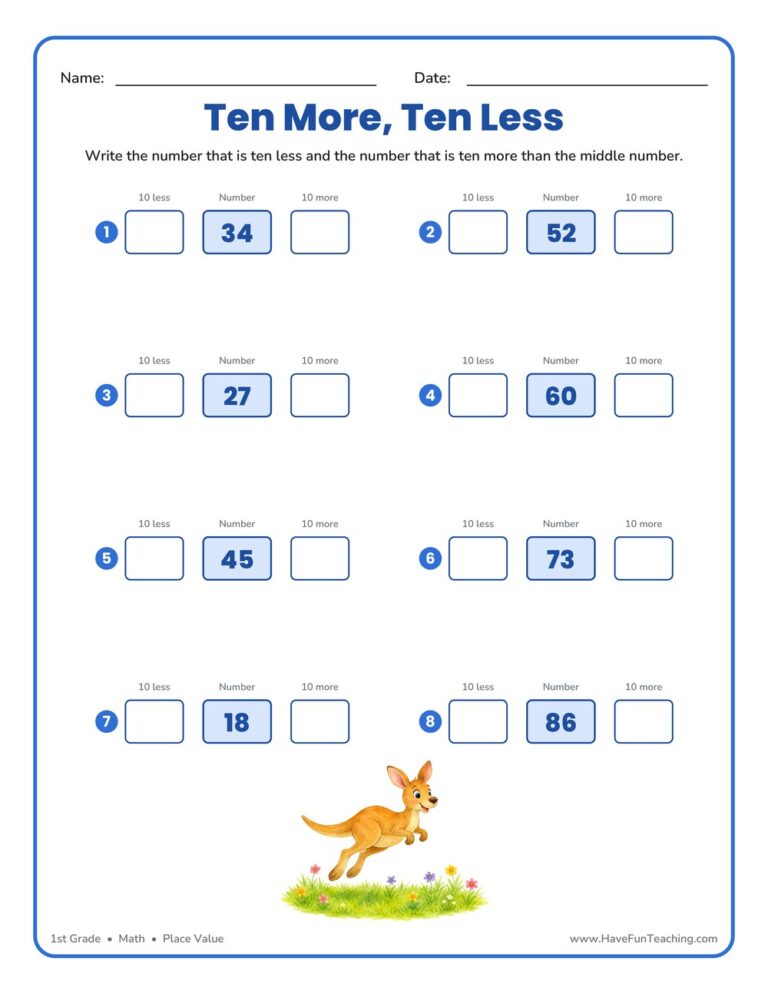
This Ten More Ten Less Worksheet gives 1st graders eight quick problems to find ten more and ten less than a two-digit number. Includes an answer key for fast, no-prep place value practice.
Using the Counting By Ones Song (Original Music Video), students practice counting by 1s by singing and counting along to this fun and engaging video!

Using the Counting By Twos Song (Original Music Video), students practice skip counting by 2s by singing and counting along to this fun and engaging video!

This finding the missing number worksheet gives first graders focused practice solving for the unknown number in addition and subtraction equations within 20. Includes an answer key — a quick, no-prep way to build number sense and fact fluency.

This counting back to subtract worksheet gives 1st graders number-line hops, six equations within 20, and a word problem, with an answer key included, so subtraction becomes a quick, confident count.
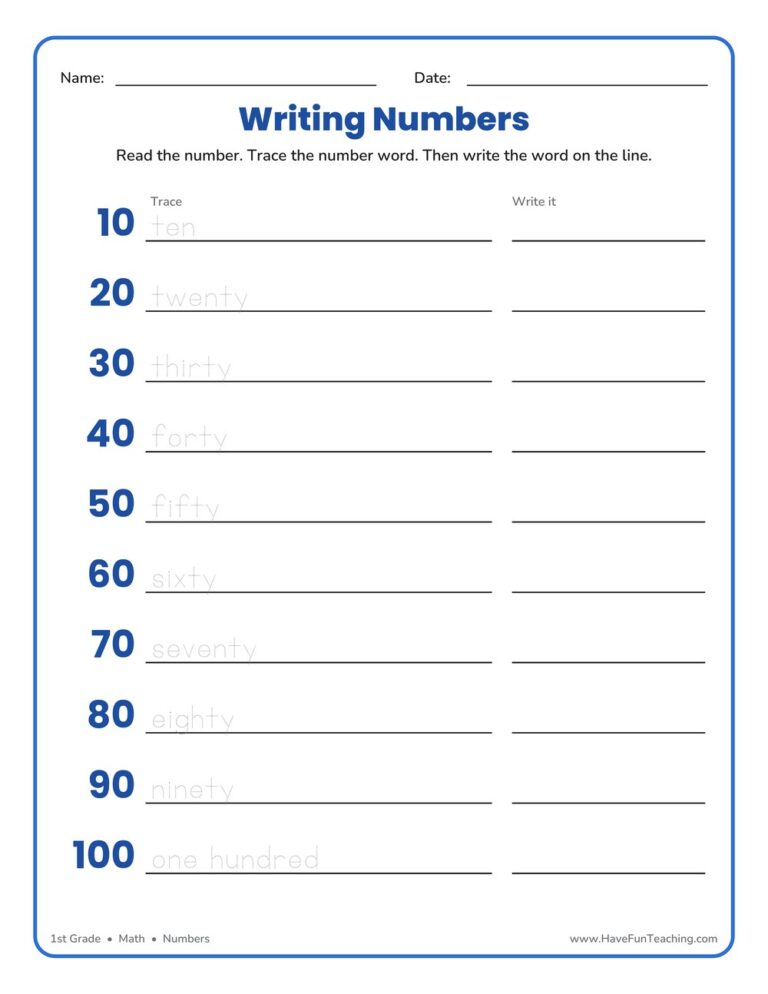
This Write Numbers to 100 Worksheet helps first graders trace and write number words from ten to one hundred while counting by tens. Answer key included — perfect for no-prep number word and handwriting practice.
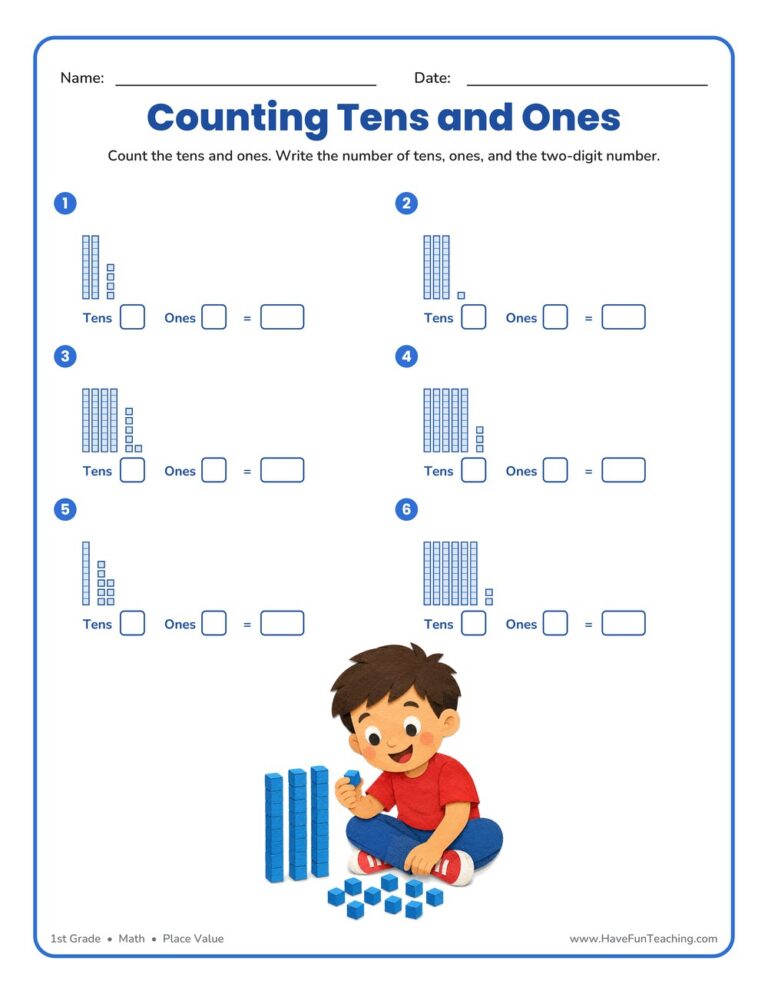
A first grade Counting Tens and Ones Worksheet where students count base ten blocks and write each two-digit number. Includes a complete answer key for easy, no-prep place value practice at home or school.

Reviews
There are no reviews yet