

Find the Number Pattern Worksheet
The Find the Number Pattern Worksheet gives 3rd graders nine sequences to extend or complete, plus a garden word problem with a table. Answer key included, so pattern practice is ready in one print.
$6.97
Or free with a membership — members pay $3.33/mo for all 10,000+ resources. See plans
Want this one free?
Tell us where to send it and it’s yours — no card, no catch.
One free resource per teacher. We’ll also send free teaching ideas each week — unsubscribe anytime.
Teaching is easier with a membership
Unlimited printables, games & videos for PreK–6th — for your classroom or homeschool. Cancel anytime.
Start your 3-day free trial$0 today · cancel anytime · Instant access to 10,000+ resources
About this resource
Description
Number patterns are one of the first places third graders discover that math is predictable. When students study a sequence like 4, 7, 10, 13 and notice that every number grows by the same amount, they are building the algebraic thinking that later shows up in multiplication facts, function tables, and equations. This Find the Number Pattern Worksheet gives students focused practice at spotting a rule, continuing a sequence, and putting that rule into their own words. Patterns can grow by adding, by subtracting, or by doubling, so children learn to test a sequence carefully instead of guessing from the first two numbers alone.
This 3rd grade patterns worksheet moves through three levels of thinking. In Part A, students extend five sequences by two numbers each and then write the rule they used. In Part B, the missing number sits in the middle of the sequence, so students have to work out the rule from the numbers on both sides before they can fill the gap. Part C closes with a real garden problem: Maya plants 6, 12, and 18 flowers in her first three rows, and students complete a table, name the rule, predict row six, and explain their reasoning in writing. Use it as morning work, as a small-group warm up, as homework, or as a quick check before a unit test.
What’s Included
- 1 print-ready PDF worksheet
- Answer key
- 9 number-pattern problems plus a table-and-explanation word problem
There are three big reasons this Find the Number Pattern Worksheet helps children learn. First, it asks students to name the rule, not just fill a blank, which turns a guessing game into real reasoning. Second, it mixes addition, subtraction, and doubling patterns so children cannot lean on a single strategy. Third, the written explanation at the end makes students defend their thinking in a sentence, which is exactly what state assessments ask third graders to do.
Teachers and parents can stretch this skill well beyond the page. Build a growing pattern with counters, blocks, or pennies and ask your child to predict the next row before they build it. Clap or stomp a repeating rhythm and have students translate it into numbers. Look for patterns in everyday life, such as the cost of buying several of the same snack, the number of wheels on a line of bicycles, or the seats in each row of a theater. Skip-counting songs are another easy way to hear a pattern before seeing it written down.
Related Resources
What teachers say
Reviews
You must be logged in to post a review.

In this Pattern Detective Activity, students play detective by generating a pattern that follows a given rule.

In this What is the Addition Subtraction Rule Worksheet, 3rd grade students find the hidden rule in six IN/OUT tables, complete each pattern, and solve two word problems. An answer key is included.
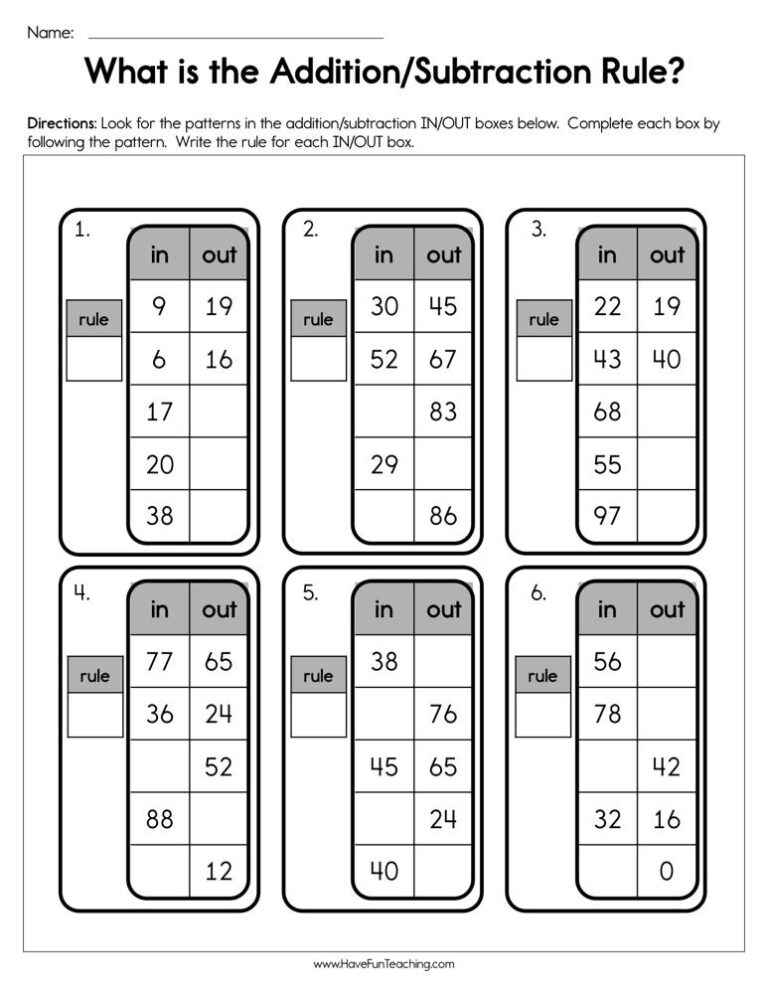
This Whats the Addition Subtraction Rule Worksheet gives 3rd graders six IN/OUT tables to solve, two word problems, and space to write each rule. An answer key is included.

This time patterns worksheet has 3rd grade students find the rule, draw missing clock hands, and write missing digital times. An answer key is included for quick, easy checking.

This Multiplication Division Rule Worksheet asks 3rd graders to find the rule in six IN and OUT tables, fill the missing number, and use a rule in two word problems. Answer key included.
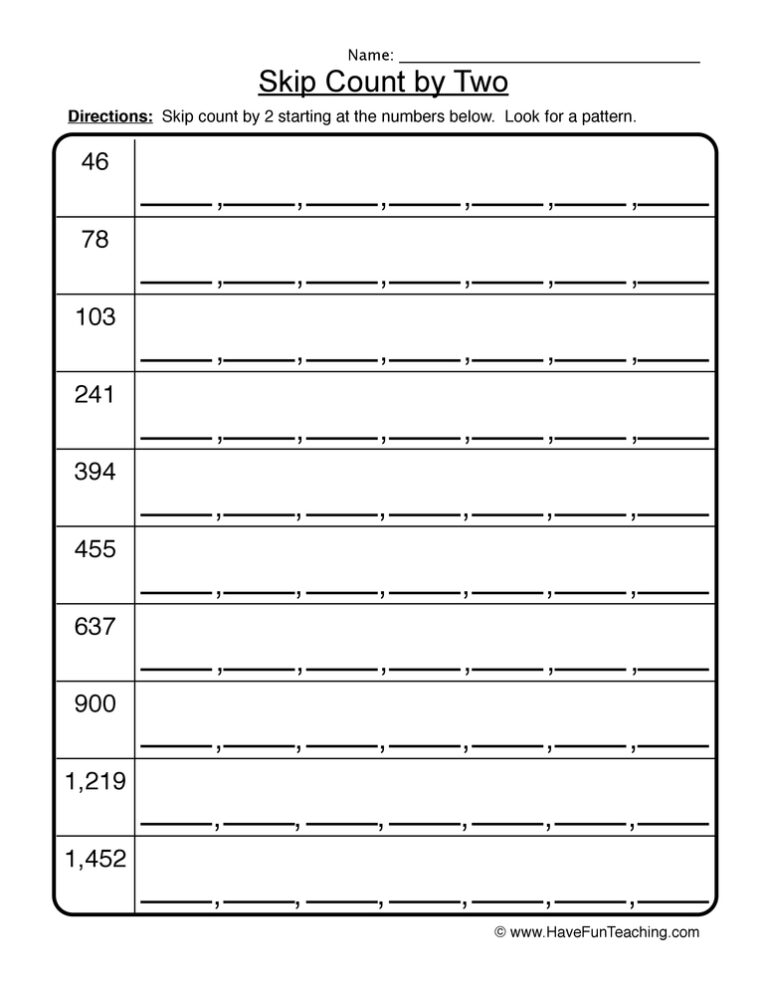
Using Skip Count by Two Worksheet, studentspractice skip-counting by 2s from any number to complete the pattern.
Using Pictures Patterns Worksheet, students identify the pattern and then complete the pattern by drawing the picture that comes next.
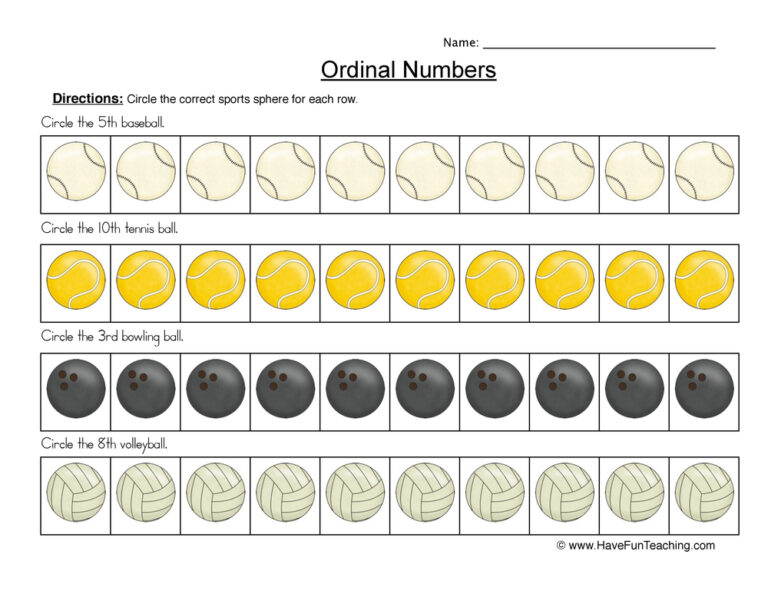
Using this Ordinal Numbers Worksheet, students circle the First, Second, Third, Fourth, and Fifth thing in each row.

Using Skip Count by Three Worksheet, studentspractice skip-counting by 3s from any number to complete the pattern.
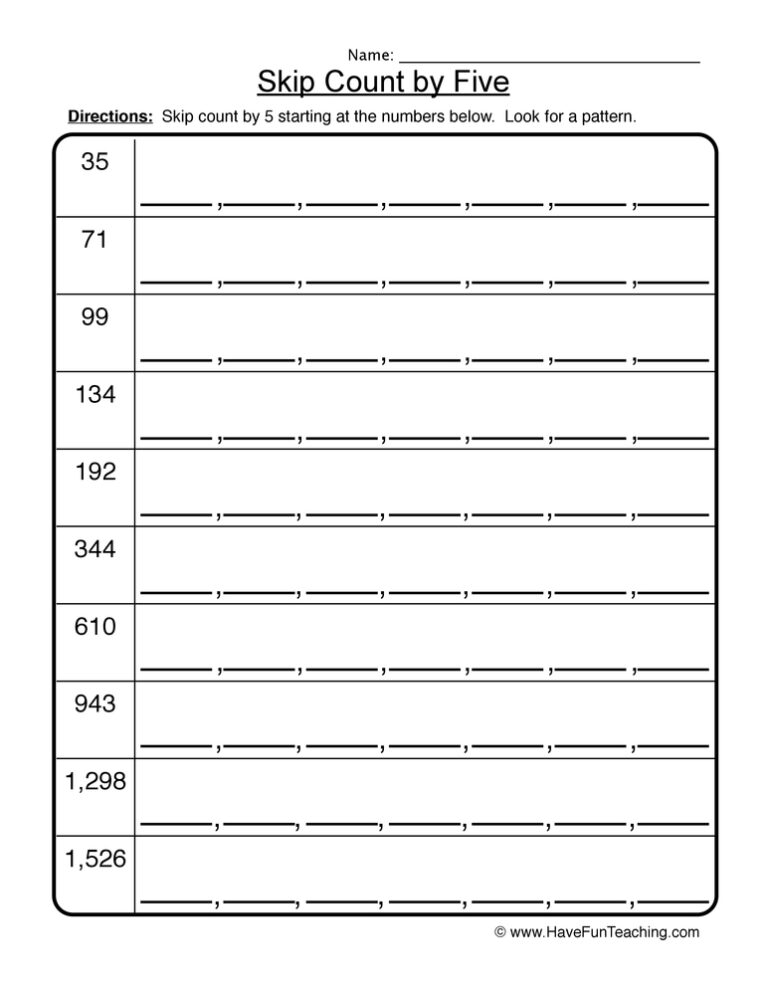
This Skip Count by Five worksheet has 3rd graders count on by fives from three-digit numbers and solve story problems, with an answer key included to make checking quick and easy.
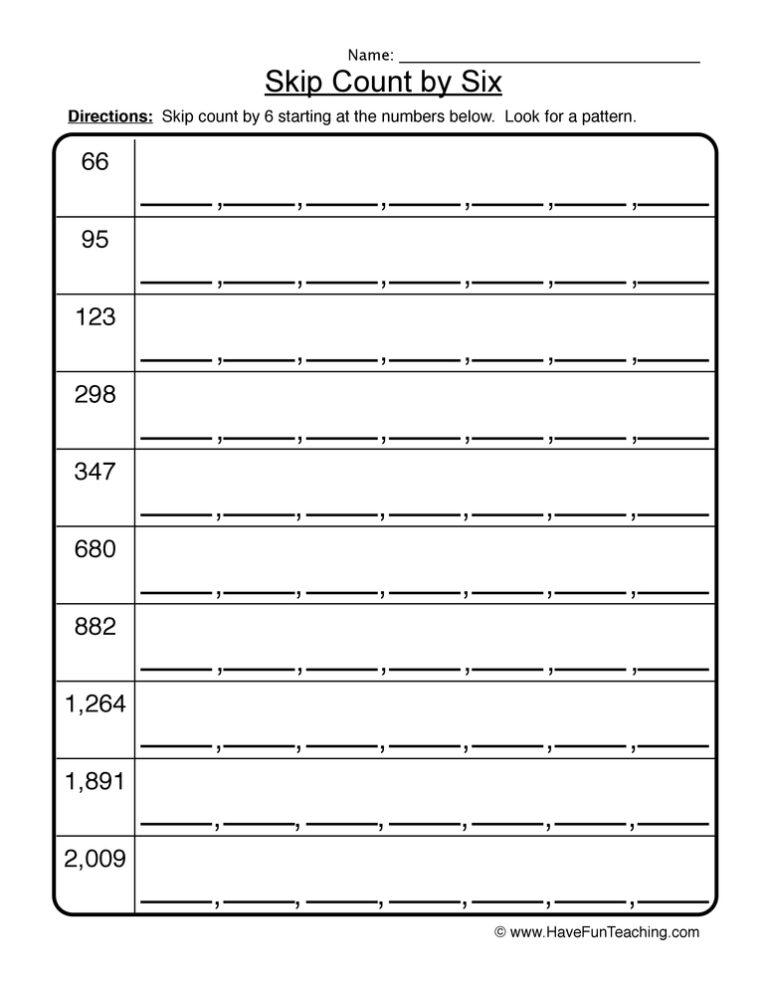
This skip count by six worksheet gives 3rd grade students practice finding missing numbers in +6 patterns and solving story problems. An answer key is included to make checking quick and easy.
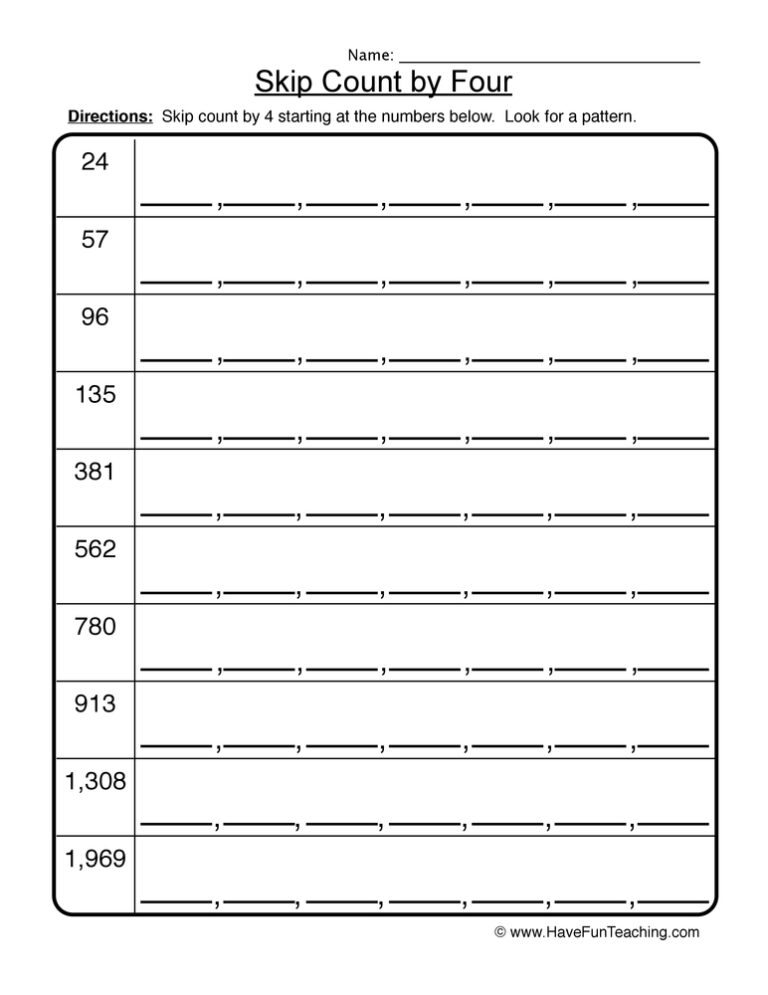
Using Skip Count by Four Worksheet, studentspractice skip-counting by 4s from any number to complete the pattern.




Reviews
There are no reviews yet