

Measuring Objects by Length Worksheet
A hands-on measuring objects by length worksheet where 1st graders count same-size units to measure a paintbrush, carrot, pencil, and feather, then compare them. Answer key included for fast, no-prep measurement practice.
$6.97
Want this one free?
Tell us where to send it and it’s yours — no card, no catch.
One free resource per teacher. We’ll also send free teaching ideas each week — unsubscribe anytime.
Free teacher account · no credit card
Membership
Get every game, song, & printable
- Every game, on any device
- 10,000+ printables
- Assign online with HFT Classroom
Then $39.97/year · cancel anytime · See plans
- Instant digital download
- Printable PDF + answer key
- Made by real teachers
Teacher / Family membership
Teaching is easier with every resource
One membership for your whole year: 10,000+ worksheets, games, songs and videos for Preschool–6th, for your classroom or homeschool.
- Unlimited printables & downloads
- Every game, on any device
- Assign online with HFT Classroom
- Cancel anytime
Teacher / Family membership · 3 days free
Yearly
Monthly would be $119.64 a year
$3.33/month
Billed $39.97 once a year
You save $79.67 every year
Start My 3 Free Days$0 today · cancel anytime
Monthly
$9.97/month
Flexible, month to month
Yearly is just $3.33/mo. Switch and save $79.67
Start My 3 Free Days$0 today · cancel anytime
About this resource
Description
Measuring objects by length is one of the first real measurement skills a young student ever practices, and it begins long before a ruler comes out of the drawer. Before children can read inches or centimeters, they learn to lay same-size units end to end along an object and count them. This Measuring Objects by Length Worksheet gives first graders that hands-on foundation: four familiar objects, each sitting above a strip of identical unit squares waiting to be counted. Learning to iterate a length unit with no gaps and no overlaps is exactly what first grade asks for, and it is the bridge to every standard measuring tool that follows.
In Part A of this 1st grade measurement worksheet, students look at a paintbrush, a carrot, a pencil, and a feather. Under each object is a row of same-size unit squares that stretches from one end of the object to the other. Children count the squares and write the number on the line to record how many units long each object is. Part B then asks them to use those four measurements to compare — how much longer one object is than another, and which object is the shortest of all. Everything a student needs sits on the page, so the sheet works equally well as morning work, a math-center task, homework, or a quick check before a measurement unit test.
What’s Included
- 1 print-ready PDF worksheet
- Answer key
- 4 measure-and-record picture cards with same-size unit strips
- 3 length-comparison questions
This measuring objects by length worksheet helps children learn in three ways. First, it makes the unit visible: because every square is exactly the same size and the squares touch with no gaps, students can see why counting units gives a true length. Second, it sets the ruler aside so attention stays on the idea of repeating a unit rather than on reading tiny marks. Third, the comparison questions in Part B push students past simple counting and into reasoning about difference, which is where measurement and early subtraction meet.
Teachers and parents can extend the skill easily. Hand children a small pile of identical objects — paper clips, snap cubes, pattern blocks, or craft sticks — and let them measure a shoe, a book, and the edge of a table, then record the results on a chart. Ask for a prediction first and check it after; a wrong guess is often the best lesson of the day. Try measuring one object with two different units, such as paper clips and then cubes, so students discover that a smaller unit gives a bigger number. Turn it into a scavenger hunt: find something that is exactly six cubes long. Once children measure confidently with same-size units, a real ruler feels like a shortcut instead of a mystery.
Related Resources
What teachers say
Reviews
You must be logged in to post a review.
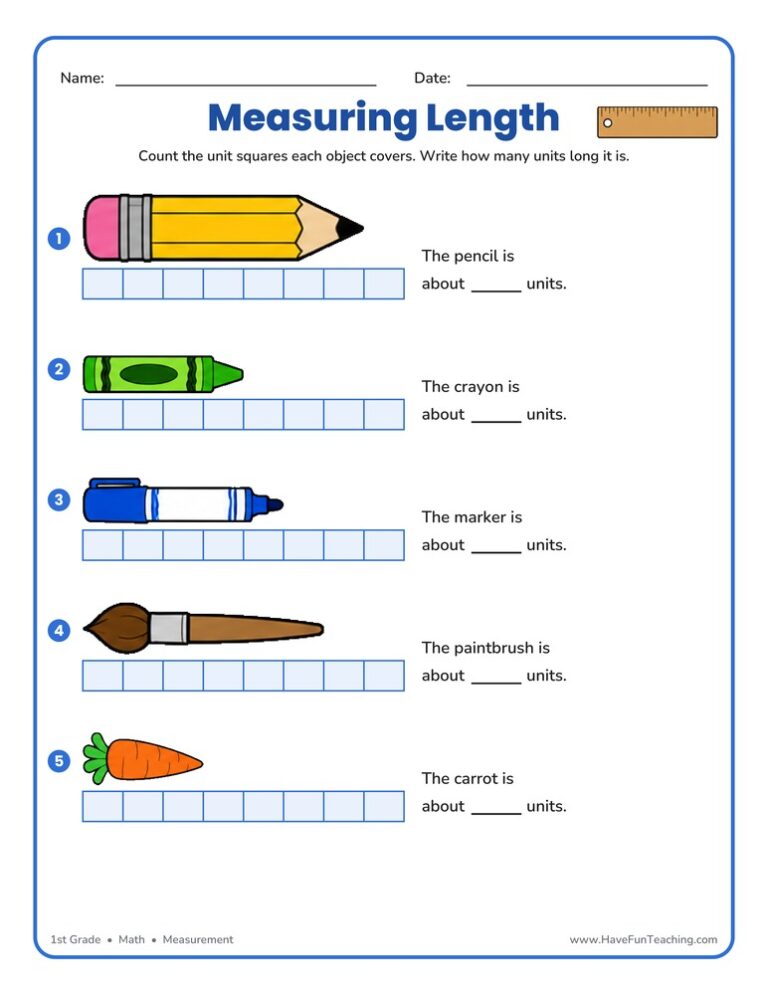
A hands-on measuring length worksheet where 1st graders count unit squares to measure a pencil, crayon, marker, paintbrush, and carrot. Includes a complete answer key — perfect for a no-prep introduction to measuring with units.
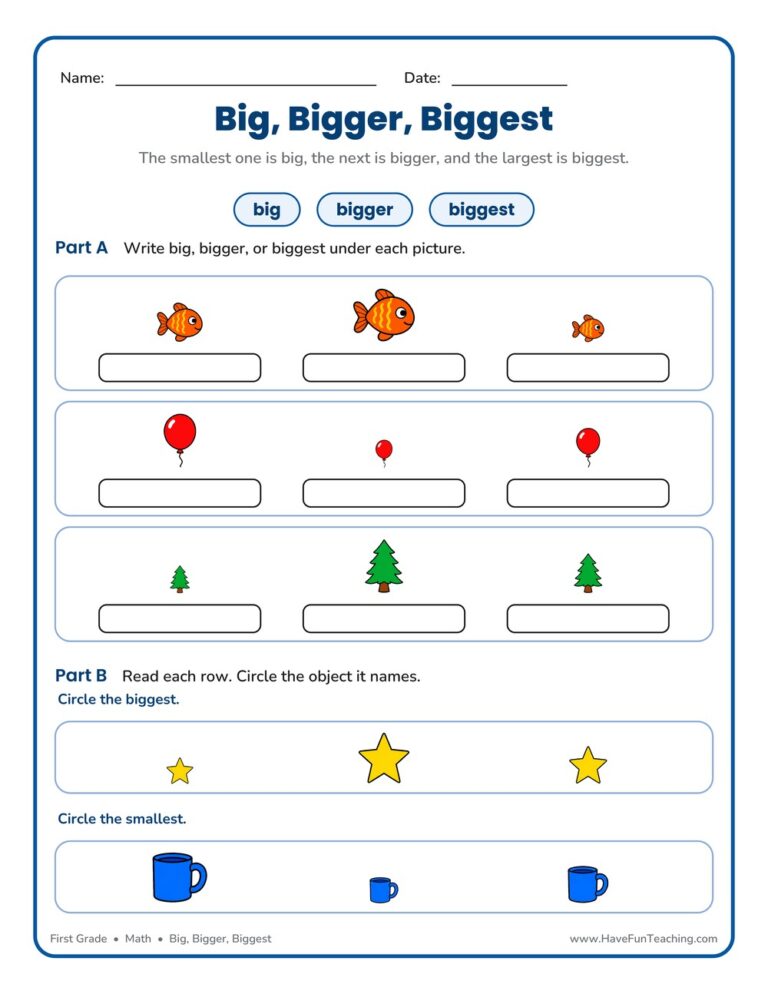
This Big, Bigger, Biggest Worksheet gives first grade students fun practice comparing objects by size, labeling big, bigger, and biggest and circling the biggest and smallest. An answer key is included to make learning simple.

The Using Length to Order Objects Worksheet gives first graders playful, picture-based practice ordering objects from shortest to longest and spotting the longest and shortest. Includes a complete answer key for fast, no-prep measurement practice.

This Comparing Sizes Worksheet has 1st graders compare pictures using taller, shorter, bigger, and smaller, then order three objects by length. An answer key is included, so it is ready for no-prep measurement practice.

A picture-based Shortest to Longest Worksheet where 1st graders order pencils, snakes, crayons, and carrots by length. Includes a complete answer key for quick, no-prep measurement practice at home or school.

This Ordering Objects by Length Worksheet has 1st graders rank pencils, ribbons, and carrots from shortest to longest, then compare objects with words. An answer key is included for quick, no-prep measurement practice.

This balance worksheet has 1st graders add the weights on level scales to find each missing number, plus a pumpkin word problem. An answer key is included, so addition practice is quick and easy.

This Measuring the Length of Objects Worksheet has 1st graders count same-size units to measure four everyday objects, then compare lengths. An answer key is included, so checking work takes seconds.

This comparing two lengths worksheet gives 1st Grade students four picture cards and a strip ordering task for practicing longer and shorter. An answer key is included, so children build real measurement sense in minutes.

Students line up paper cubes to find how long school objects are in this measuring with cubes activity for 1st to 3rd grade, with a practice page and answer key included.
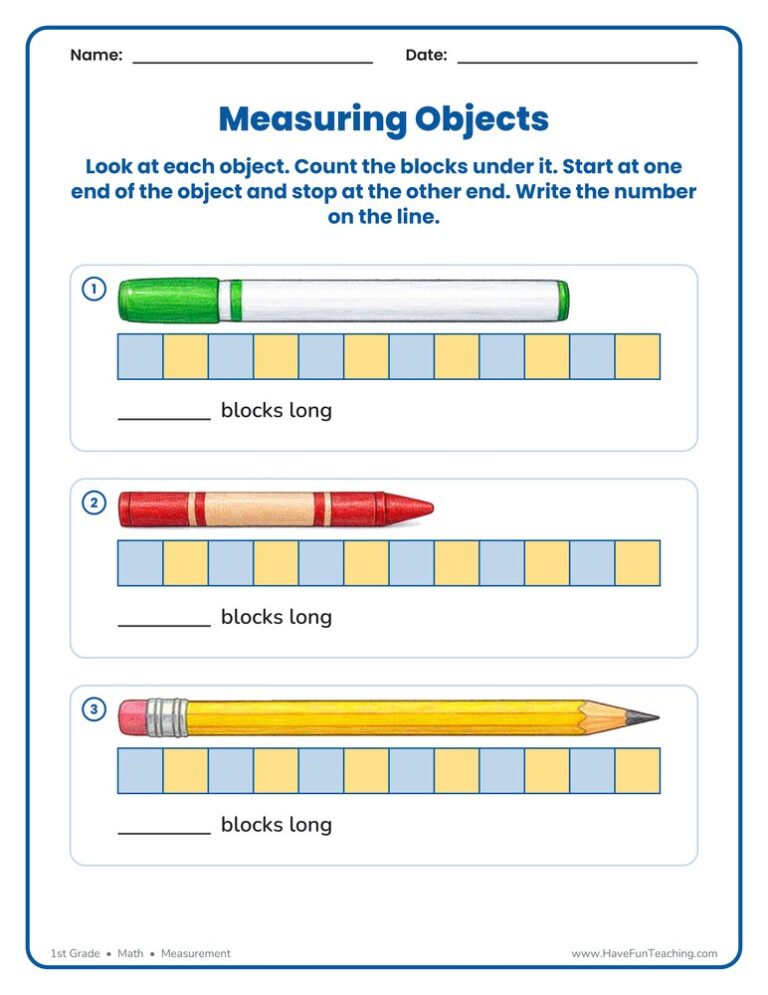
This measuring objects worksheet has 1st Grade students count unit blocks to find how long a marker, a crayon, and a pencil are. An answer key is included for quick checking and confident measuring.

This garden vegetables measuring activity has 1st and 2nd grade students measure true-size vegetable cards in inches and make a line plot. Answer key included.
Reviews
There are no reviews yet