
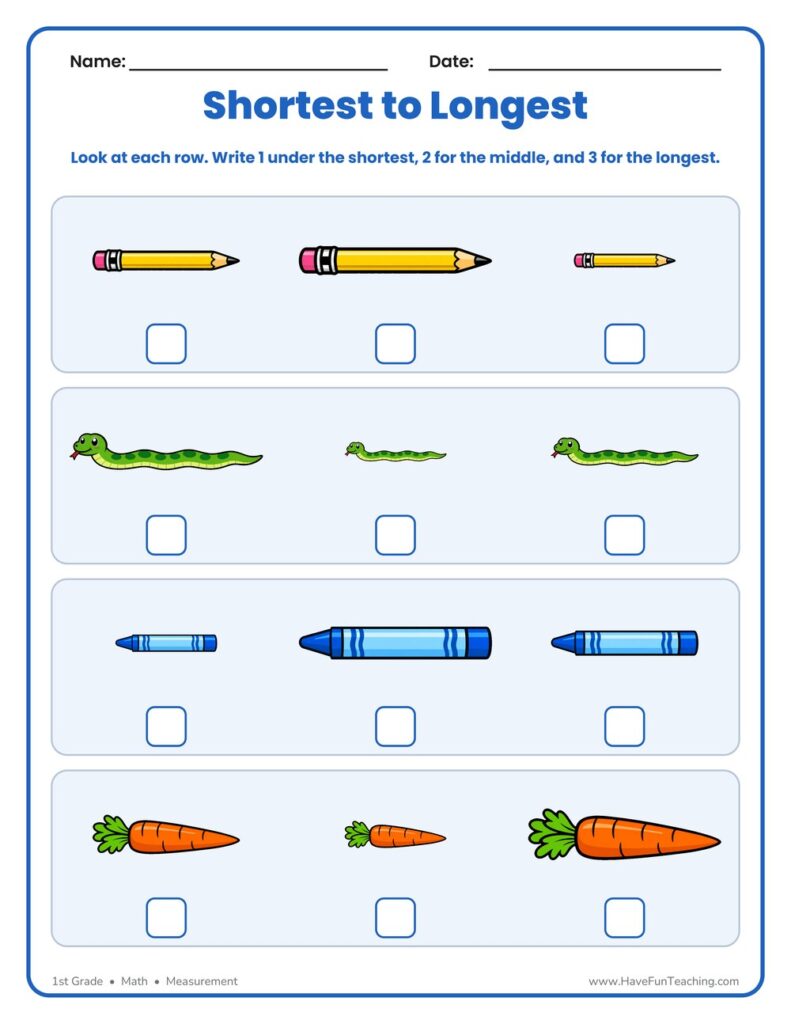
Shortest to Longest Worksheet
A picture-based Shortest to Longest Worksheet where 1st graders order pencils, snakes, crayons, and carrots by length. Includes a complete answer key for quick, no-prep measurement practice at home or school.
$6.97
Or free with a membership — members pay $3.33/mo for all 10,000+ resources. See plans
Want this one free?
Tell us where to send it and it’s yours — no card, no catch.
One free resource per teacher. We’ll also send free teaching ideas each week — unsubscribe anytime.
Teaching is easier with a membership
Unlimited printables, games & videos for PreK–6th — for your classroom or homeschool. Cancel anytime.
Start your 3-day free trial$0 today · cancel anytime · Instant access to 10,000+ resources
About this resource
Description
Comparing and ordering objects by length is one of the very first measurement skills young learners explore. This Shortest to Longest Worksheet invites first graders to look closely at familiar, everyday objects, like pencils, snakes, crayons, and carrots, and put them in order by length. Practicing this skill builds the careful visual comparison and reasoning children need long before they begin measuring with rulers and units.
This 1st grade measurement worksheet shows four rows, and each row has three of the same object drawn in three different lengths. Students study each row, decide which object is the shortest and which is the longest, and write 1, 2, and 3 in the boxes to put them in order from shortest to longest. Read the directions together, model the first row as a class, then let students finish on their own, and use the included answer key to check every response quickly.
What’s Included
- 1 print-ready PDF worksheet
- Answer key
- 4 ordering rows with bright, kid-friendly picture objects
This Shortest to Longest Worksheet helps children learn in three important ways. First, the picture-based format lets early learners compare lengths visually before they ever use numbers or measuring tools. Second, ordering three objects at once moves students beyond simple longer-or-shorter pairs and into real sequencing. Third, writing 1, 2, and 3 connects the idea of order to numbers children already know, reinforcing counting and measurement at the very same time.
Teachers and parents can bring this skill to life with hands-on play. Gather real objects, like spoons, toy cars, or wooden blocks, and have children line them up from shortest to longest on the table. Ask them to find the longest crayon in the box or the shortest book on the shelf. Encourage kids to use words like shorter, longer, and longest as they compare, building strong measurement vocabulary through simple, everyday conversation.
Related Resources
What teachers say
Reviews
You must be logged in to post a review.
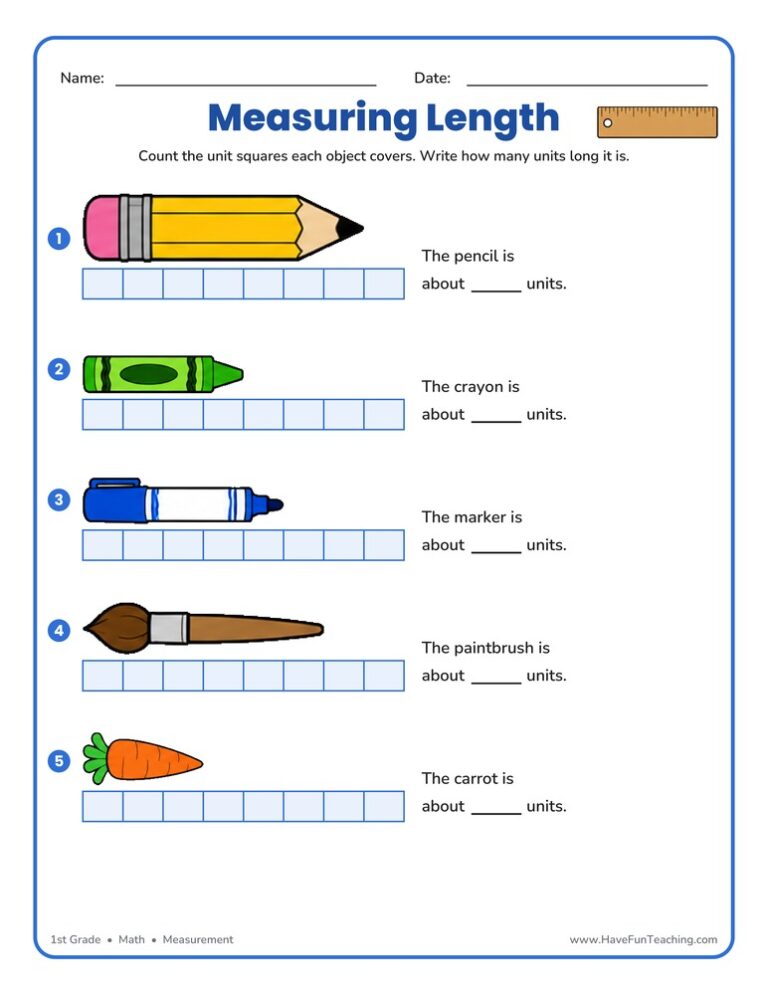
A hands-on measuring length worksheet where 1st graders count unit squares to measure a pencil, crayon, marker, paintbrush, and carrot. Includes a complete answer key — perfect for a no-prep introduction to measuring with units.
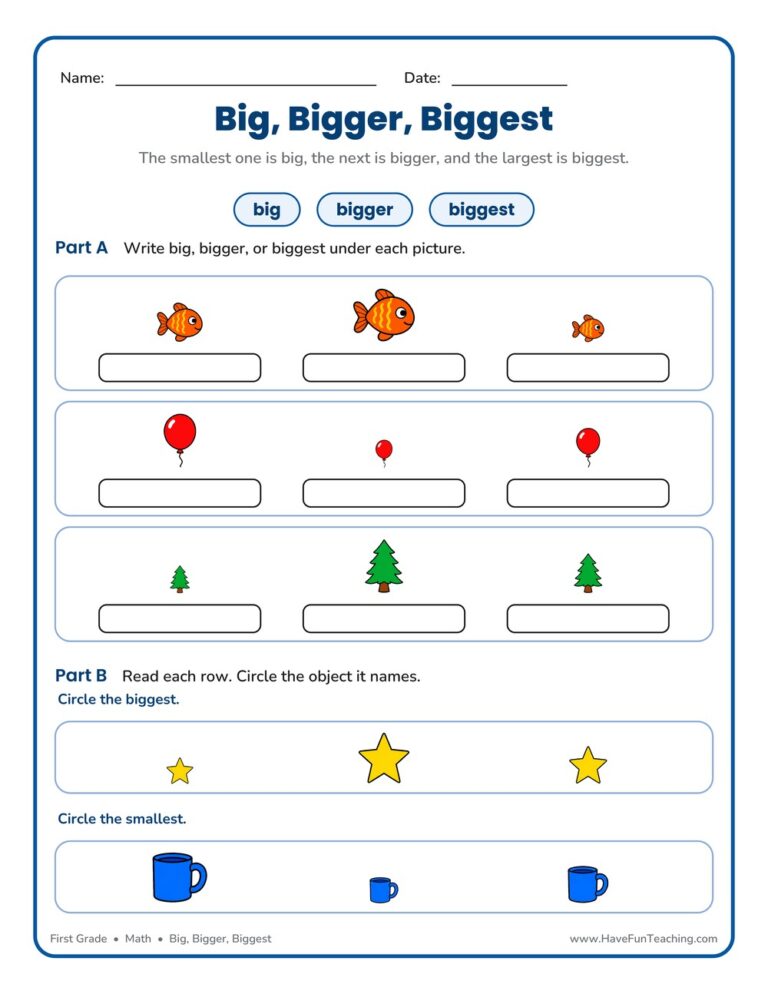
This Big, Bigger, Biggest Worksheet gives first grade students fun practice comparing objects by size, labeling big, bigger, and biggest and circling the biggest and smallest. An answer key is included to make learning simple.

This Ordering Objects by Length Worksheet has 1st graders rank pencils, ribbons, and carrots from shortest to longest, then compare objects with words. An answer key is included for quick, no-prep measurement practice.

This Measuring the Length of Objects Worksheet has 1st graders count same-size units to measure four everyday objects, then compare lengths. An answer key is included, so checking work takes seconds.

The Using Length to Order Objects Worksheet gives first graders playful, picture-based practice ordering objects from shortest to longest and spotting the longest and shortest. Includes a complete answer key for fast, no-prep measurement practice.
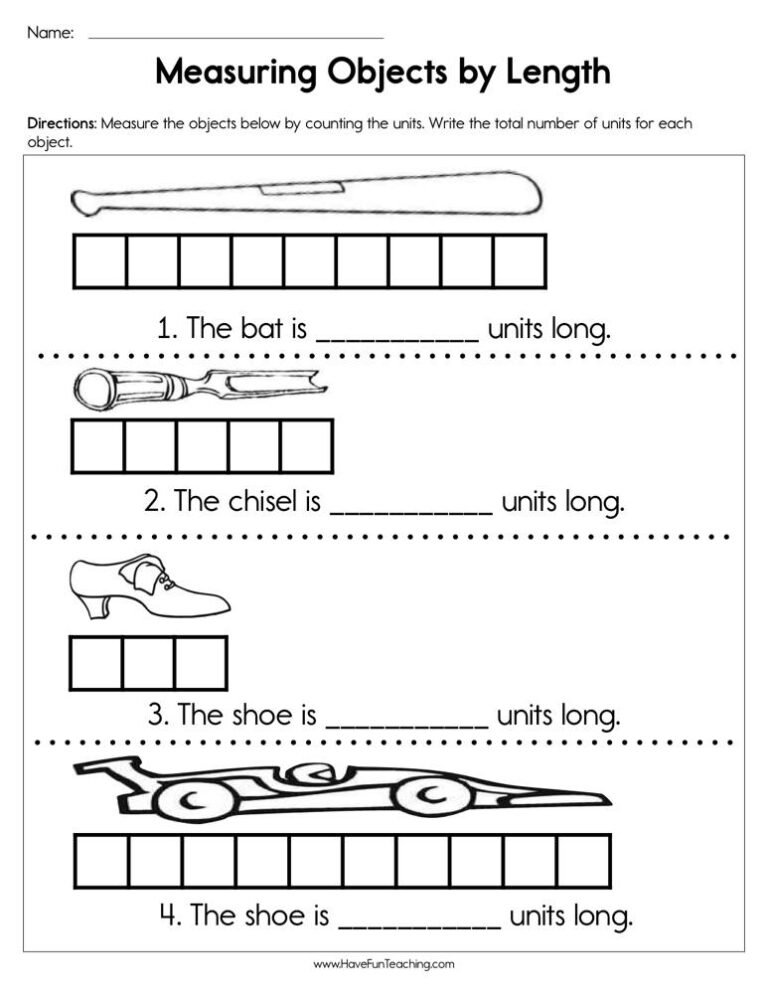
A hands-on measuring objects by length worksheet where 1st graders count same-size units to measure a paintbrush, carrot, pencil, and feather, then compare them. Answer key included for fast, no-prep measurement practice.

This Comparing Sizes Worksheet has 1st graders compare pictures using taller, shorter, bigger, and smaller, then order three objects by length. An answer key is included, so it is ready for no-prep measurement practice.

This comparing measurement worksheet gives 1st grade students four picture cards and three sentences to finish using taller, heavier, bigger and lighter. An answer key is included, so checking work takes seconds.

Using this Units of Measurement Inches Centimeters Activity, students measure the length of an object twice using length units of different lengths for the two measurements.

This comparing two lengths worksheet gives 1st Grade students four picture cards and a strip ordering task for practicing longer and shorter. An answer key is included, so children build real measurement sense in minutes.

This balance worksheet has 1st graders add the weights on level scales to find each missing number, plus a pumpkin word problem. An answer key is included, so addition practice is quick and easy.
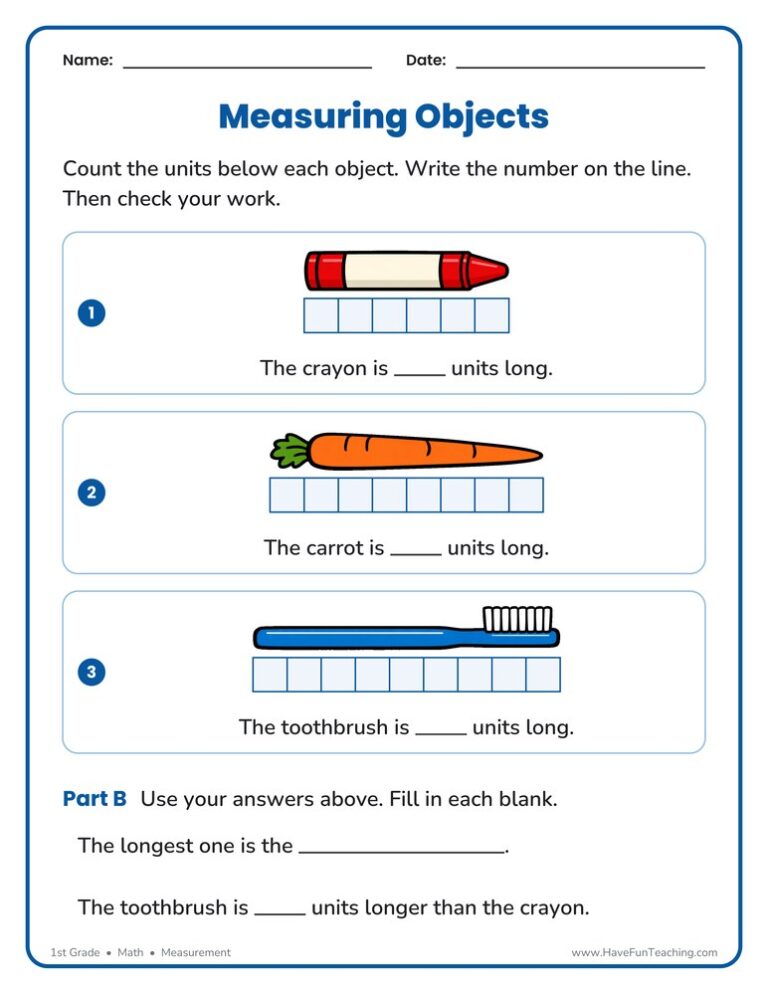
This 1.MD.2 Common Core Worksheet has 1st graders measure a crayon, a carrot, and a toothbrush by counting same-size units, then compare the lengths. Answer key included for fast, no-prep measurement practice.
Reviews
There are no reviews yet