
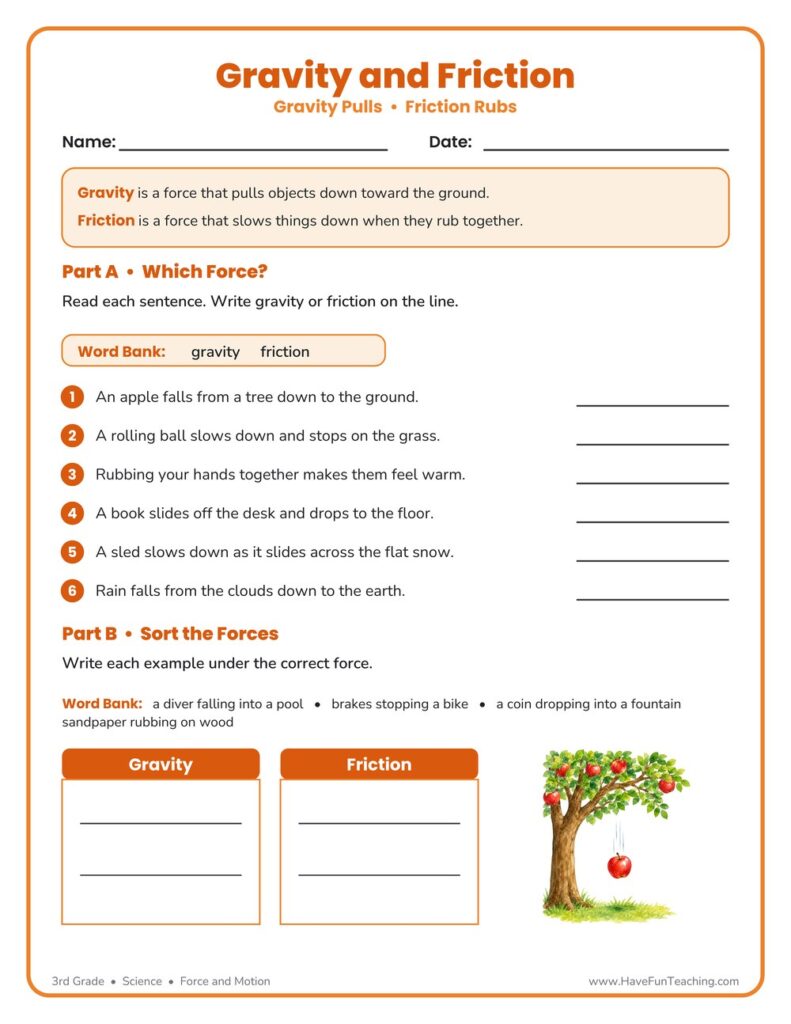
Gravity or Friction Force Worksheet
This Gravity or Friction Force Worksheet helps 3rd grade students tell the difference between gravity and friction by identifying and sorting real-life examples. Includes a complete answer key for quick, no-prep science practice.
$6.97
Want this one free?
Tell us where to send it and it’s yours — no card, no catch.
One free resource per teacher. We’ll also send free teaching ideas each week — unsubscribe anytime.
Free teacher account · no credit card
Membership
Get every game, song, & printable
- Every game, on any device
- 10,000+ printables
- Assign online with HFT Classroom
Then $39.97/year · cancel anytime · See plans
- Instant digital download
- Printable PDF + answer key
- Made by real teachers
Teacher / Family membership
Teaching is easier with every resource
One membership for your whole year: 10,000+ worksheets, games, songs and videos for Preschool–6th, for your classroom or homeschool.
- Unlimited printables & downloads
- Every game, on any device
- Assign online with HFT Classroom
- Cancel anytime
Teacher / Family membership · 3 days free
Yearly
Monthly would be $119.64 a year
$3.33/month
Billed $39.97 once a year
You save $79.67 every year
Start My 3 Free Days$0 today · cancel anytime
Monthly
$9.97/month
Flexible, month to month
Yearly is just $3.33/mo. Switch and save $79.67
Start My 3 Free Days$0 today · cancel anytime
About this resource
Description
Gravity and friction are two forces kids experience every single day, from an apple dropping off a table to a bike slowing to a stop. This Gravity or Friction Force Worksheet helps 3rd grade students understand the difference between a pulling force and a rubbing force. Gravity is the force that pulls objects down toward the ground, while friction is the force that slows things down when two surfaces rub together. Learning to spot each force in real-life examples builds a strong foundation in physical science.
This 3rd grade force worksheet gives students clear, kid-friendly definitions and then puts them to work. In Part A, children read six everyday sentences and decide whether each one shows gravity or friction. In Part B, they sort more examples into a two-column chart. Use it as independent practice, a science center activity, homework, or a quick review before a force and motion unit test. The included answer key makes checking work fast and easy.
What’s Included
- 1 print-ready PDF worksheet
- Answer key
- 2 activities: identify the force (6 items) and sort examples into a gravity or friction chart
There are three big reasons this Gravity or Friction Force Worksheet helps children learn. First, it connects an abstract science idea to concrete, familiar examples, so kids remember what each force actually does. Second, the two different activity types—identifying and sorting—give students more than one way to show what they know. Third, the clean layout and simple language keep young learners focused on the concept instead of decoding dense text.
Teachers and parents can extend the lesson in fun, hands-on ways. Try a “force hunt” around the classroom or house, naming whether each action uses gravity or friction. Roll a toy car across carpet and then across a smooth floor to feel how friction changes its speed. Drop a soft ball to watch gravity in action. Pairing movement with the worksheet helps the vocabulary stick.
Related Resources
What teachers say
Reviews
You must be logged in to post a review.
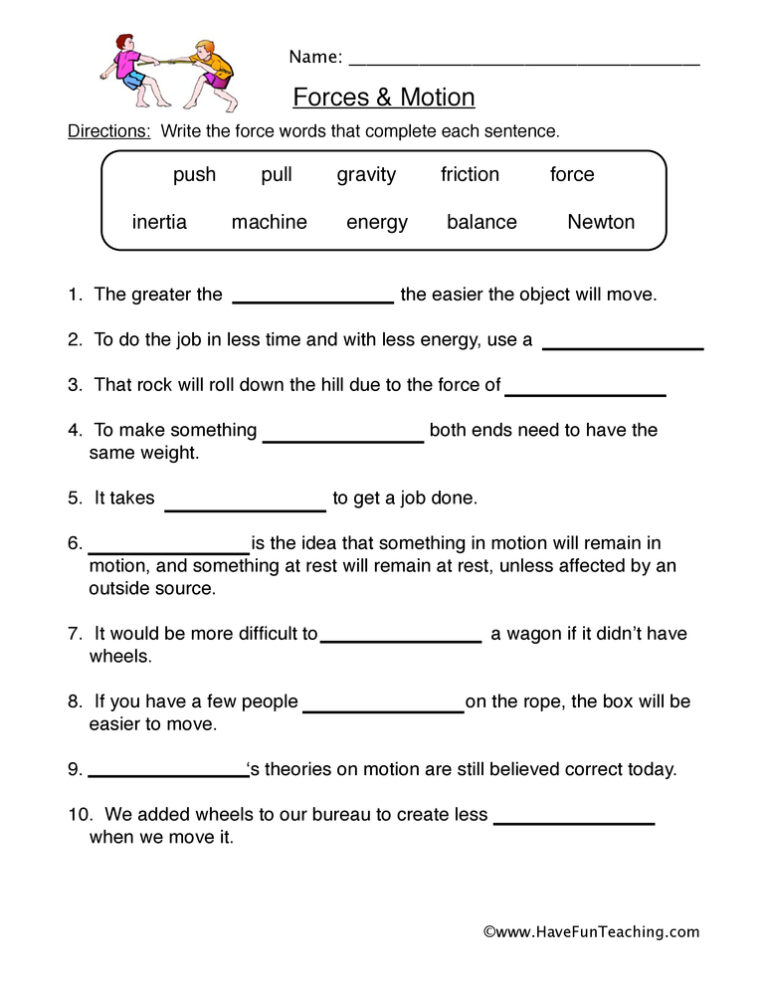
A 3rd grade forces motion worksheet where students use a word bank to complete eight sentences about force, push, pull, gravity, friction, motion, speed, and magnets. Includes an answer key for easy, no-prep science practice.
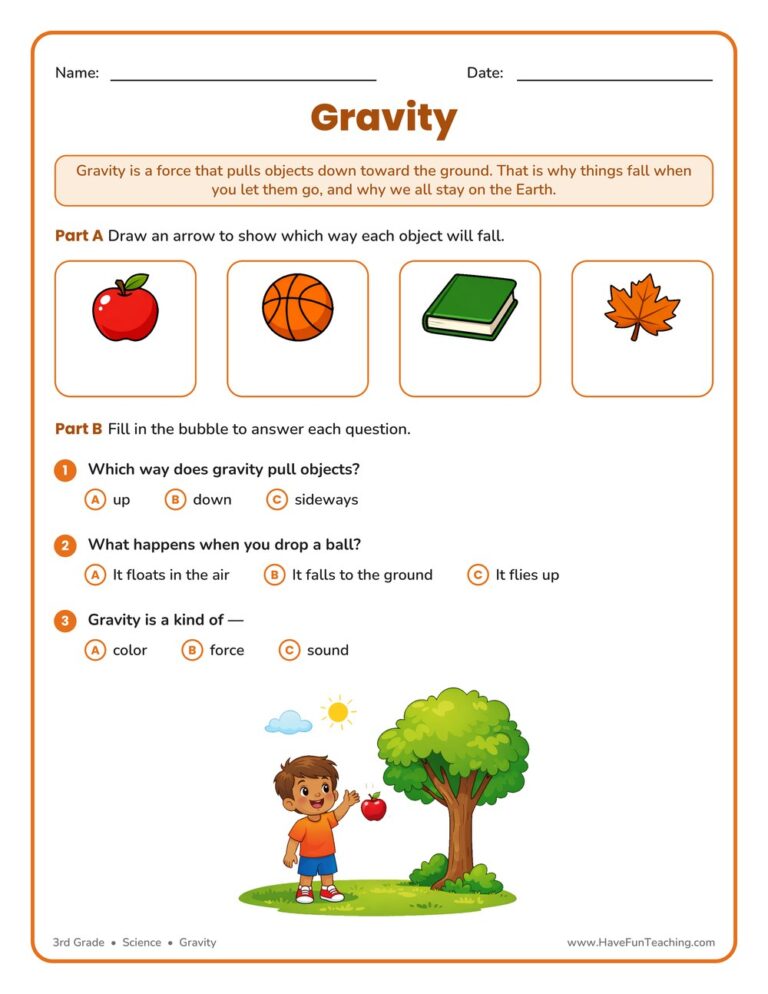
This falling gravity worksheet helps 3rd graders show which way objects fall and explain how gravity pulls things down. Answer key included — a quick, no-prep way to practice force and motion at home or in class.
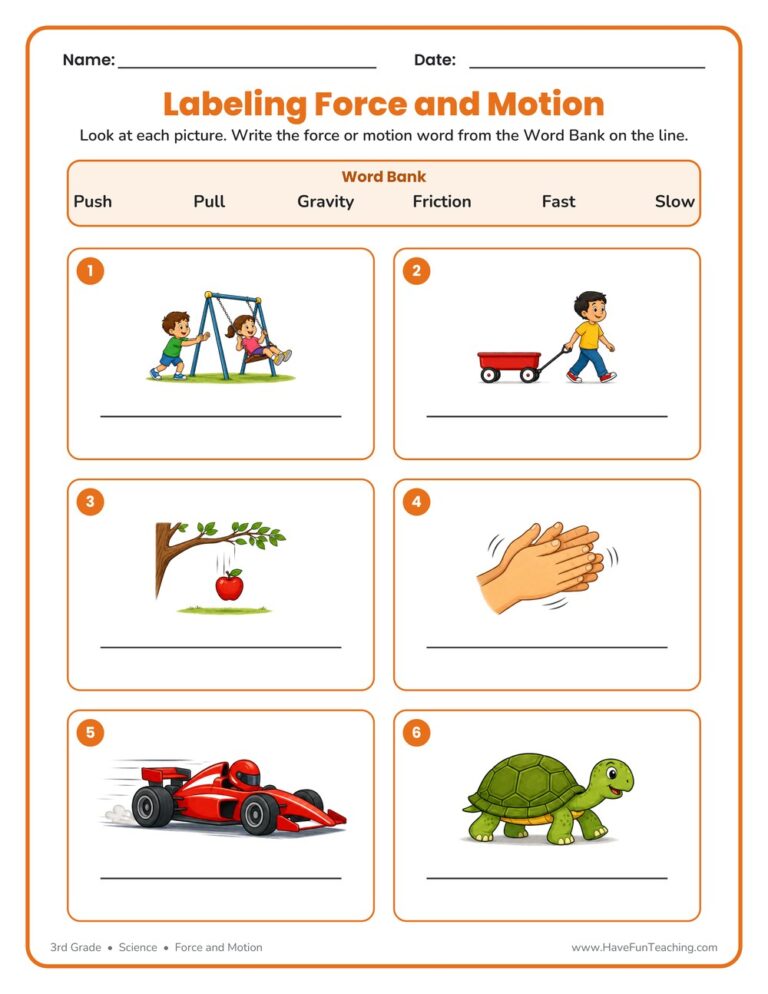
The Labeling Force and Motion Worksheet has 3rd graders label six pictures with push, pull, gravity, friction, fast, and slow from a word bank. Includes an answer key for easy, no-prep science practice.

This Fall Faster Gravity Worksheet asks 3rd graders to predict which dropped object lands first and to explain why, using gravity and air resistance. Answer key included for fast, no-prep science practice.
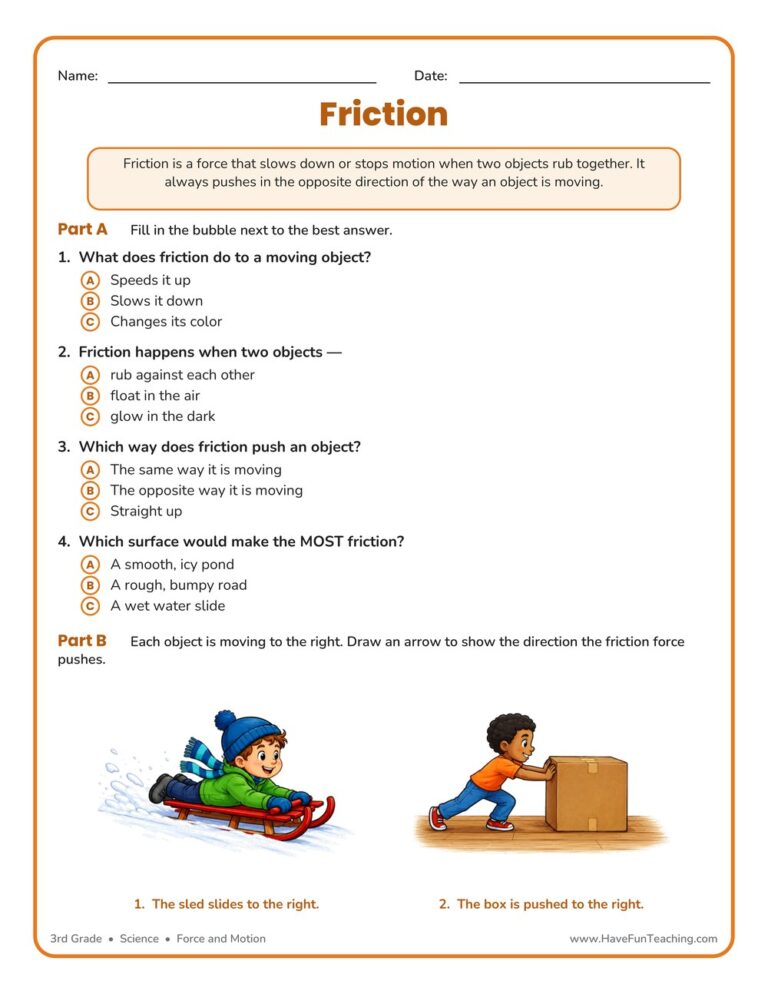
This drawing friction worksheet lets 3rd graders explore force and motion by answering questions and drawing arrows to show which way friction pushes. Answer key included for quick, no-prep science practice.

A magnetism worksheet for 3rd grade: sort eight classroom objects by whether a magnet attracts them, then find the magnetic object in four sentences. Answer key included for no-prep science practice.

This Friction Worksheet asks 3rd grade students to name the sliding, rolling, or fluid friction shown in six pictures, then explain one of them. An answer key is included, so checking work takes seconds.

This fields and poles magnets worksheet has 3rd Grade students name the poles and field of a magnet, predict a push or a pull, and explain how a compass works. An answer key is included.

This friction drawing worksheet sends 3rd graders hunting for four real places where surfaces rub together. They sketch each one and write about it, turning an abstract force into something they can point to.

This magnet activity has kindergarten to 3rd grade students sort picture cards into things a magnet will pull and things it will not, with a sorting mat, practice page and answer key.

This man and fuel powered worksheet asks 3rd graders to sort eight machines into people powered and fuel powered columns, then explain four more in writing. Answer key included for a no prep science lesson.

Post these force and motion word wall flash cards for 2nd to 5th grade: 16 science words with kid-friendly meanings, plus a vocabulary practice page, answer key included.
Reviews
There are no reviews yet