
Skip to content
Start My 3 Free Days $0 today · cancel anytime

Clocks Activities

14 clocks activities. Teacher favorites: Telling Time Activity and Bee on Time to the Hour Activity. How teachers use these

Clocks Activities

14 clocks activities. Teacher favorites: Telling Time Activity and Bee on Time to the Hour Activity. How teachers use these

Activity
Activity1st GradeTelling Time Activity

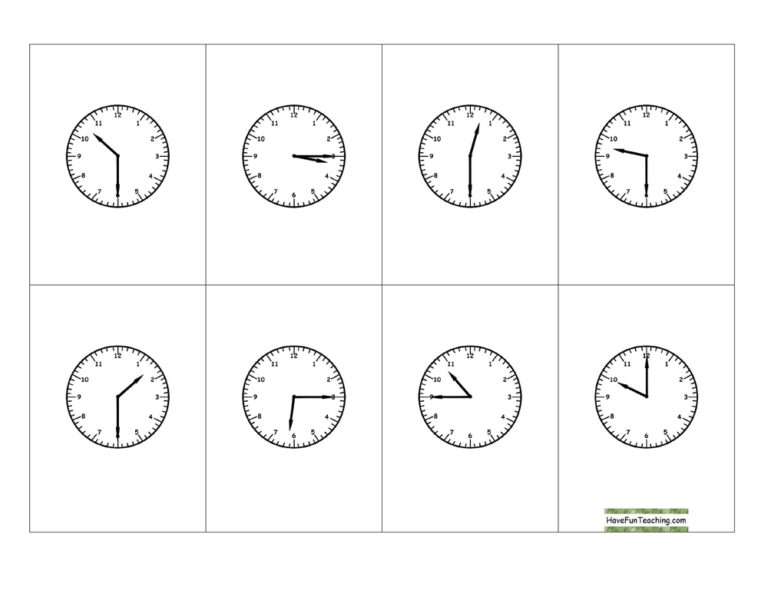
Read analog clocks to the hour, half hour and quarter hour with leveled clock task cards, a recording sheet and a draw-the-hands practice page for 1st and 2nd grade. An answer key is included.

Activity
Activity1st GradeBee on Time to the Hour Activity

This Bee on Time to the Hour activity is a memory match game where 1st and 2nd Grade students pair clock cards with honeycomb time cards. Answer key included.

Activity
Activity1st GradeTelling Time Half Hour Clock BINGO

This telling time half hour clock BINGO activity has 1st and 2nd grade children read analog clocks to the hour and half hour on 12 boards. Answer key included.

Activity
Activity1st GradeTelling Time Hour Clock BINGO

This telling time hour clock bingo activity helps 1st to 3rd grade students read analog clocks to the hour with six BINGO boards and caller cards, answer key included.

Activity
Activity2nd GradeWhat Time Is It to 5 Minutes Activity

This what time is it to 5 minutes activity lets 2nd and 3rd grade students match analog clocks to digital times in a domino circle game. Answer key included for easy checking.

Activity
Activity1st GradeTelling Time To The Hour Clock Activity

This telling time to the hour clock activity lets 1st and 2nd Grade students match analog clocks to fiesta event cards for a Cinco de Mayo schedule. Answer key included.

Activity
Activity3rd GradeTime in the Kitchen Time Intervals Activity

In this time in the kitchen time intervals activity, 3rd-4th grade students solve elapsed time recipe problems and match each answer to an analog clock. Answer key included.

Activity
Activity1st Grade1.MD.3 Common Core Activity

This 1.MD.3 Common Core Activity teaches students about how to read a clock to the hour and half hour through this matching activity.

Activity
Activity1st GradeTelling Time To The Half Hour Clock Activity

Using this Telling Time To The Half Hour Clock Activity, students practice telling time to the half hour on an analog clock.

Activity
Activity1st GradeTime for Sunshine To The Hour Clock Activity

This time for sunshine to the hour clock activity lets 1st and 2nd Grade kids match sun clocks to digital times on self-checking puzzles. Answer key included.

Activity
ActivityKindergartenIt's Time For Fun To The Hour Clock Activity

Kids match clocks with hands to digital times in the It's Time For Fun To The Hour Clock Activity for Kindergarten and 1st Grade. Answer key included.

Activity
ActivityKindergartenTime for Sunshine To The Half Hour Clock Activity

Using this Time for Sunshine To The Half Hour Clock Activity , students practice telling time to the half hour on an analog clock.

Activity
Activity2nd GradeTelling Time Quarter Hour Clock BINGO

Using this Telling Time Quarter Hour Clock BINGO, students practice telling time to the quarter hour on an analog clock.

Activity
ActivityKindergartenSpin It to Win It Telling Time Activity

Using this Spin It to Win It Telling Time Activity, students Play “Hour Power” and “Minute It To Win It” to begin learning about the basic parts of a clock.

From our teachers' playbook

Tick tock, read the clock!

What do kids learn about clocks?

Reading a clock builds step by step. First graders tell time to the hour and half hour, learning that the short hand shows the hour and the long hand shows the minutes: 3:30 = half past three. Second graders read time to the nearest five minutes by skip counting around the clock and learn a.m. and p.m. Third graders tell time to the minute and solve elapsed time problems, like how long recess lasts. The click moment comes when a child glances at the classroom clock and announces "Ten more minutes until lunch!"

Our favorite ways to teach telling time

Analog clocks can be confusing. These moves break it into easy steps.

Hands-on clocks

Give every child a clock with movable hands. Call out a time and have them show it, then check with a partner. Start with only the hour hand so kids learn to read it first, then add the minute hand.

Why it works: going from real objects to pictures to symbols is a core recommendation of the U.S. Department of Education's elementary math guide.

Telling Time ActivityTry it withTelling Time ActivityActivitiesOpen it →
Hour then half hour

Show clocks at 2:00 and 2:30 side by side and talk about what changed. The minute hand moved halfway around, and the hour hand moved halfway to 3. Noticing the hour hand move is what prevents classic mistakes.

Why it works: children learn more from words and pictures together than from words alone (Mayer, 2009).

Telling Time To The Half Hour WorksheetTry it withTelling Time To The Half Hour WorksheetWorksheetsOpen it →

Elapsed time stories

Mix elapsed time word problems into daily practice, using real class times: "Art starts at 10:15 and lasts 45 minutes. When does it end?" Draw a number line timeline to jump by hours and minutes.

Why it works: shuffled practice teaches kids to choose the right strategy, not just repeat one, and it improved test scores in research (Rohrer and Taylor, 2007).

Elapsed Time Word Problem Solving WorksheetTry it withElapsed Time Word Problem Solving WorksheetWorksheetsOpen it →

Questions parents and teachers ask us

What age do kids learn to tell time?

Most kids learn to tell time to the hour and half hour in 1st grade (around age 6 or 7), to five minutes in 2nd grade, and to the minute in 3rd grade.

How do I teach my child to read a clock?

Start with the hour hand only. Then add the minute hand and practice counting by fives around the clock. Ask "What time is it?" often during the day.

What is elapsed time?

Elapsed time is how much time passes between a start time and an end time. For example, from 2:00 to 2:45 is 45 minutes. Third graders solve elapsed time problems.

Why do kids still need analog clocks?

Analog clocks help kids understand time as a measure that moves, and they connect to fractions like half past and quarter past. They also appear on tests and in many classrooms.



