Skip to content
Start My 3 Free Days $0 today · cancel anytime

Magnets Resources

11 magnets resources: 9 worksheets, 3 activities and 1 lesson plan. How teachers use these

Magnets Resources

11 magnets resources: 9 worksheets, 3 activities and 1 lesson plan. How teachers use these

Lesson Plan
Lesson Plan3rd GradeMagnets Lesson Plan

Materials available in this Magnets Lesson Plan include two Magnet Activities and four Magnet Worksheets.Our Magnet Lesson Plan provides you with

Worksheet
Worksheet3rd GradeMagnetism Worksheet

A magnetism worksheet for 3rd grade: sort eight classroom objects by whether a magnet attracts them, then find the magnetic object in four sentences. Answer key included for no-prep science practice.

Worksheet
Worksheet4th GradeMagnetic Earth Worksheet

This Magnetic Earth Worksheet gives 4th Grade students four magnet words and six real-life clues to match, plus an answer key, so magnetism vocabulary sticks long after the lesson ends.

Worksheet
Worksheet1st GradeMagnetic Objects Worksheet

This magnetic objects worksheet lets 1st graders circle pictures and words to show which things a magnet will pull. An answer key is included for quick checking.

Worksheet
Worksheet1st GradeClassroom Objects Magnet Attraction Worksheet

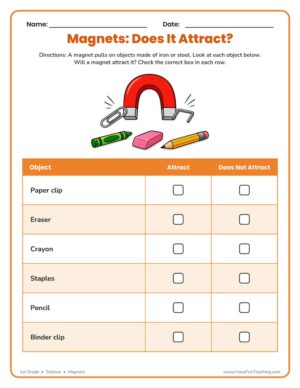
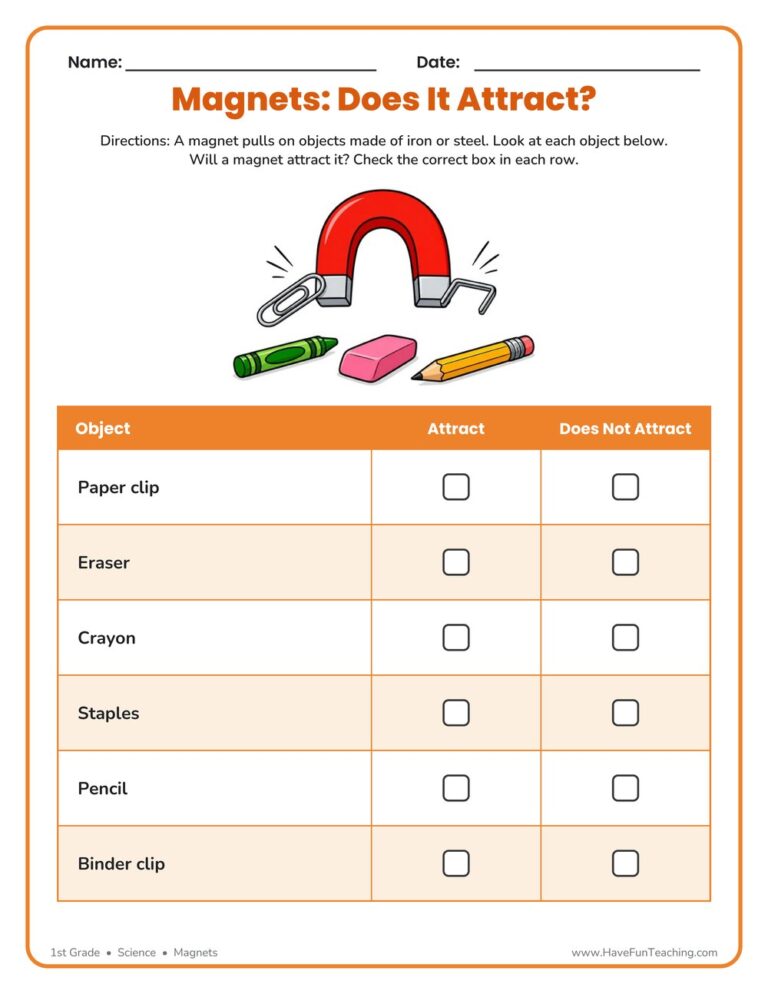
This first grade classroom objects magnet attraction worksheet has students sort six everyday items into attract or does-not-attract columns as they explore magnetism. Answer key included — a quick, hands-on way to practice physical science.

Worksheet
Worksheet3rd GradeIs it Magnetic Worksheet

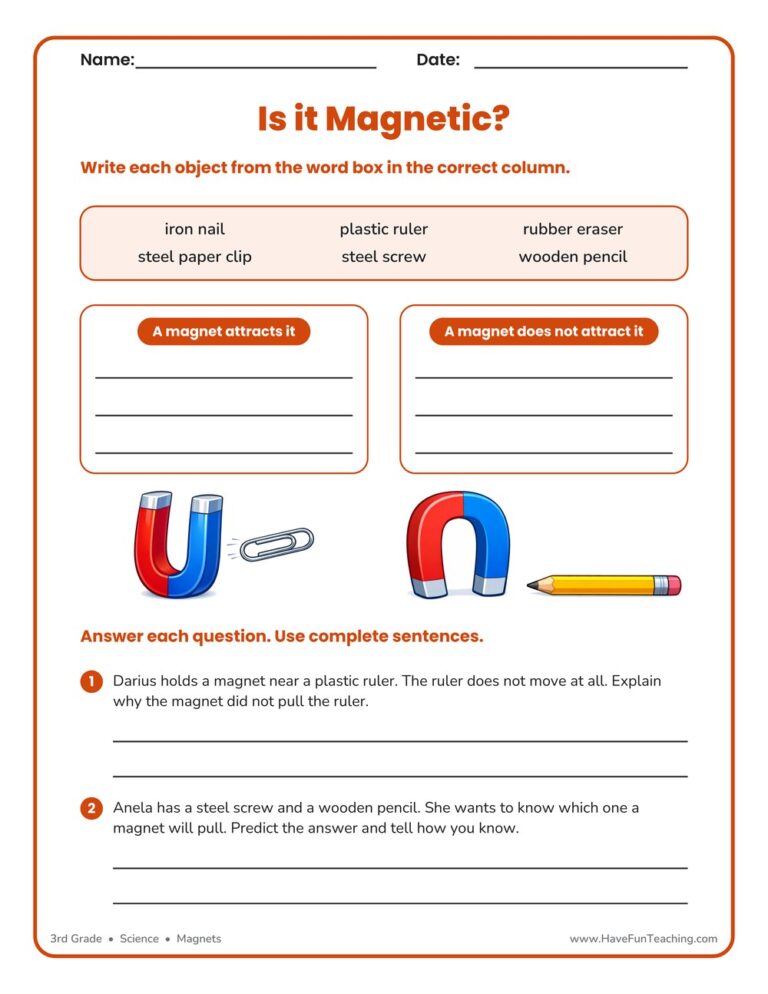
This Is it Magnetic Worksheet has 3rd Grade students sort six classroom objects by the material they are made of, then explain two predictions in writing. Answer key included, so checking work takes seconds.

Worksheet
Worksheet3rd GradeFields and Poles Magnets Worksheet

This fields and poles magnets worksheet has 3rd Grade students name the poles and field of a magnet, predict a push or a pull, and explain how a compass works. An answer key is included.

Activity
ActivityKindergartenMagnet Activity

This magnet activity has kindergarten to 3rd grade students sort picture cards into things a magnet will pull and things it will not, with a sorting mat, practice page and answer key.

Worksheet
Worksheet2nd GradeMagnet Attraction Worksheet

This magnet attraction worksheet has 2nd grade students test seven objects with a magnet and record whether each is metal, iron or steel, and magnetic. An answer key is included for fast, easy checking.

Worksheet
Worksheet3rd GradeMagnetism Experiment Worksheet

This magnetism experiment worksheet has 3rd graders sort eight objects by material, decide whether magnet poles attract or repel, and explain why steel is pulled and plastic is not. Answer key included for fast, no-prep science practice.

Activity
Activity1st GradeFun with Magnets Science Activity

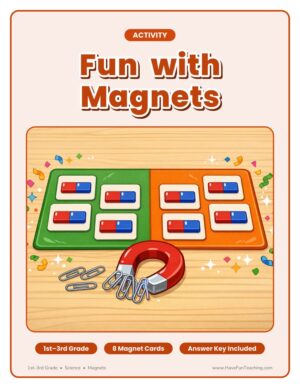
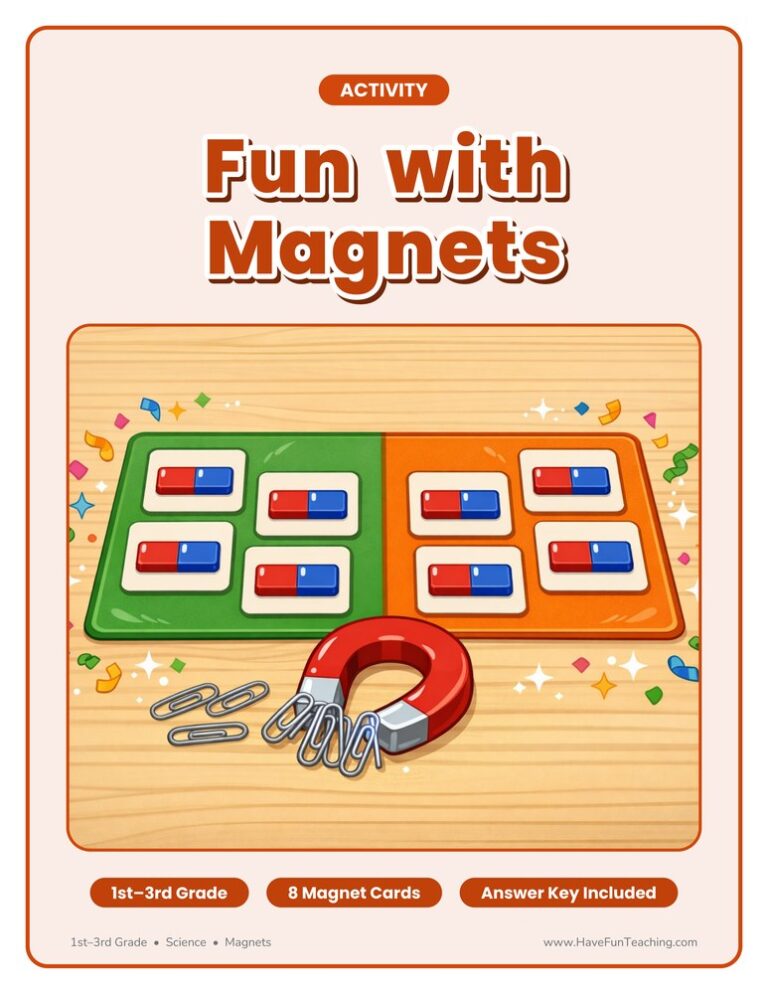
This fun with magnets science activity has 1st to 3rd grade students predict, sort and check whether magnet poles attract or repel. Answer key included.

From our teachers' playbook

Push, pull and a whole lot of "whoa!"

What do kids learn about magnets?

Kids discover that magnets pull on some things and ignore others. The surprise: not every metal is magnetic! Magnets grab iron and steel, like paper clips and nails, but not aluminum foil or most coins. Next they meet the two ends of a magnet, north and south poles. Opposite poles pull together and matching poles push apart, which feels like magic in their hands. Older kids learn that magnets work through paper and water, that the pull gets weaker with distance, and that Earth itself acts like a giant magnet, which is why a compass works.

Our favorite ways to make magnets click

Magnets practically teach themselves, as long as kids predict before they test. Here's how we keep it focused.

Predict, then test

Model the routine once: hold up an object, say your prediction out loud, then test it. After that, kids run it themselves with a recording sheet. The "I was wrong!" moments with foil and coins are the best part of the lesson.

Why it works: showing first, practicing together, then letting kids try alone is the "gradual release" model teachers have relied on for decades (Pearson and Gallagher, 1983).

Magnets Lesson PlanTry it withMagnets Lesson PlanLesson PlansOpen it →

Hands on the poles

Give partners two bar magnets and one job: find the ends that push and the ends that pull. Kids feel the push before they learn the word "repel." Then label N and S together and let them explain it back.

Why it works: going from real objects to pictures to symbols is a core recommendation of the U.S. Department of Education's elementary math guide.

Magnet ActivityTry it withMagnet ActivityActivitiesOpen it →

See the invisible

Magnetic force is invisible, so draw it! Show the arcs of a magnetic field around a bar magnet and have kids sketch arrows between poles. A picture turns "it just sticks" into a real explanation.

Why it works: children learn more from words and pictures together than from words alone (Mayer, 2009).

Fields and Poles Magnets WorksheetTry it withFields and Poles Magnets WorksheetWorksheetsOpen it →

Questions teachers and parents ask about magnets

What materials are attracted to magnets?

Iron, steel, nickel and cobalt. Things like paper clips, nails and steel spoons stick, while aluminum foil, copper, plastic, wood and most coins do not.

How do you explain magnetic poles to kids?

Every magnet has a north end and a south end. Opposites pull together and matching ends push apart. Let kids feel it with two bar magnets before you name it.

Why does a compass point north?

Earth acts like a giant magnet. The tiny magnet in a compass needle lines up with Earth's magnetic field, so it points north.

What grade learns about magnets?

Kids often explore what magnets attract in kindergarten to 2nd grade. Poles, pushes and pulls, and forces at a distance usually come in 3rd grade.

Are magnets safe for young kids?

Classroom bar and horseshoe magnets are fine with supervision. Keep tiny magnets away from young children, since swallowing them is dangerous.

Keep exploring