Skip to content
Start My 3 Free Days $0 today · cancel anytime

Scientific Method Resources

10 scientific method resources: 7 worksheets, 3 activities, 2 songs and more. How teachers use these

Scientific Method Resources

10 scientific method resources: 7 worksheets, 3 activities, 2 songs and more. How teachers use these

Worksheet
Worksheet4th GradeScientific Method Worksheet

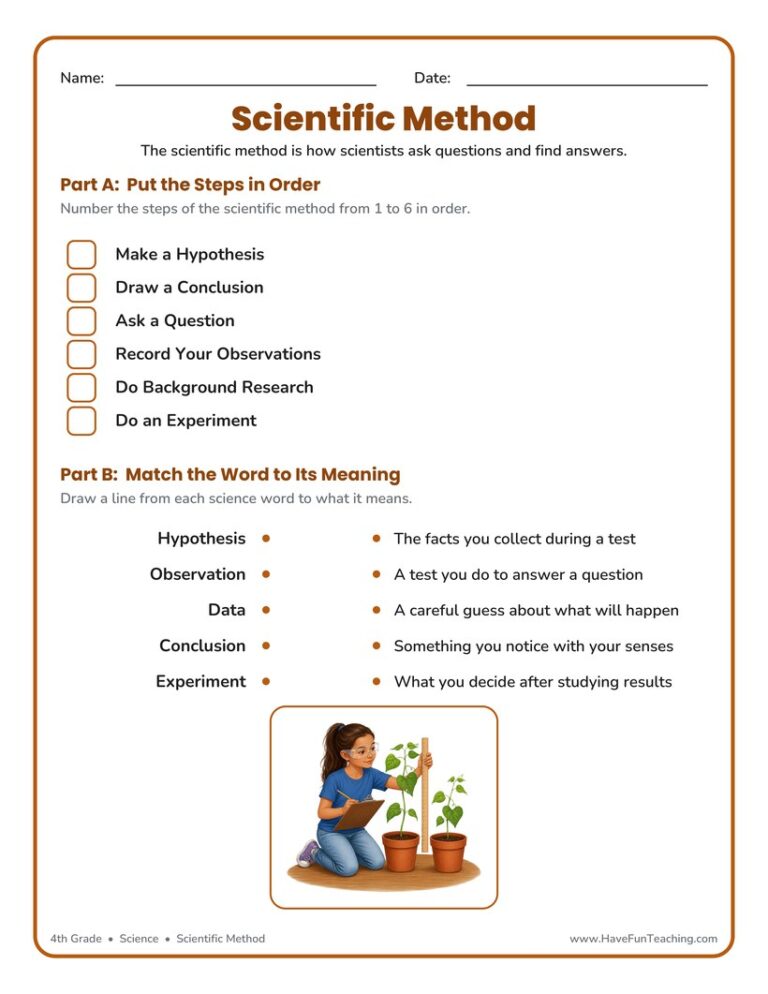
This Scientific Method Worksheet helps 4th graders order the six steps of an investigation, match key science words, and analyze a real bean-plant experiment. Answer key included — a no-prep way to build real science-thinking skills.

Worksheet
Worksheet4th GradeScientific Observation Worksheet

This scientific observation worksheet gives 4th graders practice sorting observations from inferences, recording what they notice, and judging a science note. Answer key included for quick, no-prep science practice.

Video
Video3rd GradeScientific Method Song (Animated Music Video)

While listening the Scientific Method Song (Animated Music Video), students learn about seven steps of the scientific method while listening to a catchy song.

Worksheet
Worksheet3rd GradeScience is in Everything Worksheet

A Science is in Everything Worksheet for 3rd grade: match six everyday things to biology, chemistry or geology, then explain one in writing. Answer key included for no-prep science practice.

Worksheet
Worksheet4th GradeScientist Matching Worksheet

This scientist matching worksheet has 4th grade students pair six famous scientists with the work they are known for, then explain one discovery. Answer key included.

Video
VideoPreschoolScientific Method Song (MP3)

While listening the Scientific Method Song (MP3), students learn about seven steps of the scientific method while listening to a catchy song.

Activity
Activity3rd GradeScience Notebook Activity Booklet

This science notebook activity booklet walks 3rd graders through a real experiment, one page per step, from a focus question to claims, evidence and new questions they can test next.

Activity
Activity1st GradeScientific Method Activity Booklet

Using this Scientific Method Activity Booklet, studentsfollow the scientific method when conducting an experiment or proving a hypothesis.

Activity
Activity4th GradeHow Much Will It Absorb Diaper STEAM Activity

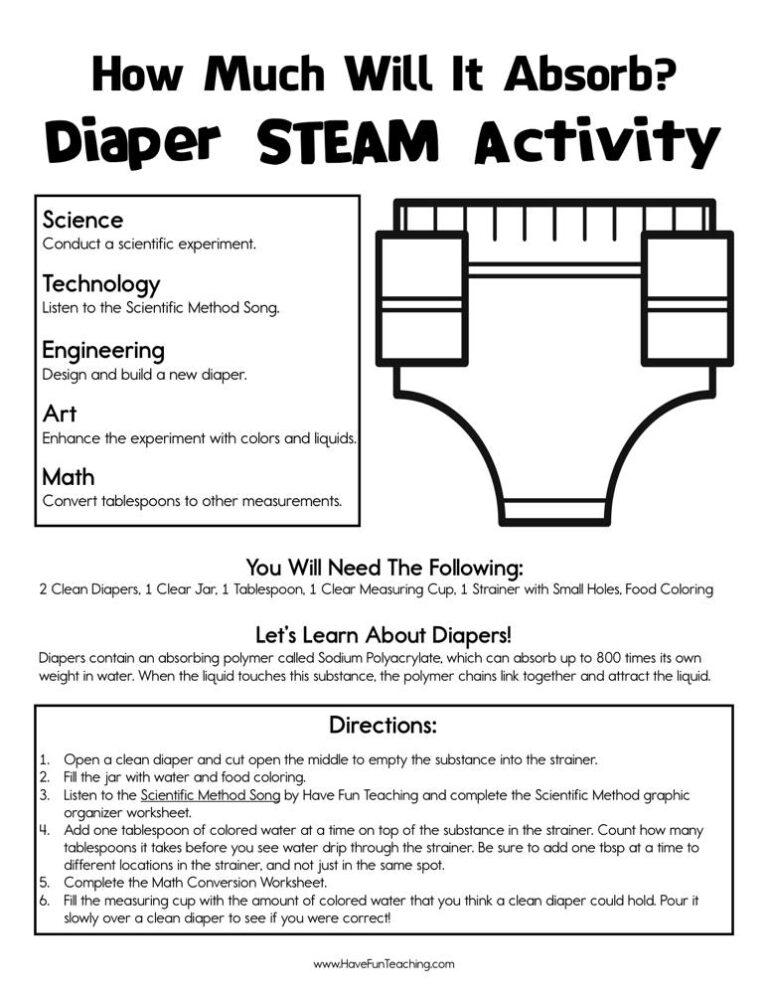
Run the How Much Will It Absorb Diaper STEAM Activity as a real lab for 4th to 6th grade: test diaper gel, convert capacity units, and design a diaper, with an answer key included.

Worksheet
Worksheet2nd GradeNew Inventions Magazine Worksheet

The New Inventions Magazine Worksheet lets 2nd graders name, draw and describe an invention of their own. An open-ended science and writing page that turns curiosity about inventors into real explaining practice.

From our teachers' playbook

Ask it, test it, prove it!

What do kids learn about the scientific method?

Kids learn that scientists follow steps to answer questions: ask a question, make a prediction, test it, observe and record, then draw a conclusion. Young kids start simple: "Will this float or sink?" Older students learn to write a hypothesis as an if-then statement, change only one thing at a time, and repeat a test to be sure. The best lesson is that a wrong prediction isn't a failure. It's information! The click moment is when kids start asking "How could we test that?" about everything.

Our favorite ways to teach the scientific method

Kids learn the steps by doing real tests, again and again. Here's how we keep it hands-on.

Sing the steps

A song gives kids the order of the steps in a way they won't forget. Play it before every experiment and have kids hold up fingers for each step. Soon they're reminding you what comes next.

Why it works: words set to a repeating melody are easier to recall than the same words spoken (Wallace, 1994).

Scientific Method Song (Animated Music Video)Try it withScientific Method Song (Animated Music Video)SongsOpen it →

Keep a lab booklet

Give every kid a booklet with a page for each step and use it for every experiment. Same booklet, same steps, new question each time. The routine makes the method automatic.

Why it works: going from real objects to pictures to symbols is a core recommendation of the U.S. Department of Education's elementary math guide.

Scientific Method Activity BookletTry it withScientific Method Activity BookletActivitiesOpen it →

Model a fair test

Run a quick demo with a mistake on purpose: change two things at once and ask kids why the result doesn't prove anything. They spot it fast. Then redo it changing only one thing.

Why it works: handing over the work step by step, from teacher to student, is one of the most widely used teaching frameworks (Pearson and Gallagher, 1983).

Scientific Method WorksheetTry it withScientific Method WorksheetWorksheetsOpen it →

Questions teachers and parents ask about the scientific method

What are the steps of the scientific method for kids?

Ask a question, make a prediction (hypothesis), test it with an experiment, observe and record what happens, and draw a conclusion. Some versions add "share your results" as a final step.

What is a hypothesis in kid terms?

It's a smart guess about what will happen, based on what you already know. Kids can write it as "I think ___ will happen because ___."

What's an easy experiment to teach the scientific method?

Float or sink is a classic. Kids predict whether objects will float, test them in a tub of water and record results. Growing beans in light versus dark works well too.

What age can kids learn the scientific method?

Even kindergartners can predict, test and tell what happened. By 3rd to 5th grade, kids write hypotheses, run fair tests and record data in tables.

Keep exploring