
Skip to content
Start My 3 Free Days $0 today · cancel anytime

Contractions Worksheets

12 contractions worksheets. Teacher favorites: Is Contractions Worksheet and Contractions Word Bank Worksheet. How teachers use these

Contractions Worksheets

12 contractions worksheets. Teacher favorites: Is Contractions Worksheet and Contractions Word Bank Worksheet. How teachers use these

Worksheet
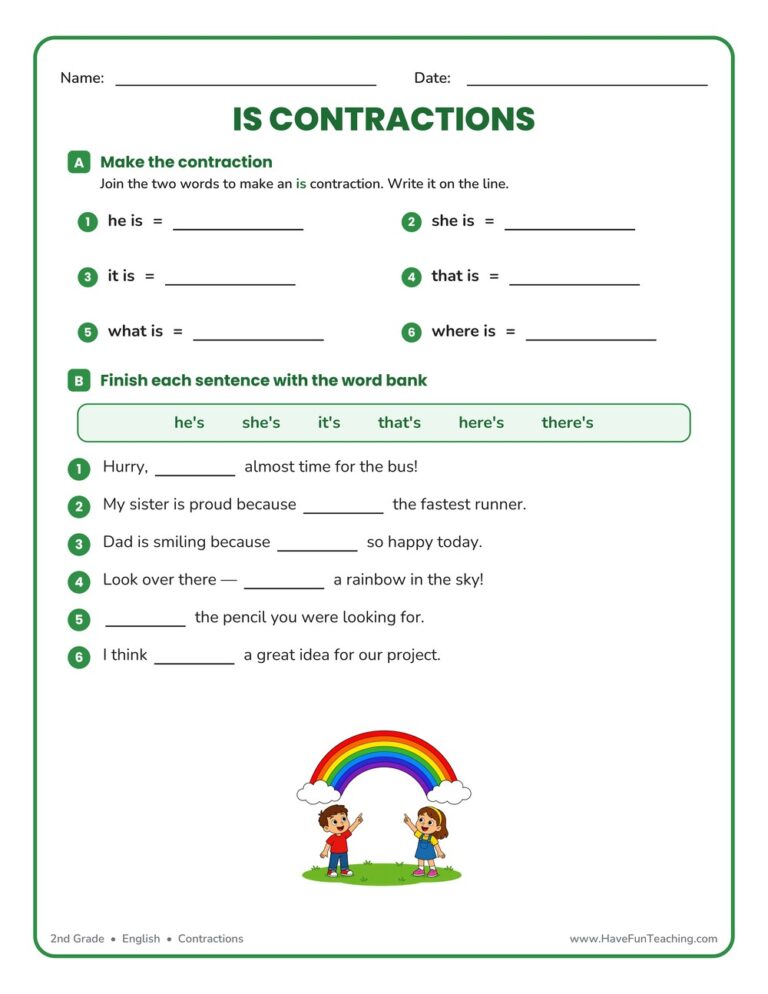
Worksheet2nd GradeIs Contractions Worksheet

The Is Contractions Worksheet gives 2nd graders two-part practice building and using “is” contractions like he’s, she’s, and it’s. Includes a complete answer key — a quick, low-prep way to strengthen grammar skills at home or in class.

Worksheet
Worksheet2nd GradeContractions Word Bank Worksheet

This Contractions Word Bank Worksheet asks 2nd grade students to write six contractions from a word bank and unpack two more from sentences, with an answer key that makes checking quick.

Worksheet
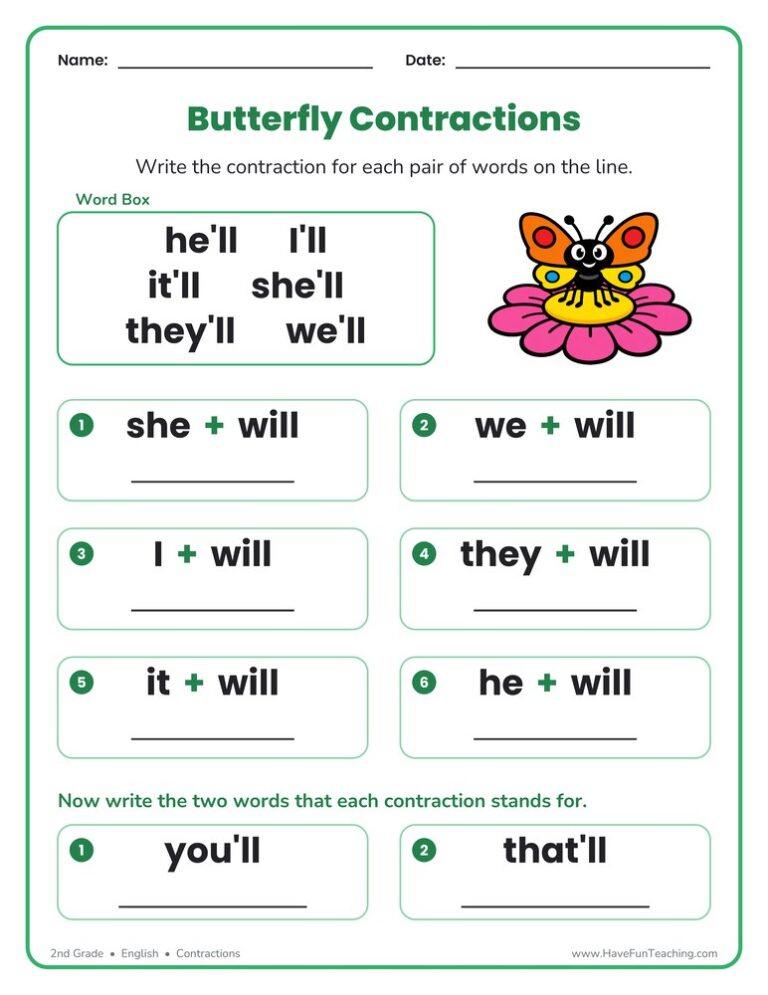
Worksheet2nd GradeButterfly Will Contractions Worksheet

Practice contractions with will on this Butterfly Will Contractions Worksheet. Second graders build he'll, I'll, it'll, she'll, they'll and we'll, then expand two more. Answer key included.

Worksheet
Worksheet2nd GradeContractions Practice Worksheet

This Contractions Practice Worksheet helps 2nd graders join two words into one and break contractions back apart, with clear examples to guide them. Answer key included—perfect for quick, no-prep grammar practice at home or school.

Worksheet
Worksheet2nd GradeWriting Contractions Worksheet

This Writing Contractions Worksheet gives 2nd grade students eight sentences to practice building contractions and splitting them back into two words, with an answer key included, so the apostrophe rule finally sticks.

Worksheet
Worksheet2nd GradeBumblebee Is/Are Contractions Worksheet

This Bumblebee Is/Are Contractions Worksheet gives 2nd grade students six word pairs and three garden sentences to rewrite with apostrophes. An answer key is included, so contraction practice is ready to hand out in minutes.

Worksheet
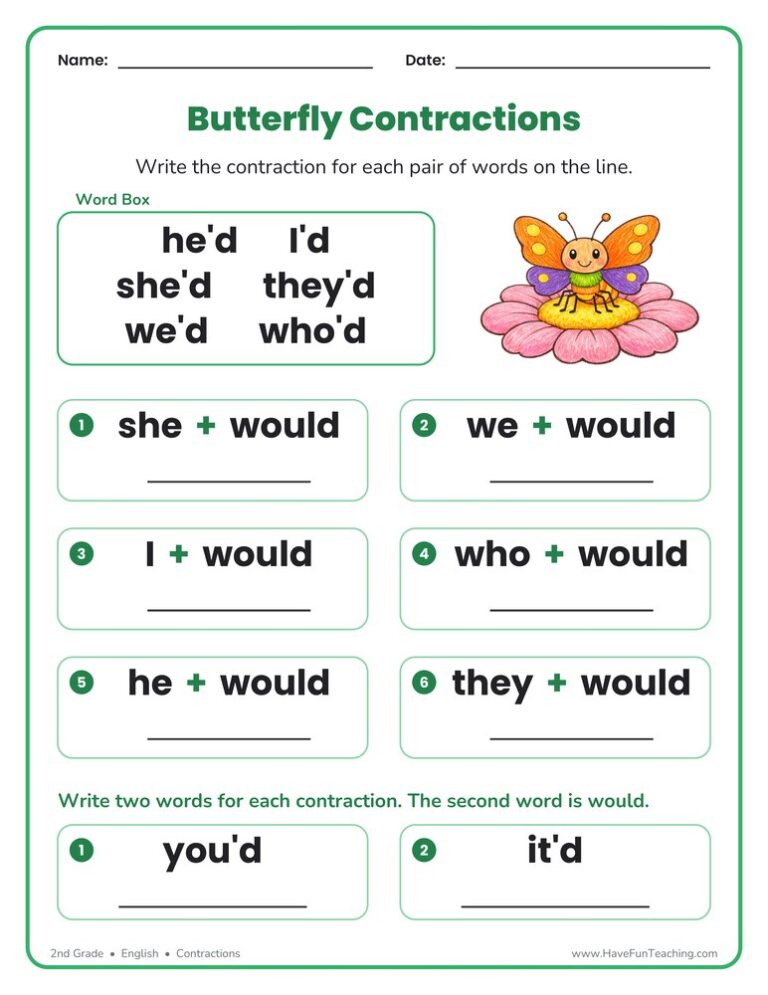
Worksheet2nd GradeButterfly Would Contractions Worksheet

Practice contractions with would on this Butterfly Would Contractions Worksheet. Second graders form I'd, she'd, they'd and more, then expand two contractions. Answer key included.

Worksheet
Worksheet2nd GradeButterfly Not Contractions Worksheet

This butterfly not contractions worksheet gives 2nd Grade students six word pairs and a Word Box, plus two reverse items and an answer key, so contractions with not finally click.

Worksheet
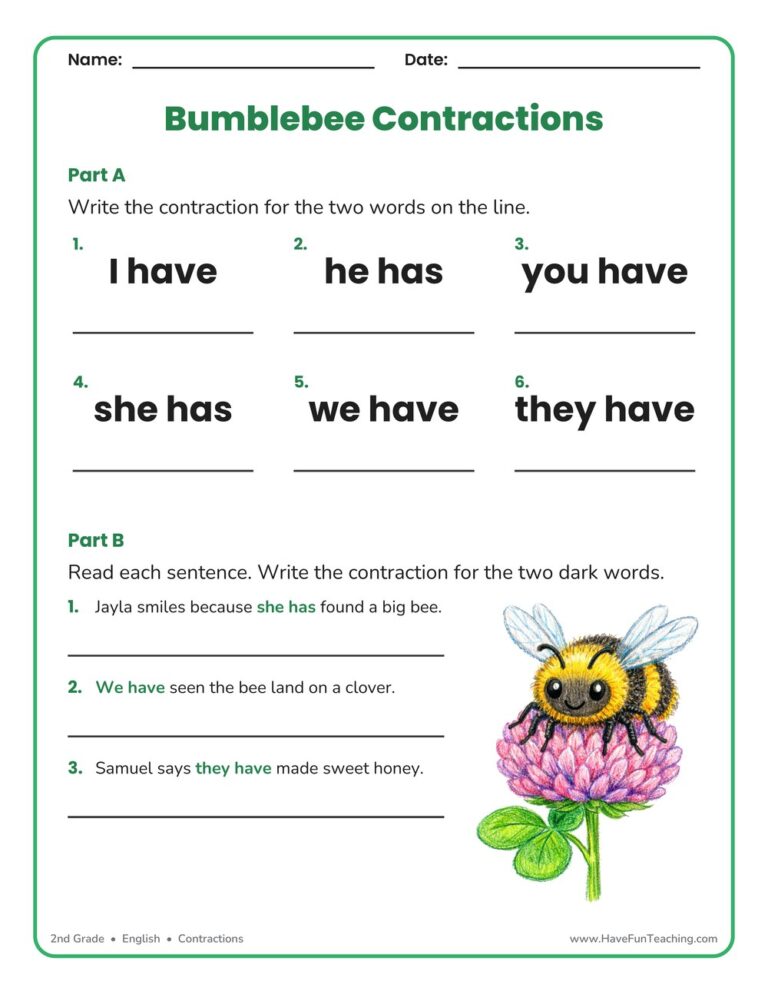
Worksheet2nd GradeBumblebee Have Contractions Worksheet

This Bumblebee Have Contractions Worksheet lets 2nd grade students form contractions with have and has, then use them in sentences. An answer key is included, so practice is quick to check and easy to build on.

Worksheet
Worksheet3rd GradeCircling Contractions Worksheet

This circling contractions worksheet has students pick the correctly spelled contraction, then fix four more in sentences. Built for 3rd grade with an answer key included.

Worksheet
Worksheet3rd GradeContractions List Worksheet

This contractions list worksheet has 3rd graders sort twelve contractions by not, will and have, then decide if 'd means had or would. An answer key is included for easy checking.

Worksheet
Worksheet3rd GradeContractions Crossword Puzzle

This contractions crossword puzzle worksheet gives 3rd graders seven sentence clues and a 9 by 9 grid, plus a written question about the apostrophe. No word bank. Answer key included.

From our teachers' playbook

Two words squeezed into one

What do kids learn about contractions?

A contraction is two words smooshed together with an apostrophe taking the place of the missing letters: do + not = don't, I + am = I'm, we + will = we'll. First graders learn common ones and what the apostrophe means. In 2nd grade kids form contractions with not, is, are, will, have and would, and match them back to the two words. They also learn a couple of rule-breakers, like won't for will not. Later they keep it straight from look-alikes like its and it's. The click is when a child realizes they've been saying contractions all their lives, they just never saw them written.

Our favorite ways to teach contractions

Contractions are a puzzle kids can solve. These moves make the apostrophe make sense.

Snip and squeeze

Write "do not" on a paper strip. Kids cut out the o in not, push the words together and glue an apostrophe where the letter was. Physically removing the letter shows exactly what the apostrophe is doing.

Why it works: going from real objects to pictures to symbols is a core recommendation of the U.S. Department of Education's elementary math guide.
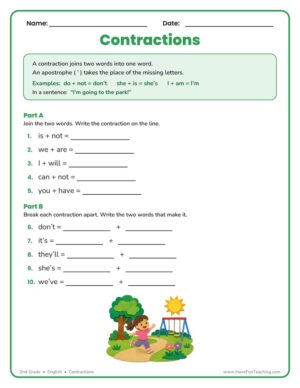
Contractions Practice WorksheetTry it withContractions Practice WorksheetWorksheetsOpen it →

Family by family

Teach one family at a time: all the not contractions, then all the will contractions. Model a few aloud, "is not becomes isn't," and let kids find the pattern. Grouping by family makes the rule obvious.

Why it works: handing over the work step by step, from teacher to student, is one of the most widely used teaching frameworks (Pearson and Gallagher, 1983).

Contractions Lesson PlanTry it withContractions Lesson PlanLesson PlansOpen it →

Flash and match

Hold up a contraction card and kids say the two words, or flip it and they say the contraction. Quick rounds a few times a week make these automatic for reading and writing.

Why it works: pulling an answer out of memory makes it stick far better than rereading it, one of the strongest findings in learning research (Dunlosky and colleagues, 2013).

Contractions Flash CardsTry it withContractions Flash CardsFlash CardsOpen it →

Contractions: your questions

What is a contraction for kids?

A contraction is a short way to write two words as one. An apostrophe shows where letters were left out, like can't for can not.

What grade learns contractions?

Most children are introduced to contractions in 1st grade and practice forming and using them in 2nd grade.

Why is won't a contraction for will not?

It comes from an old way of saying will not, "wol not." It doesn't follow the usual pattern, so kids just learn it as a special case.

What's the difference between its and it's?

It's is a contraction for it is or it has. Its shows something belongs to it, like the dog wagged its tail. If you can say "it is" instead, use the apostrophe.



