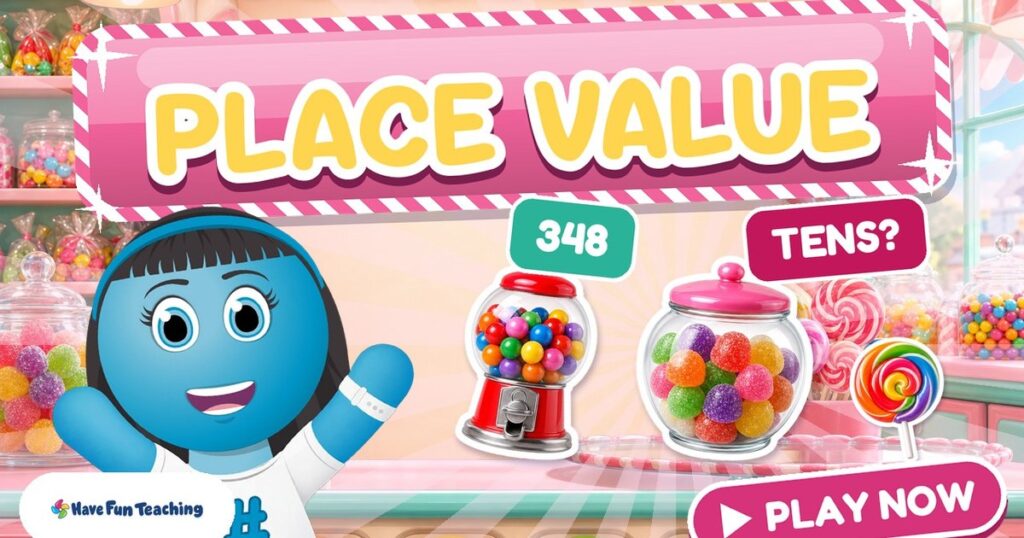
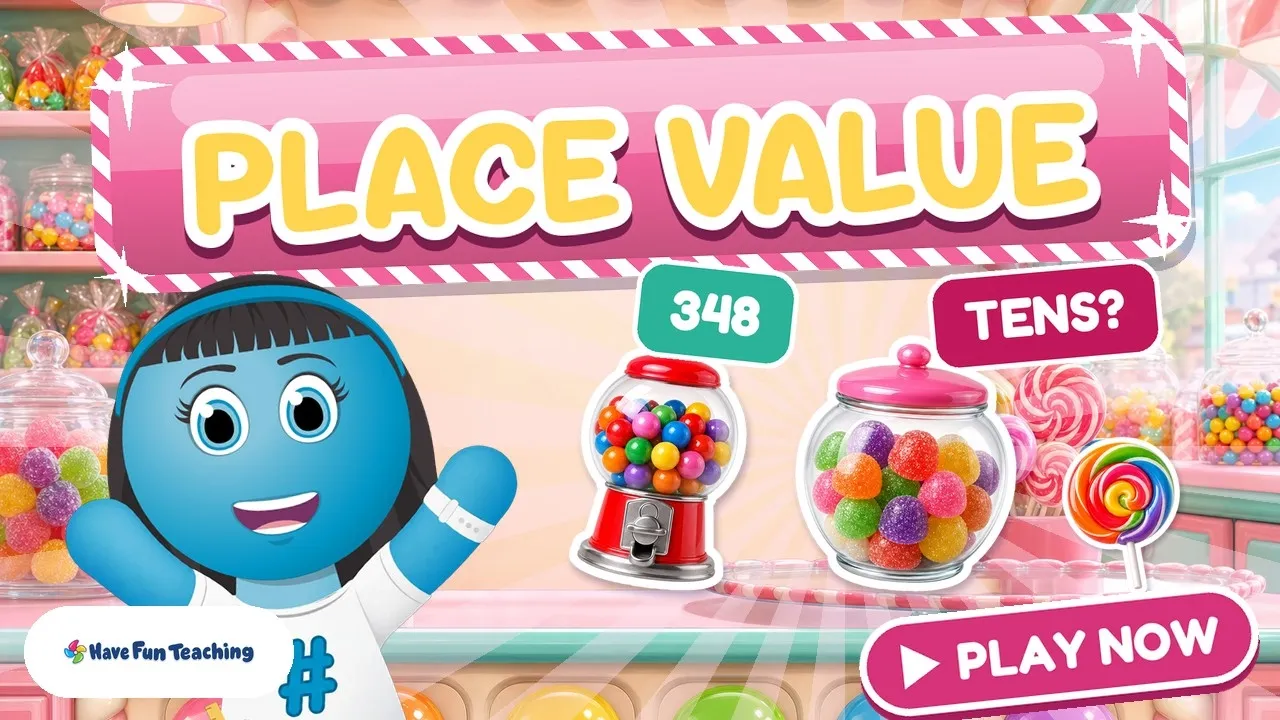
Our new place value game turns hundreds, tens and ones into something kids can see, tap and count. Instead of copying digits into boxes, children help Penny the Funzy sort her candy shop, one gumball at a time.
You know the moment: a child writes 7 for the hundreds in 348 because 7… well, it was in there somewhere. Or zero in 270 means “nothing,” so it gets skipped. Place value is easy for us to see and surprisingly slippery for seven-year-olds.
The Determining Place Value Game gives every child their own turn with real base-ten thinking. Penny reads every number and direction aloud, shows an example before each round, and gives a gentle hint when a child picks the wrong place.
- A tap-only place value game for 2nd grade (great for 1st grade enrichment and 3rd grade review).
- Three rounds, nine three-digit numbers: how many hundreds, tens and ones?
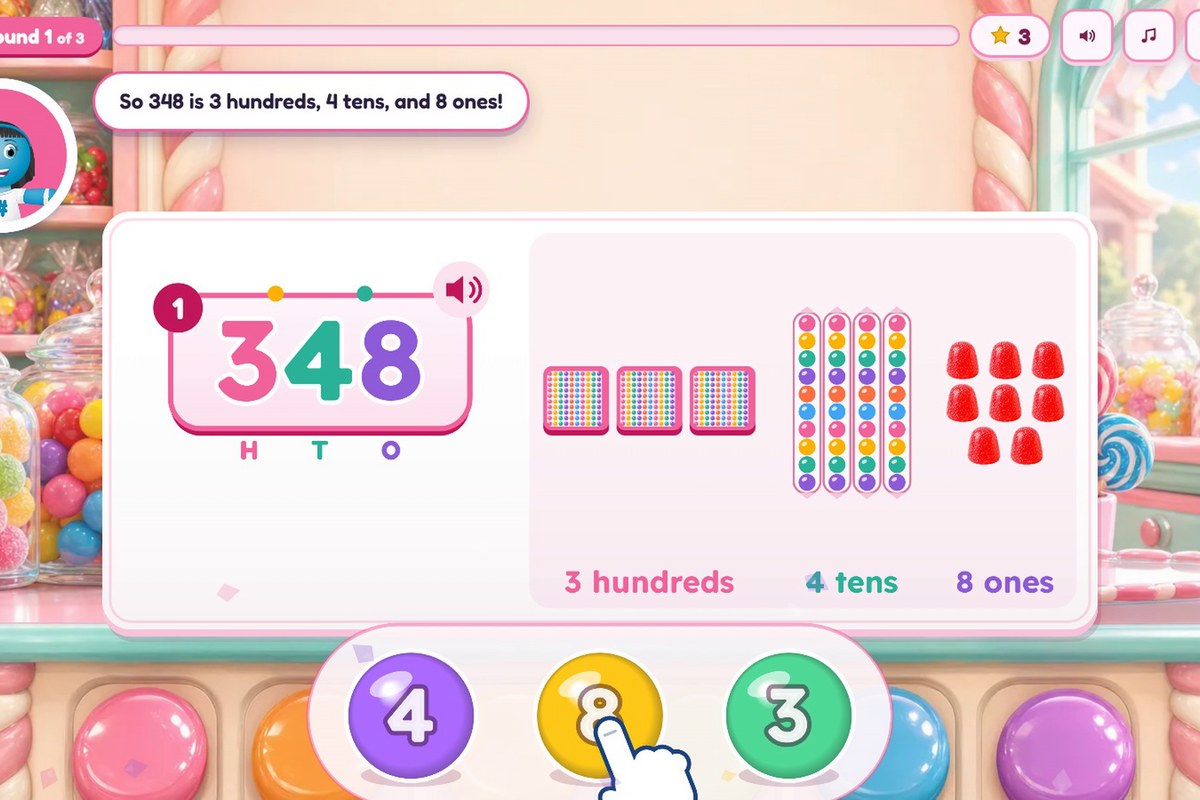
- Every right answer builds the number in candy: hundred flats, ten rods and single gumdrops.
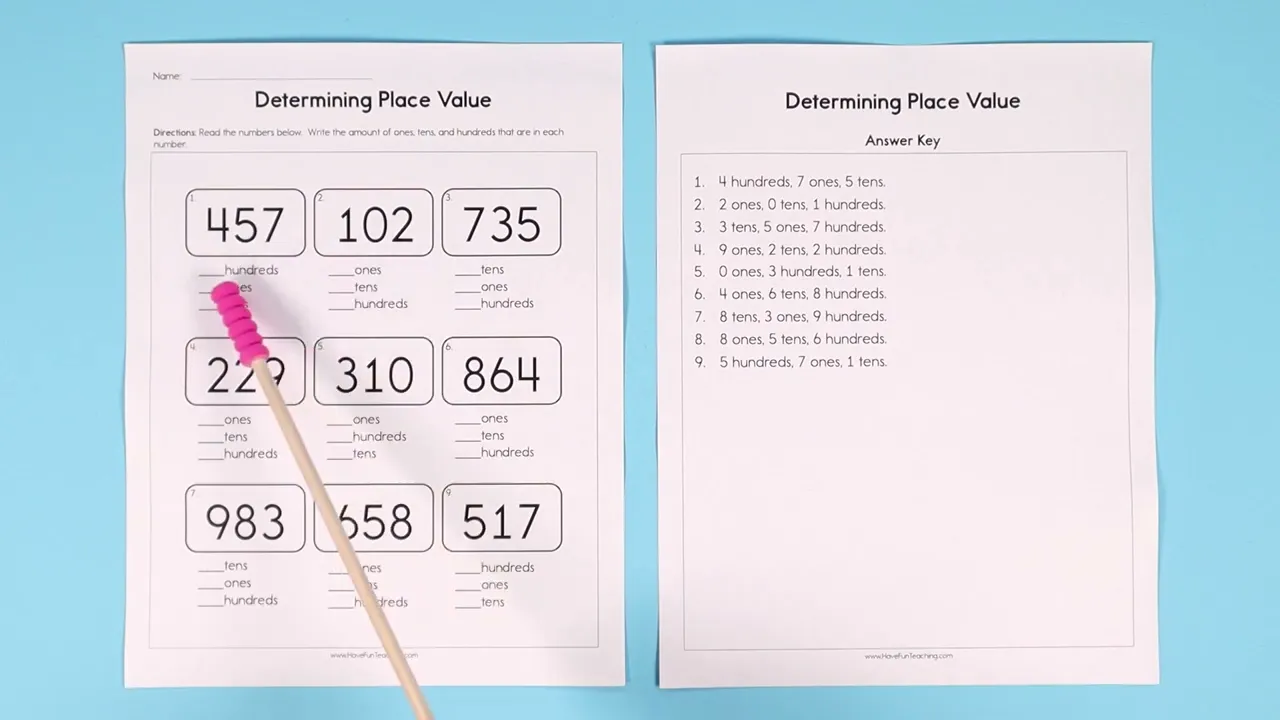
- Made from the Determining Place Value Worksheet, so you can play it, then print it.
Why kids love this place value game
Place value is abstract: the same 4 means four, forty or four hundred depending on where it sits. The game makes it concrete. Kids see a hundred flat drop for every hundred, a ten rod for every ten and a gumdrop for every one.
Penny reads it all
Every number, question and hint is spoken and captioned, so kids can play on their own.
Base ten, in candy
Hundred flats, ten rods and gumdrops show what every digit is worth.
Three big gumballs
One question at a time and three choices, big enough for small fingers.
Hints that teach
A wrong tap gets a friendly “So close!” and a hint that names the place.
Watch the place value game in action
See a full play-through of all three rounds, then watch the matching worksheet walkthrough. Find more on the Have Fun Teaching YouTube channel.
How to play the place value game
Press Play and Penny takes it from there. Each round starts with a short “Watch me!” example, then it is the child’s turn.
Read left to right
Penny reads the number. The first digit is the hundreds, then the tens, then the ones.
Tap a gumball
“How many hundreds?” Kids tap one of three gumballs. Then the tens, then the ones.
Watch it build
Flats, rods and gumdrops drop onto the counter, and Penny reads the whole number back.
The Determining Place Value Game is part of the Have Fun Teaching membership. Members can open it full screen on any device. New here? Start your 3 free days and play it today.
What kids learn from the place value game
Each round targets one big place value idea from the 2nd grade math year (2.NBT.1), so kids build understanding step by step.
Ten ones make a ten
Ten gumdrops line up into a ten rod, and ten rods make one hundred flat.
Reading left to right
The first digit is the hundreds, the middle digit the tens, the last digit the ones.
Zero holds a place
270 has no single gumdrops, so the ones digit is zero, and it still matters.
Digit vs. value
The 4 in 348 sits in the tens place, so it means 4 tens: forty.
Math words
Hundreds, tens, ones, digit and place, used the same way every time.
Fixing mix-ups
The three choices are the number’s own digits, so every hint targets a real mix-up.
Teacher tip: play it, then print it
Play the game on the whiteboard as a class, then hand out the Determining Place Value Worksheet with the same nine numbers. Check off each step as your class finishes it:
More place value resources for kids
Keep the practice going with printables that teach the same hundreds, tens and ones as the game.
 2nd Grade · WorksheetDetermining Place Value WorksheetThe worksheet behind the game: the same nine numbers on paper.
 2nd Grade · ActivityPrintable Base 10 BlocksCut-out flats, rods and units to build numbers by hand.
 2nd Grade · WorksheetHundreds, Tens, Ones Place ValueWrite how many hundreds, tens and ones are in each number.
 2nd Grade · WorksheetHTO Place Value WorksheetSort each digit into its H, T or O column.
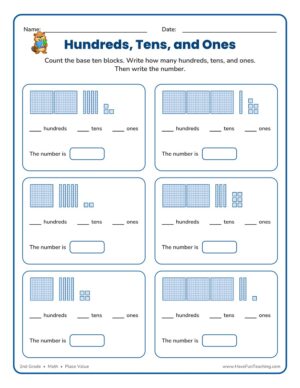 2nd Grade · WorksheetBase 10 Blocks Place ValueCount the flats, rods and units, then write the number.
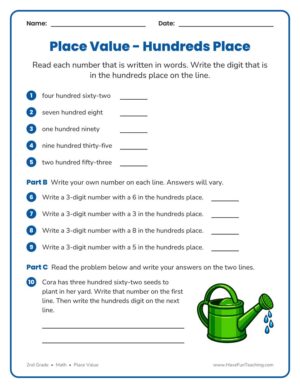 2nd Grade · WorksheetFinding Place Value WorksheetFind the place of the underlined digit in each number.
 1st Grade · WorksheetPlace Value Tens and OnesA warm-up with two-digit numbers before the hundreds.
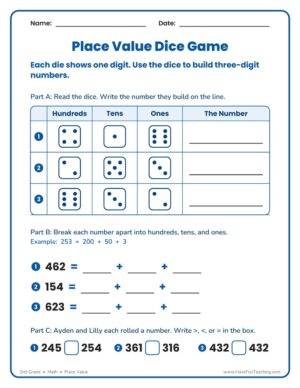 2nd Grade · GamePlace Value Dice GameRoll, build and compare numbers in a quick table game.
Explore more resources
Get every game with a membership
Place value practice, sorted for the whole year
Members play the Determining Place Value Game and every other Have Fun Teaching game, and download the place value printables, songs and videos that go with it.
- Every Have Fun Teaching game, including the Determining Place Value Game
- Every printable, song and video, Preschool–6th
- Unlimited downloads, new resources added daily
- Use it with your class or your kids at home
Place value game FAQ
What is the Determining Place Value Game?
The Determining Place Value Game is an online place value game for kids from Have Fun Teaching. Penny the Funzy reads each three-digit number and asks how many hundreds, how many tens and how many ones it has. Kids tap the right gumball and watch the number get built in candy flats, rods and gumdrops.
What grade is the place value game for?
It is made for 2nd grade and works well for 1st grade enrichment and 3rd grade review. Every direction is read aloud and captioned, so kids can play on their own.
How does the game teach place value?
Each round starts with a short example. Penny shows that ten ones make a ten rod and ten rods make a hundred flat, reads numbers left to right, and shows why zero holds a place. After every right answer, that many flats, rods or gumdrops drop onto the candy counter.
Can kids play it on a tablet or phone?
Yes. The game runs in the browser on computers, tablets, phones, Chromebooks and interactive whiteboards. There is nothing to install.
Is there a printable version?
Yes. The game is built from the Determining Place Value Worksheet, so kids can play the game and then complete the same nine numbers on paper.
Ready to build numbers with Penny?
Press Play and let your kids find the hundreds, tens and ones themselves.
Works on computers, tablets, phones and interactive whiteboards.