

Density and Volume in Metric Worksheet
This Density and Volume in Metric Worksheet asks 3rd graders to choose the best metric unit—grams, kilograms, milliliters, or liters—for ten everyday objects. Answer key included for fast, no-prep measurement practice.
$6.97
Or free with a membership — get this and 10,000+ resources. See plans
Teaching is easier with a membership
Unlimited printables, games & videos for PreK–6th — for your classroom or homeschool. Cancel anytime.
Start your 3-day free trialNo commitment · Cancel anytime · Instant access to 10,000+ resources
About this resource
Description
Understanding the difference between mass and volume is a key measurement skill, and this Density and Volume in Metric Worksheet helps third graders master it. Students learn that mass is how heavy an object is, measured in grams and kilograms, while volume, or capacity, is how much liquid a container holds, measured in milliliters and liters. Choosing the right metric unit for everyday objects builds the estimation and reasoning skills young mathematicians use every day.
This printable worksheet gives students ten objects and asks them to fill in the bubble next to the best metric unit for each one. It works well as independent practice, a math-center task, or a quick review before a measurement quiz, and it doubles as a friendly 3rd grade capacity worksheet for learners who are just beginning to compare liters and milliliters. A short reference box at the top reminds students which units measure mass and which measure capacity, so they can work confidently on their own.
What’s Included
- 1 print-ready PDF worksheet
- Answer key
- 10 fill-in-the-bubble measurement questions covering mass and capacity
There are three big reasons this Density and Volume in Metric Worksheet helps students learn. First, the fill-in-the-bubble format keeps the focus on reasoning about units instead of copying numbers. Second, the mix of small and large objects trains students to estimate and pick a sensible unit rather than guess. Third, the built-in answer key lets students check their thinking right away, turning every mistake into a quick teaching moment.
To extend the lesson, invite students to hunt for objects around the classroom or kitchen and decide whether each is best measured in grams, kilograms, milliliters, or liters. Bring in a balance scale and a measuring cup so learners can test their predictions, or challenge them to sort picture cards into “mass” and “capacity” groups. Cooking, filling water bottles, and weighing produce at the store all give real-world practice with metric units.
Related Resources
What teachers say
Reviews
You must be logged in to post a review.

Using this Measurement Conversion Activity, students demonstrate knowledge of relative sizes of measurement units within one system of units.

Using this Measuring Metric Word Problems Worksheet, students solve the metric word problems using pictures and equations.
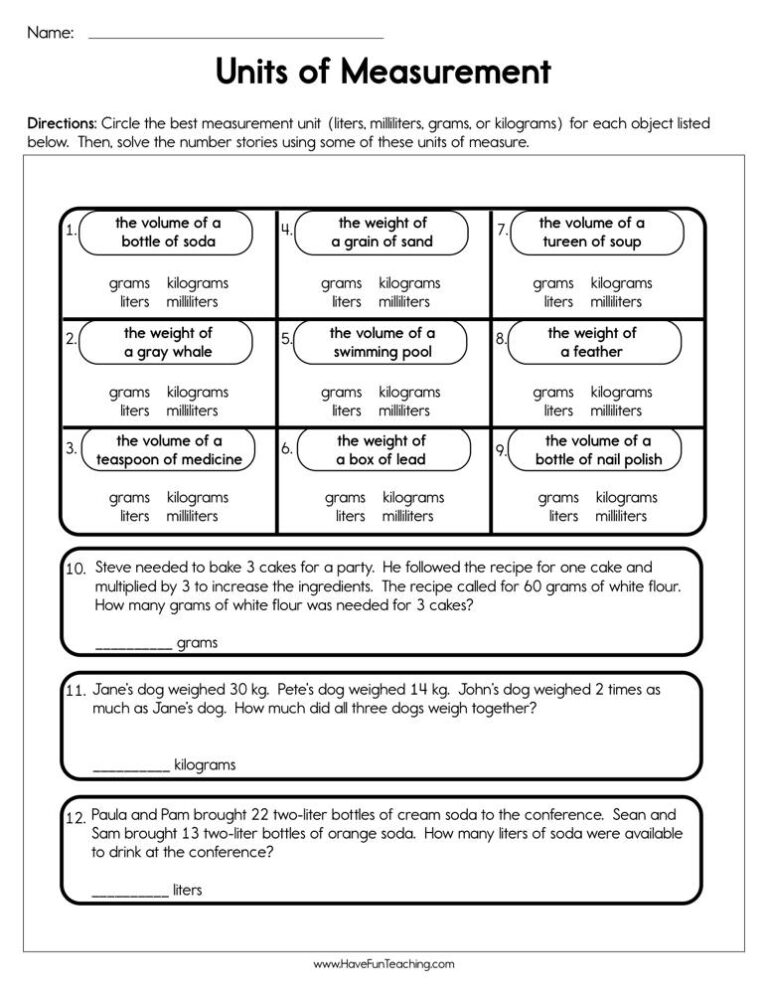
Using this Units of Measurement Worksheet, students choose the best unit of measurement for each object to measure precisely and accurately.
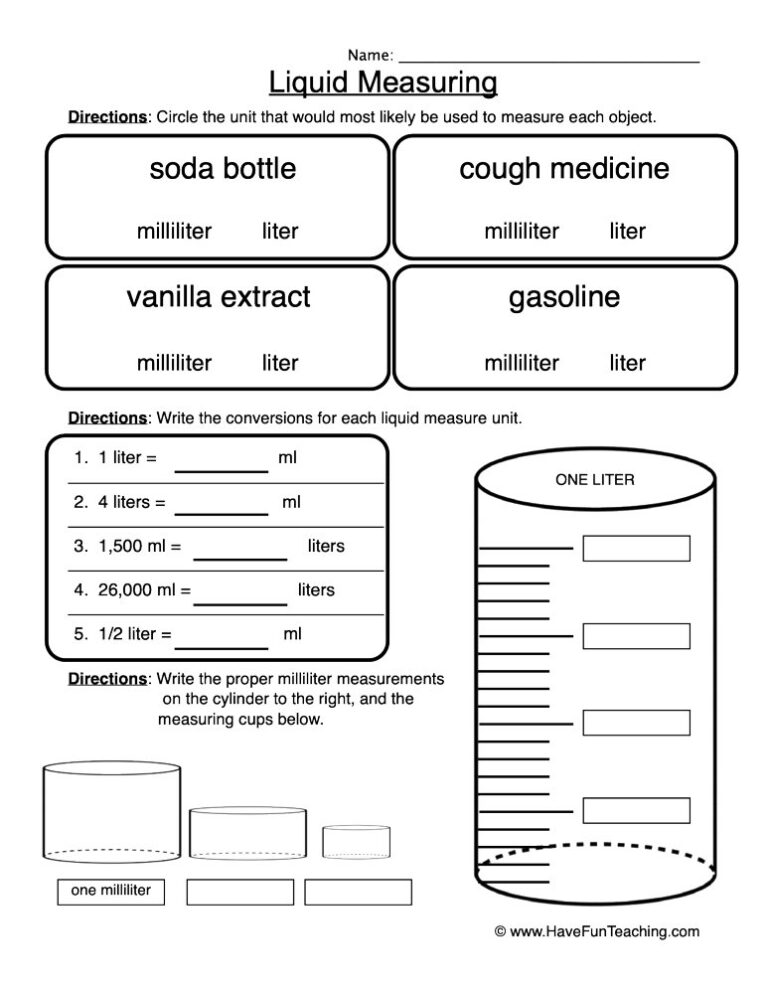
Using this Choosing Milliliter or Liter Worksheet, students estimate the best measurement type for different containers of liquid.
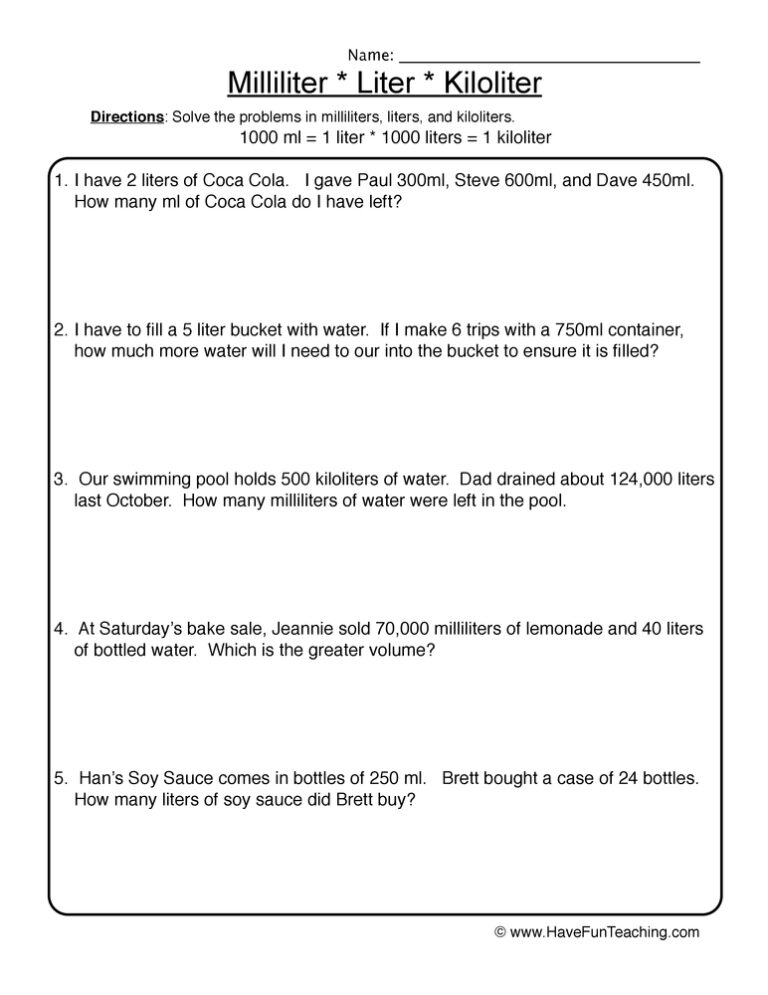
Using Liquid Measurement Scenarios Worksheet, students convert the liquid measures to build their understanding of metric units.

Using Measurement Conversions Worksheet, students convert the liquid and dry measures to build their understanding of capacity.

This third grade multiplication and division test practice worksheet gives students twelve multiple-choice problems that mix facts with word problems. Includes a complete answer key — perfect for quick, no-prep review before a quiz or test.
Using the Counting Songs (Classic Video Collection), students practice skip counting by all of the numbers by singing and counting along to these thirteen videos.
A printable, ready-to-use blank calendar with a landscape monthly grid and labeled day columns. Great for Kindergarten through 5th grade classrooms to map out lessons, holidays, and daily routines—just add the month and the dates.
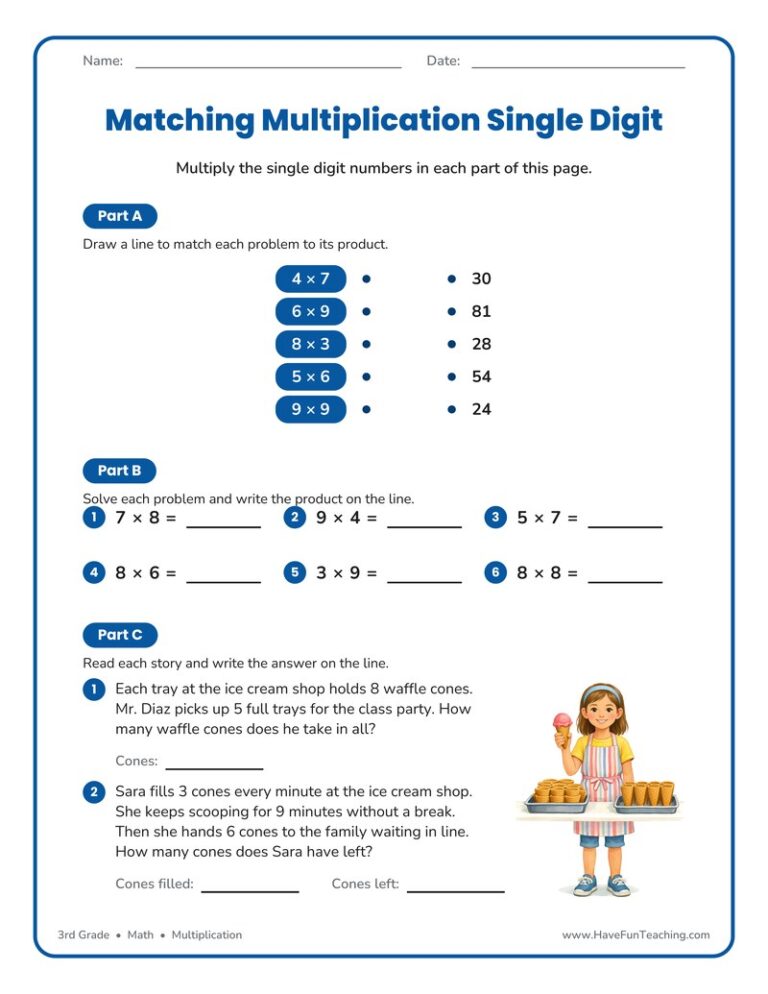
A Matching Multiplication Single Digit Worksheet that gives 3rd graders three ways to practice the same facts: matching, solving, and two ice cream story problems. Answer key included for fast, no-prep fact fluency.
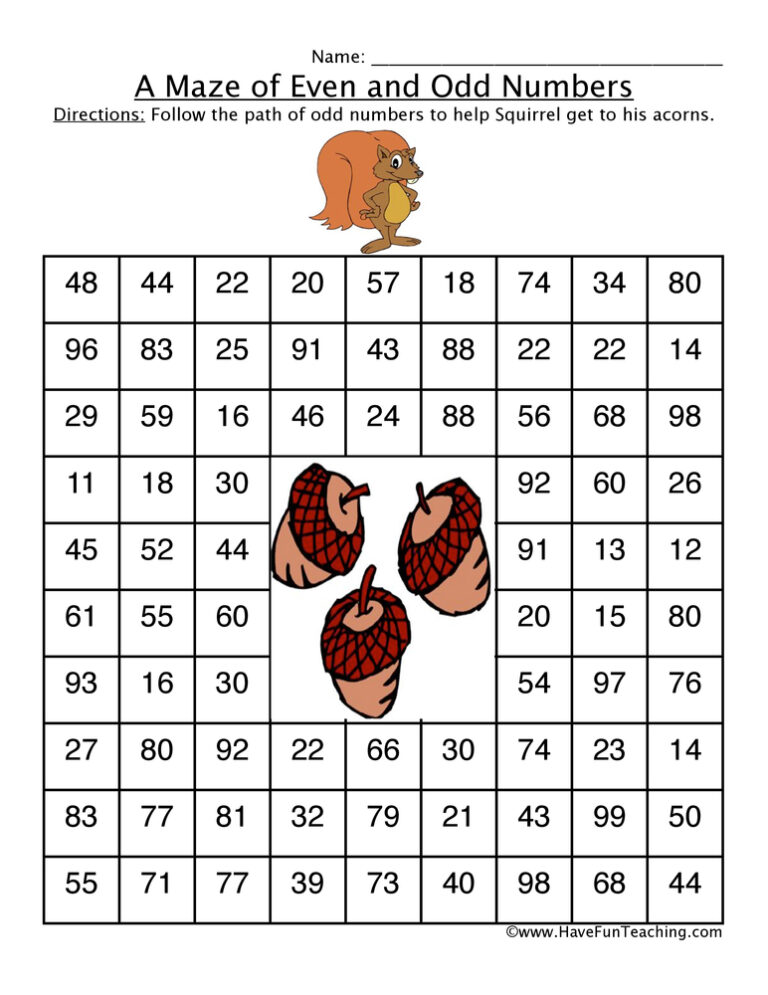
Using Odd Number Squirrel Maze Worksheet, students follow the path of odd numbers to get the squirrel to his acorns.
Using the Adding 8 Song (Lyric Mjusic Video), students sing and practice adding 8 with all addition facts 1-15. Your kids will learn how to add 8.
Reviews
There are no reviews yet