Skip to content
Start My 3 Free Days $0 today · cancel anytime

Density Resources

4 density resources: 3 worksheets and 1 activity. How teachers use these

Density Resources

4 density resources: 3 worksheets and 1 activity. How teachers use these

Worksheet
Worksheet1st GradeSink Float Identify Worksheet

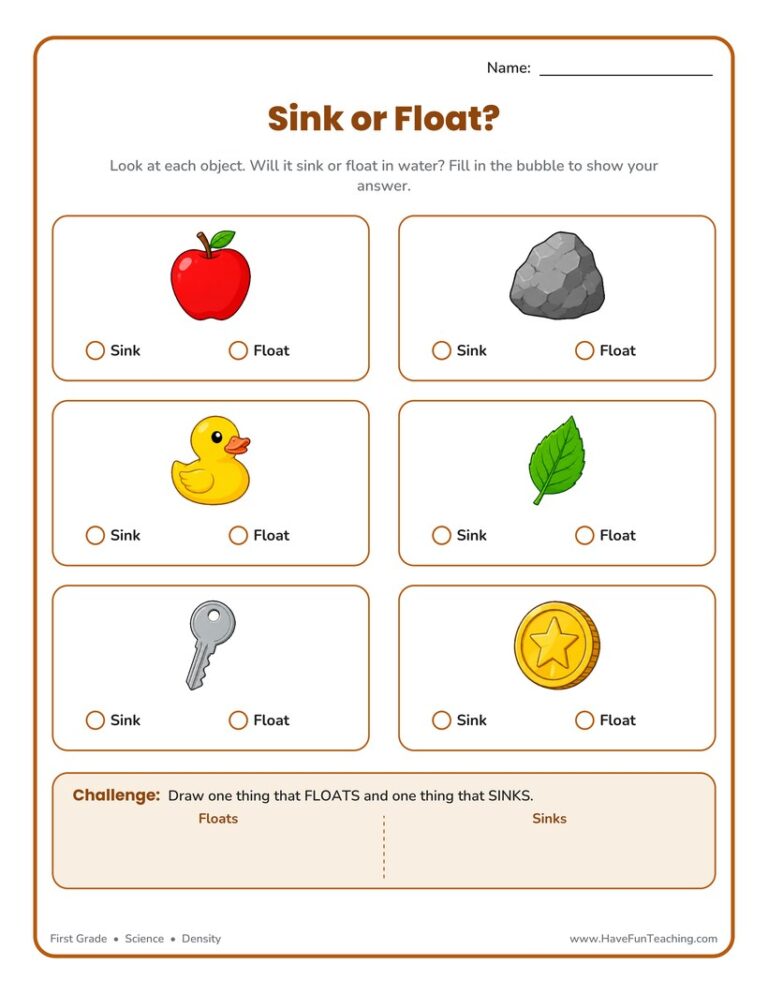
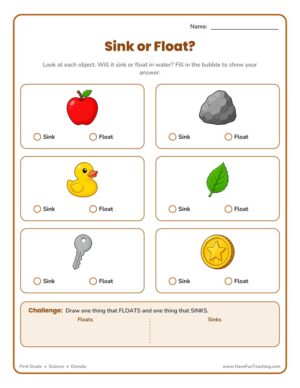
This sink float identify worksheet lets first graders predict whether an apple, rock, duck, and more will sink or float in water. Includes an answer key for a fun, hands-on introduction to density.

Worksheet
Worksheet3rd GradeDensity and Volume in Metric Worksheet

This Density and Volume in Metric Worksheet asks 3rd graders to choose the best metric unit—grams, kilograms, milliliters, or liters—for ten everyday objects. Answer key included for fast, no-prep measurement practice.

Activity
ActivityKindergartenSink or Float Activity

This sink or float activity has kindergarten and 1st grade scientists predict and sort 12 picture cards on a Float and Sink mat, then circle new floating objects. Answer key included.

Worksheet
Worksheet3rd GradeSink Float Examples Worksheet

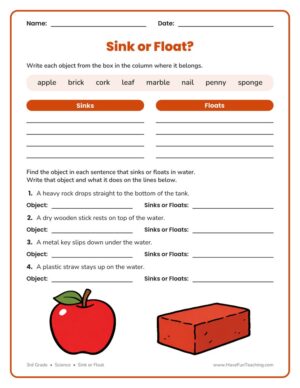
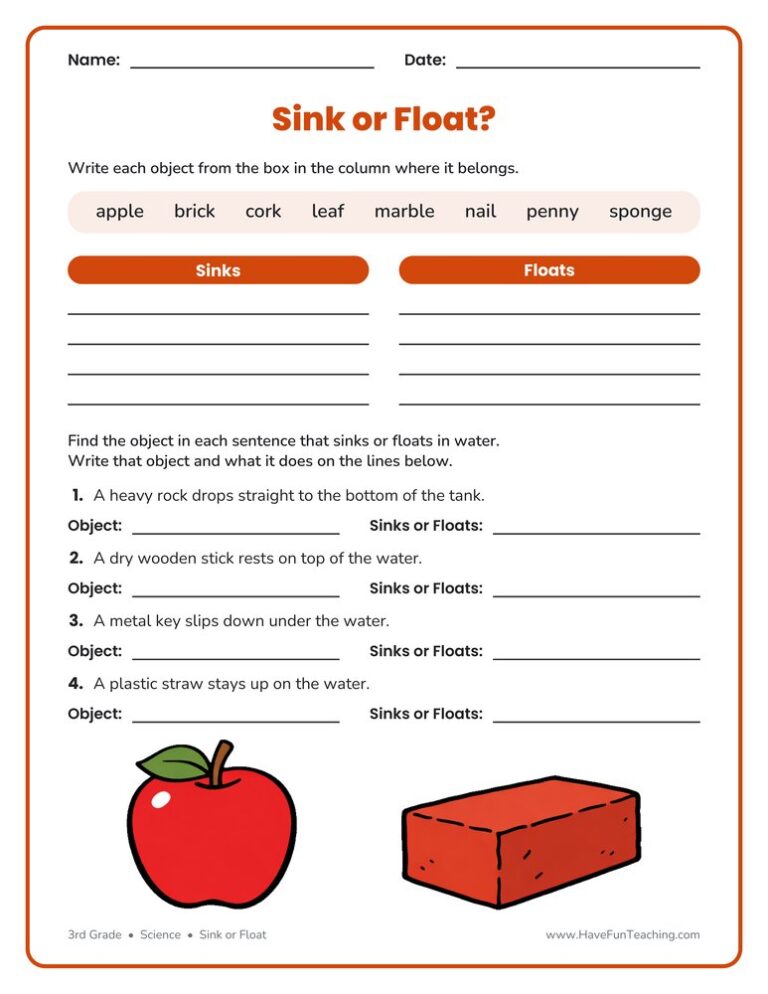
This Sink Float Examples Worksheet has 3rd graders sort eight everyday objects into Sinks and Floats columns, then name the object in four sentences. Answer key included for hands-on science practice.

From our teachers' playbook

Why do some things float?

What do kids learn about density?

Density is how tightly packed the stuff inside an object is. Young scientists start with a simple test: does it sink or float? They discover that size isn't the whole story, since a big log floats while a tiny pebble sinks. Older students learn that density compares mass to volume, written as density = mass ÷ volume, and that anything less dense than water (1 gram per cubic centimeter) floats. The click comes when kids predict correctly and can explain why.

Our favorite ways to teach density

Density is a perfect topic for predicting, testing and explaining. Grab a tub of water!

Predict, drop, record

Set out a tub of water and a basket of objects: a cork, a coin, an apple, a crayon. Kids predict sink or float, test, and record. Afterward ask "Did size decide it?" Testing their own predictions makes the idea stick.

Why it works: the U.S. Department of Education's guide for teaching elementary math recommends moving from hands-on objects to drawings to numbers.

Sink or Float ActivityTry it withSink or Float ActivityActivitiesOpen it →
Sort the evidence

After the experiment, kids sort pictures of objects into sink and float columns. Then they look for patterns: metal, wood, plastic. Seeing it all in one place helps them spot what really matters.

Why it works: children learn more from words and pictures together than from words alone (Mayer, 2009).

Sink Float Identify WorksheetTry it withSink Float Identify WorksheetWorksheetsOpen it →

Do the math

For older students, model how to find density by measuring mass and volume, then dividing. Show it with two blocks the same size but different weights. Working one example out loud prepares them for practice on their own.

Why it works: handing over the work step by step, from teacher to student, is one of the most widely used teaching frameworks (Pearson and Gallagher, 1983).

Density and Volume in Metric WorksheetTry it withDensity and Volume in Metric WorksheetWorksheetsOpen it →

Questions parents and teachers ask

What is density in simple terms for kids?

It's how much stuff is packed into a space. A brick and a sponge can be the same size, but the brick is denser because more matter is squeezed inside.

Why do some things float and others sink?

Things that are less dense than water float, and things that are denser than water sink. Shape matters too: a flat foil boat floats while the same foil in a ball sinks.

What grade learns about density?

Kids explore sink and float in the early grades. The idea of density as mass divided by volume usually appears around 5th to 8th grade.

What is an easy density experiment at home?

Put an egg in a glass of plain water and it sinks. Stir in several spoonfuls of salt and it floats! The salt water is denser than the egg.

Keep exploring