

Measuring Angles Worksheet
This measuring angles worksheet gives 4th graders hands-on practice using a protractor to measure angles in degrees and to name acute, right, obtuse, and straight angles. Answer key included for fast, no-prep geometry practice.
$6.97
Or free with a membership — members pay $3.33/mo for all 10,000+ resources. See plans
Want this one free?
Tell us where to send it and it’s yours — no card, no catch.
One free resource per teacher. We’ll also send free teaching ideas each week — unsubscribe anytime.
Teaching is easier with a membership
Unlimited printables, games & videos for PreK–6th — for your classroom or homeschool. Cancel anytime.
Start your 3-day free trial$0 today · cancel anytime · Instant access to 10,000+ resources
About this resource
Description
Learning to measure angles is an essential geometry skill, and this Measuring Angles Worksheet gives fourth graders focused practice using a protractor. Students see that angles are measured in degrees, that a full turn is 360 degrees, and that the size of an angle depends on how far one ray is rotated away from the other. Reading a protractor accurately builds the foundation for later work in geometry, measurement, and real-world problem solving.
This 4th grade angles worksheet is simple to use at home or in the classroom. In Part A, students place a protractor on each of six angles, read the correct scale, and write the measurement in degrees. In Part B, they look at four more angles and name each one as acute, right, obtuse, or straight. Just print the page and hand each student a protractor to begin, and use the included answer key to check work quickly.
What’s Included
- 1 print-ready PDF worksheet
- Answer key
- 10 angle problems (6 measuring, 4 identifying)
This measuring angles worksheet helps children learn in three ways. First, the hands-on protractor practice turns an abstract idea into a concrete, repeatable skill. Second, mixing measurement with classification helps students connect a number of degrees to the name of the angle, deepening their understanding. Third, the clean, uncluttered layout lets learners focus on reading the protractor correctly, building both accuracy and confidence.
Teachers and parents can extend this skill in fun ways beyond the page. Go on an “angle hunt” around the room and estimate the angles formed by open doors, clock hands, and scissors before measuring them. Challenge students to draw an angle of a given size, then trade papers and measure a partner’s work. You can also connect angles to art by having children design a geometric pattern and label the angles they used.
Related Resources
What teachers say
Reviews
You must be logged in to post a review.
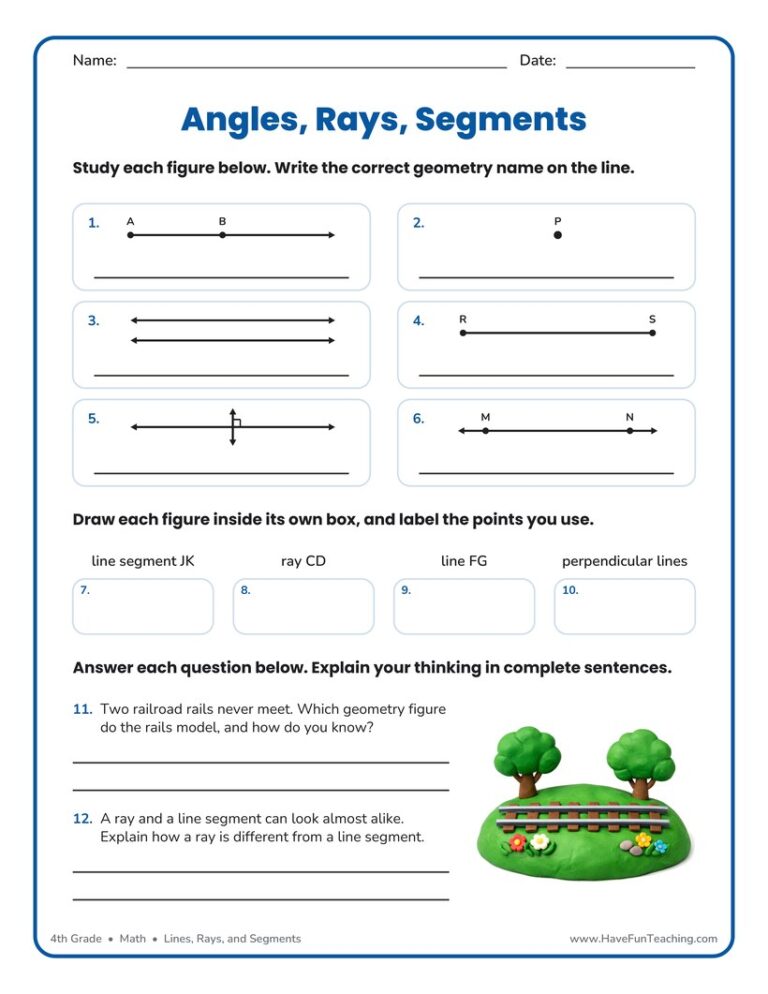
Students use this Lines Rays and Segments Worksheet to name, draw, and explain points, lines, segments, rays, and parallel and perpendicular lines. Built for 4th Grade with an answer key included, so checking takes seconds.

This 4.MD.7 Common Core Worksheet gives 4th graders practice finding unknown complementary and supplementary angles using right angles and straight lines. Includes a complete answer key — perfect for no-prep angle measurement practice.
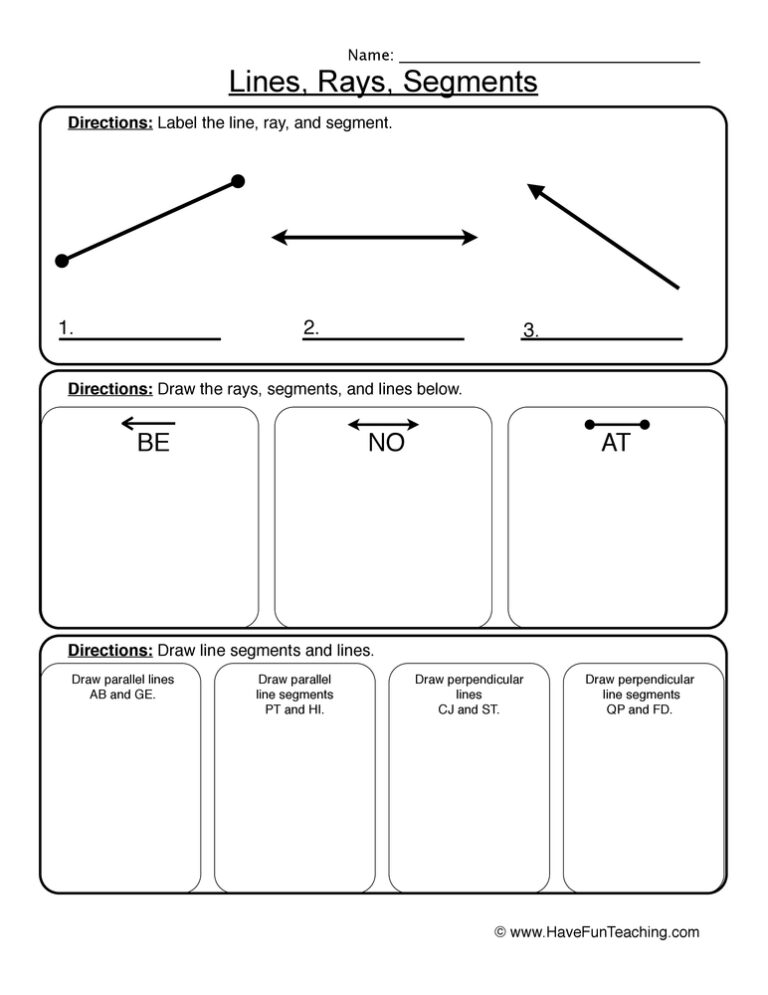
This angles rays and segments worksheet gives 4th graders practice naming and drawing lines, rays, segments, and parallel lines. An answer key is included, so checking work takes seconds.
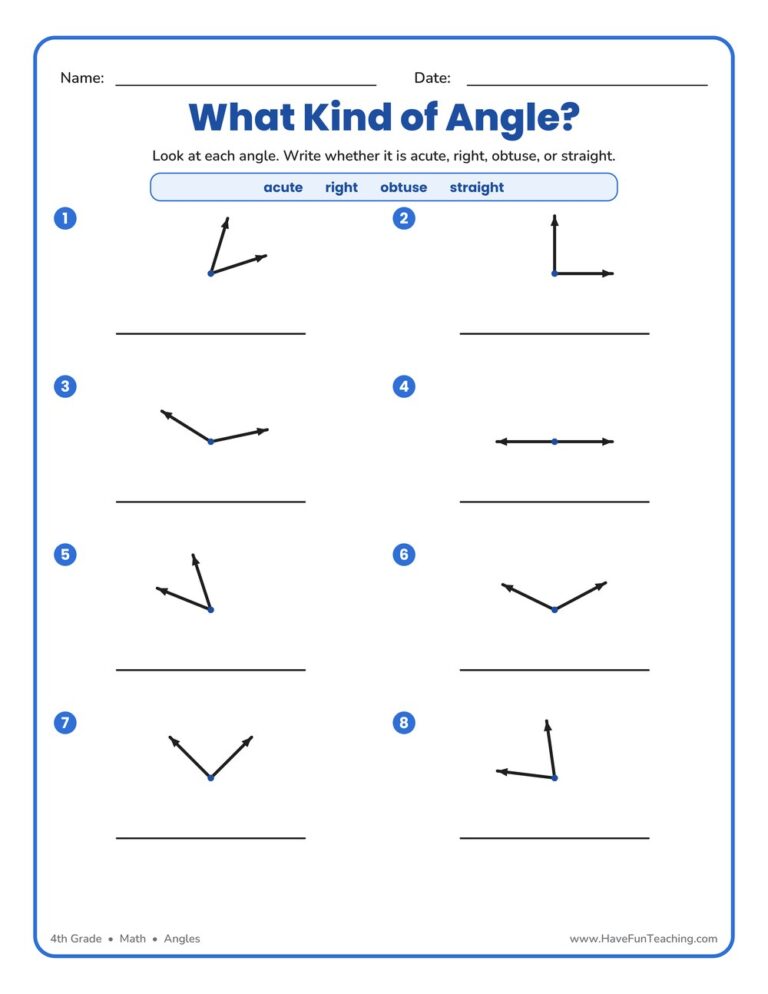
The What Kind of Angle worksheet gives 4th graders eight angles to sort as acute, right, obtuse, or straight. Answer key included for quick, no-prep geometry practice.

This angles measuring worksheet has 4th graders measure six angles with a protractor and label each one acute, obtuse, right, or straight. An answer key is included, so protractor practice checks itself in minutes.

This rays worksheet has 4th graders tell rays from lines and line segments on six labeled figures, draw ray MN from two given points, and explain the difference in writing. Answer key included.

In this Star Wars Rays and Angles Activity, students recognize angles as obtuse, acute or right by playing War!
In this 4.MD.7 Fourth Grade Common Core lesson students solve addition and subtraction problems to find unknown angles on a diagram.

Using this Measuring Monstrous Angles Activity, students measure angles in whole-number degrees using a protractor.

In this Up, Up, and Away! Measuring Angles Activity, students solve addition and subtraction problems to find unknown angles on a diagram.
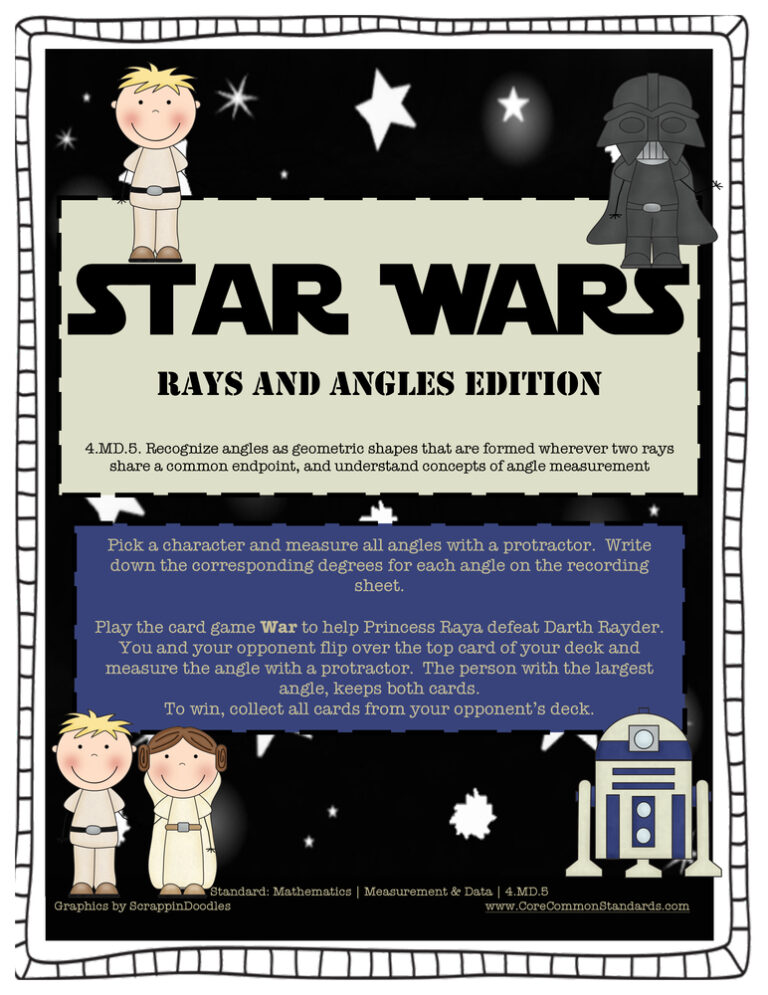
In this 4.MD.5 Common Core Activity, students recognize angles as obtuse, acute or right by playing this game of War with a partner!

In this 4.G.1 Fourth Grade Common Core Lesson, students identify points, lines, line segments, rays, angles, perpendicular and parallel lines.

Reviews
There are no reviews yet