
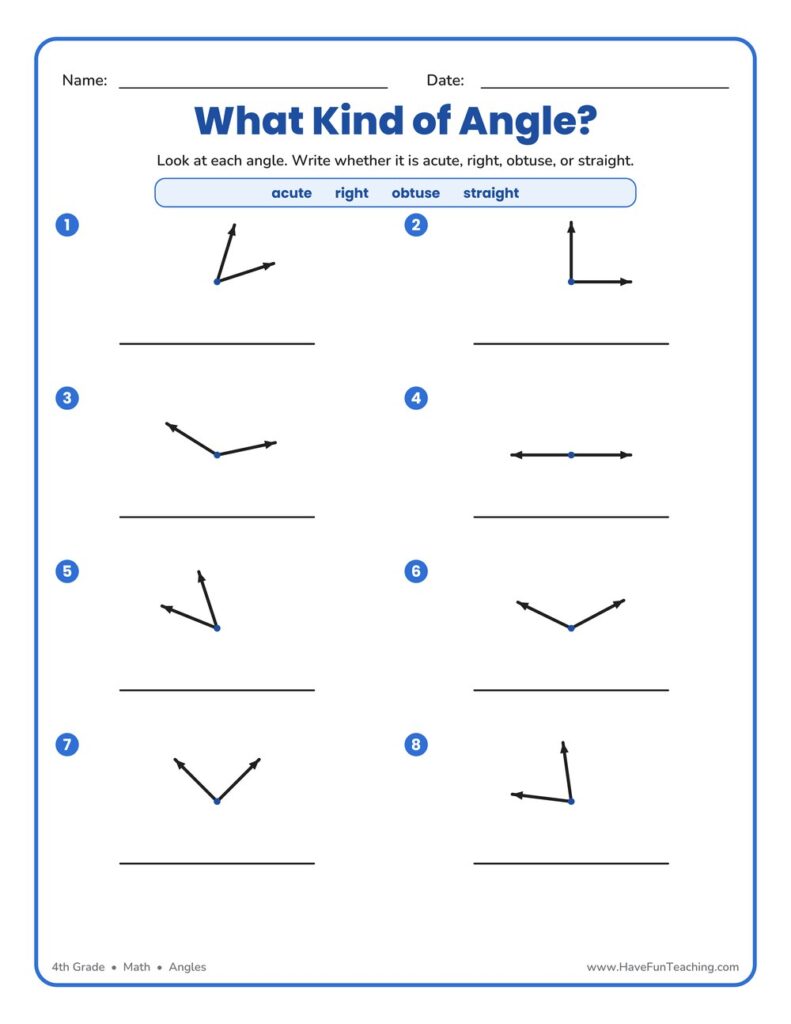
What Kind of Angle Worksheet
The What Kind of Angle worksheet gives 4th graders eight angles to sort as acute, right, obtuse, or straight. Answer key included for quick, no-prep geometry practice.
$6.97
Or free with a membership — members pay $3.33/mo for all 10,000+ resources. See plans
Want this one free?
Tell us where to send it and it’s yours — no card, no catch.
One free resource per teacher. We’ll also send free teaching ideas each week — unsubscribe anytime.
Teaching is easier with a membership
Unlimited printables, games & videos for PreK–6th — for your classroom or homeschool. Cancel anytime.
Start your 3-day free trial$0 today · cancel anytime · Instant access to 10,000+ resources
About this resource
Description
Knowing what kind of angle you are looking at is one of the first big steps toward understanding geometry. The What Kind of Angle worksheet helps students recognize and name angles by comparing each one to a right angle and deciding whether it is acute, right, obtuse, or straight. Building this vocabulary early gives learners the language they need to describe shapes, measure figures, and talk about the world around them with confidence.
This printable 4th grade angles worksheet presents eight clearly drawn angles, each one opening in a different direction so students learn to identify angle types no matter how a figure is rotated. A word bank at the top lists the four angle names, and a writing line beneath every figure gives students room to record their answer. To use it, print the page, review what makes an angle acute (smaller than a right angle), right (a square corner), obtuse (larger than a right angle), or straight (a flat line), then have students work through all eight examples on their own or with a partner.
What’s Included
- 1 print-ready PDF worksheet
- Answer key
- 8 angle-classifying problems with a word bank
There are three big reasons the What Kind of Angle worksheet makes learning stick. First, by comparing every angle to a right angle, students build a reliable mental benchmark for telling acute from obtuse. Second, showing angles in many orientations trains learners to focus on the size of the opening instead of the direction the rays happen to point. Third, the built-in answer key lets students check their work right away, turning practice into fast, low-stress feedback that builds real understanding.
Teachers and parents can extend this skill in playful ways. Go on an “angle hunt” around the classroom or house, spotting right angles in door frames, acute angles in a pair of scissors, and obtuse angles in an open laptop. Have students bend a pipe cleaner or their own arms to form each type of angle, or fold a paper “angle tester” to a perfect square corner and use it to sort real objects. These hands-on activities connect the worksheet to the shapes students already see every day.
Related Resources
What teachers say
Reviews
You must be logged in to post a review.
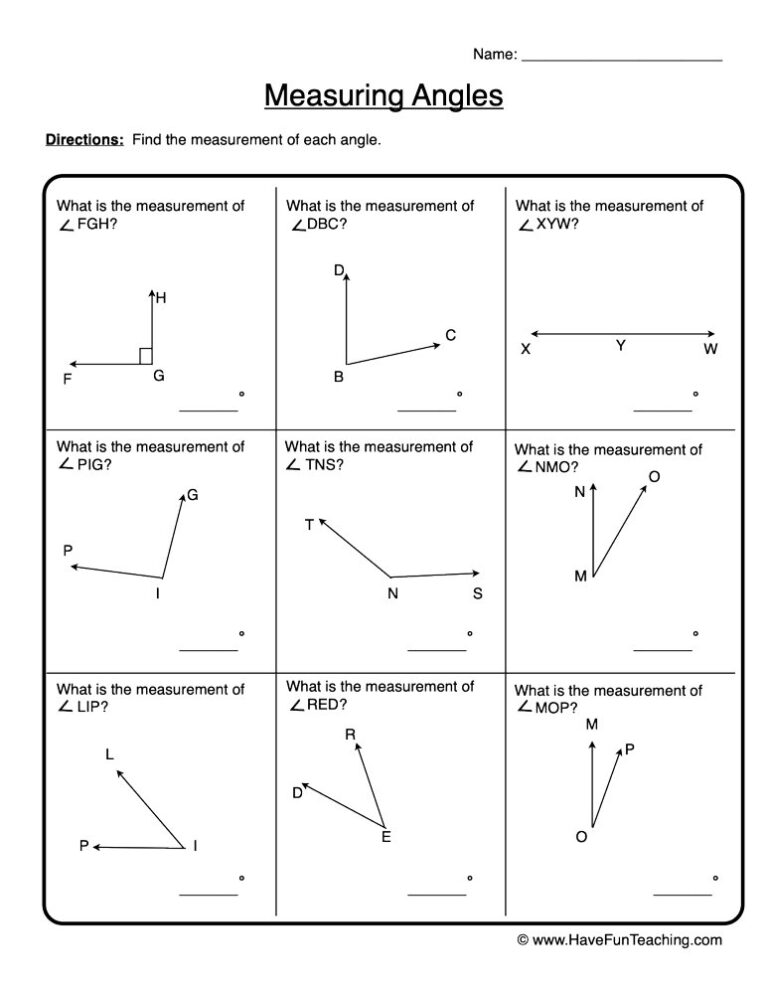
This measuring angles worksheet gives 4th graders hands-on practice using a protractor to measure angles in degrees and to name acute, right, obtuse, and straight angles. Answer key included for fast, no-prep geometry practice.
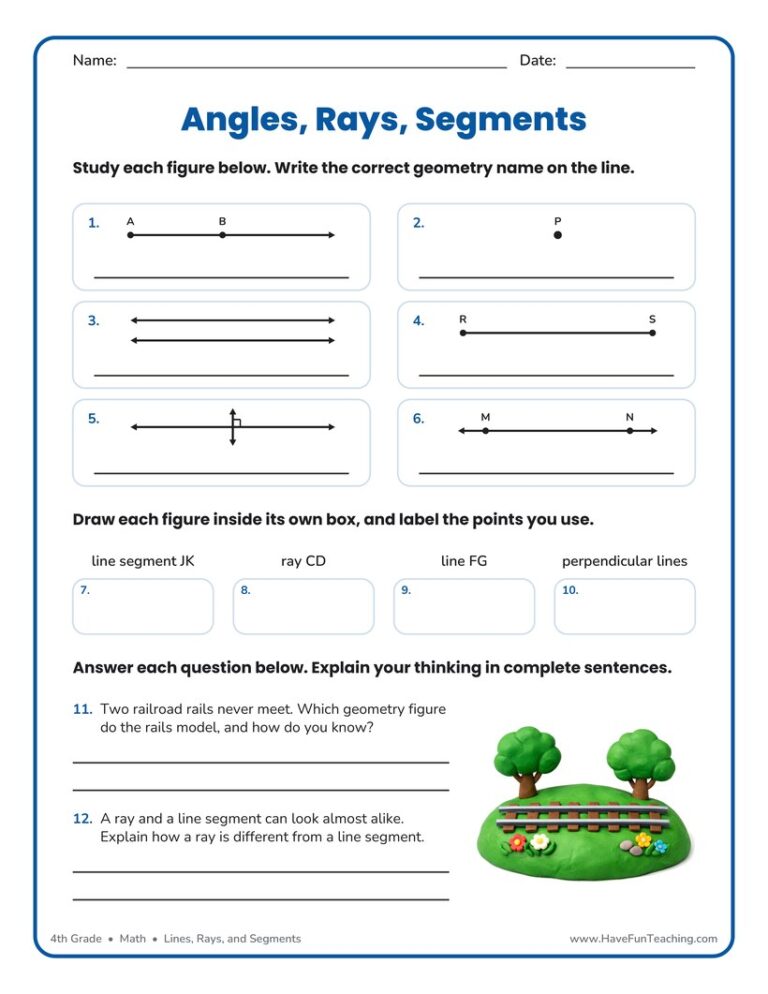
Students use this Lines Rays and Segments Worksheet to name, draw, and explain points, lines, segments, rays, and parallel and perpendicular lines. Built for 4th Grade with an answer key included, so checking takes seconds.

This 4.MD.7 Common Core Worksheet gives 4th graders practice finding unknown complementary and supplementary angles using right angles and straight lines. Includes a complete answer key — perfect for no-prep angle measurement practice.
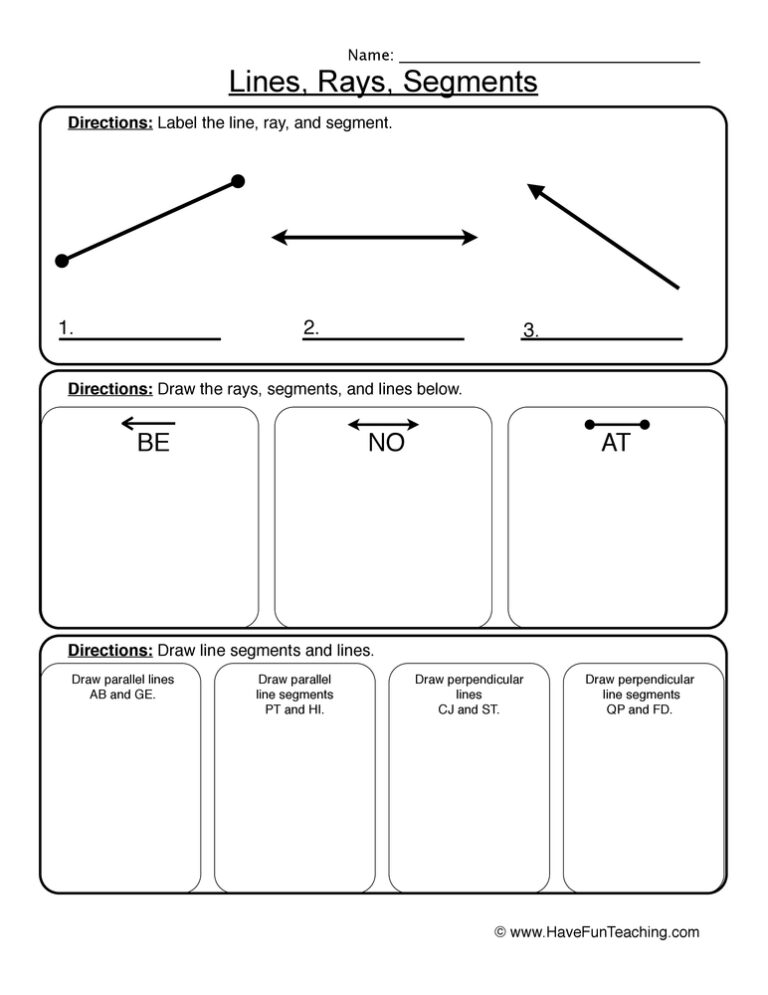
This angles rays and segments worksheet gives 4th graders practice naming and drawing lines, rays, segments, and parallel lines. An answer key is included, so checking work takes seconds.

This angles measuring worksheet has 4th graders measure six angles with a protractor and label each one acute, obtuse, right, or straight. An answer key is included, so protractor practice checks itself in minutes.

This rays worksheet has 4th graders tell rays from lines and line segments on six labeled figures, draw ray MN from two given points, and explain the difference in writing. Answer key included.

In this Star Wars Rays and Angles Activity, students recognize angles as obtuse, acute or right by playing War!
In this 4.MD.7 Fourth Grade Common Core lesson students solve addition and subtraction problems to find unknown angles on a diagram.

Using this Measuring Monstrous Angles Activity, students measure angles in whole-number degrees using a protractor.

In this Up, Up, and Away! Measuring Angles Activity, students solve addition and subtraction problems to find unknown angles on a diagram.
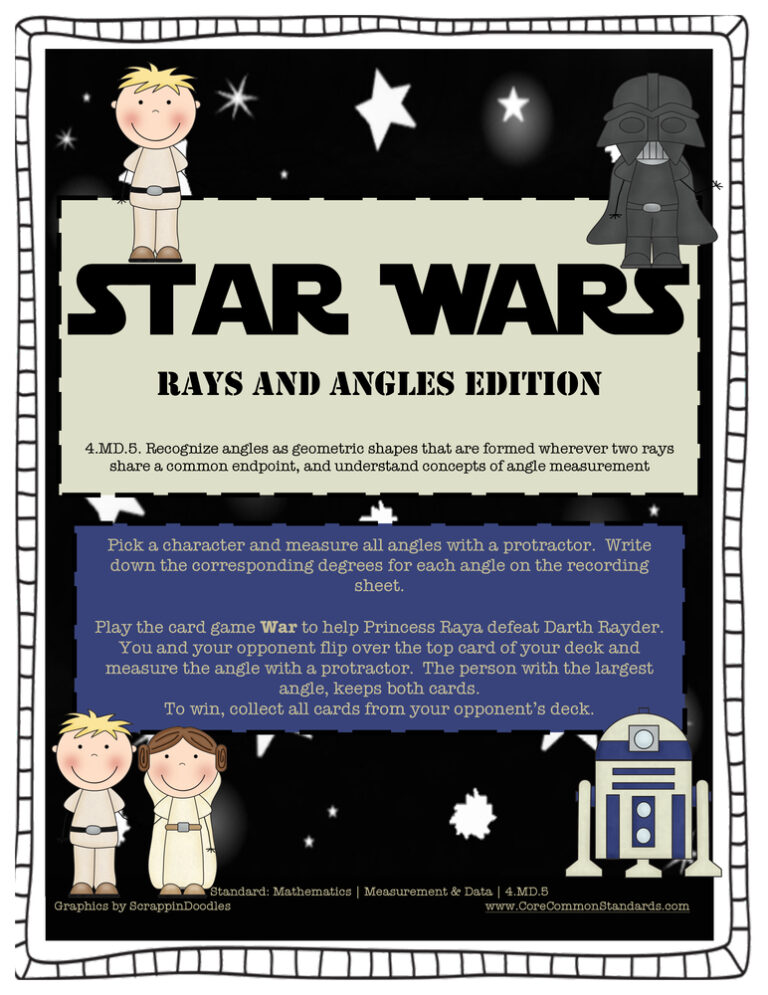
In this 4.MD.5 Common Core Activity, students recognize angles as obtuse, acute or right by playing this game of War with a partner!

In this 4.G.1 Fourth Grade Common Core Lesson, students identify points, lines, line segments, rays, angles, perpendicular and parallel lines.

Reviews
There are no reviews yet