
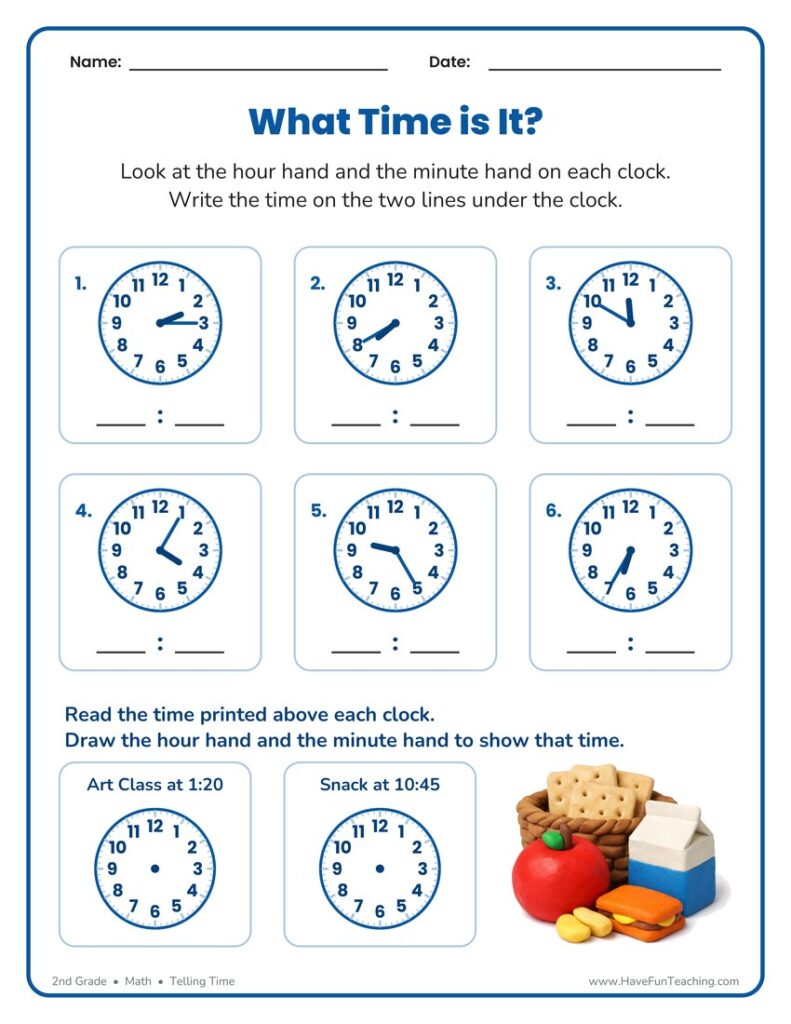
Write the Time Worksheet
This Write the Time Worksheet has 2nd graders read six analog clocks to the nearest five minutes, then draw the hands for two more. Answer key included, so clock practice is ready in one print.
$6.97
Or free with a membership — members pay $3.33/mo for all 10,000+ resources. See plans
Want this one free?
Tell us where to send it and it’s yours — no card, no catch.
One free resource per teacher. We’ll also send free teaching ideas each week — unsubscribe anytime.
Teaching is easier with a membership
Unlimited printables, games & videos for PreK–6th — for your classroom or homeschool. Cancel anytime.
Start your 3-day free trial$0 today · cancel anytime · Instant access to 10,000+ resources
About this resource
Description
Reading an analog clock to the nearest five minutes is the moment telling time stops being a memory trick and starts being real math. A second grader has to read two hands at once: the short hour hand, which creeps forward as the hour goes by, and the long minute hand, which points to a number that must be counted by fives. This Write the Time Worksheet gives students eight clock faces to work through, so the two-hand habit gets built one careful reading at a time.
This 2nd grade telling time worksheet is a two-part printable. In Part A, students study six analog clocks and write the digital time on a pair of solid handwriting lines under each face — the hour on the left, the minutes on the right, with the colon already printed between them. Every clock is drawn to the real instrument’s geometry: sixty minute ticks, twelve numbered hours, and an hour hand that sits partway between two numerals exactly as a real clock shows it. In Part B, the job flips. Students read a printed time above two empty clock faces and draw both hands themselves, which is the harder half of the standard and the one that shows whether a child truly understands what each hand means. Print this Write the Time Worksheet for morning work, a math center, homework, or a quick check before a unit test.
What’s Included
- 1 print-ready PDF worksheet
- Answer key
- 6 read-the-clock items and 2 draw-the-hands items, all to the nearest five minutes
There are three reasons this page moves students forward quickly. First, the times were chosen so that no two items share an hour or a minute value, which means a child cannot pattern-match their way to an answer — each clock has to be read on its own. Second, the hour hand is drawn where it truly belongs rather than parked on a numeral, so students learn to say “it is a little past nine” instead of guessing the nearest number. Third, asking students to draw the hands in Part B turns passive recognition into active construction, the same shift second grade standards ask for.
Teachers and parents can stretch this practice all week. Keep a small demonstration clock nearby and have children set it to the time lunch starts, recess ends, or the school day finishes. Count around a real classroom clock by fives together, touching each numeral as you go. Ask students to write a simple schedule for their afternoon and draw a clock beside each activity. Then sing the Counting By Fives Song together so counting the minute marks becomes automatic.
Related Resources
What teachers say
Reviews
You must be logged in to post a review.

This count by fives on a clock worksheet has 2nd graders skip count around a clock face, then read three clocks to the nearest five minutes. Answer key included, so telling time practice takes no prep.

This Show the Time Worksheet has 2nd graders draw clock hands for six printed times, then write the digital time two clocks already show. Answer key included, so telling time practice needs no prep.

This What Is The Time Worksheet gives 2nd graders six analog clocks to read to the nearest five minutes, plus three a.m./p.m. sentences. An answer key is included, so time practice checks itself in seconds.

Using this Telling Time Activity, students practice telling time to the hour on an analog clock.

This how much time passed to the hour worksheet gives 2nd graders four pairs of analog clocks plus two word problems to find the hours between a start and an end time. Answer key included for fast, no-prep practice.
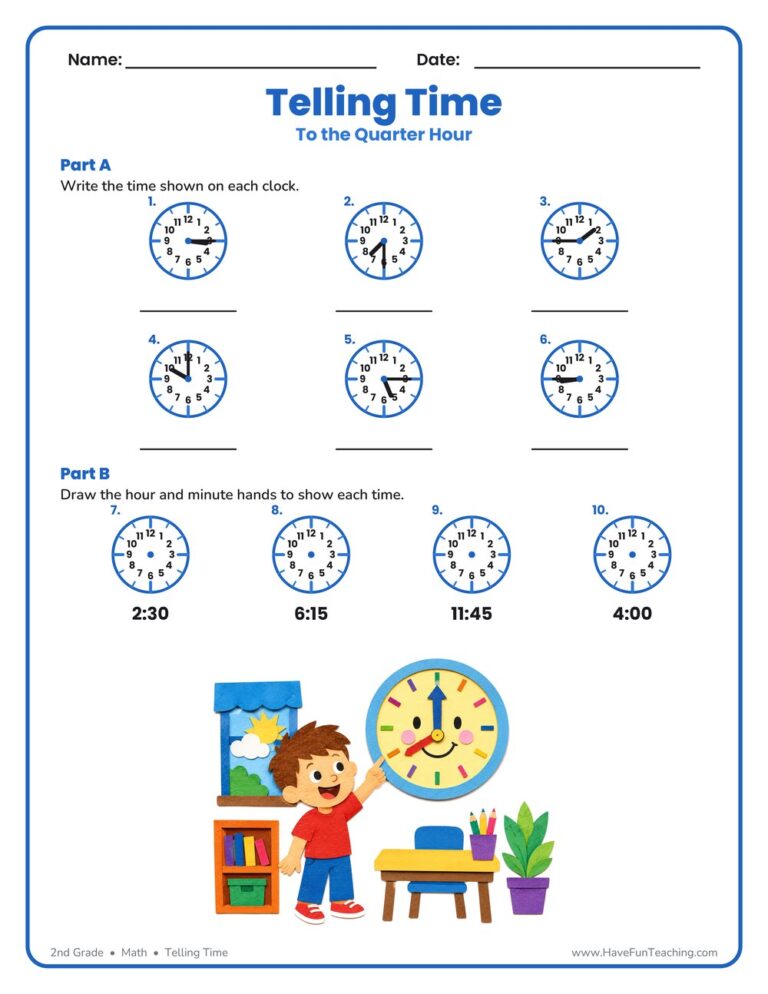
A classroom-themed Telling Time to the Quarter Hour Worksheet where 2nd graders read clocks and draw hands for times to the quarter hour. Answer key included for quick, no-prep math practice.

Using this Telling Time Hour Clock BINGO, students practice telling time to the hour on an analog clock.

On this how much time passed to the half hour worksheet, 2nd Grade students read a start clock and an end clock, then write the hours and minutes that went by. An answer key is included.

A showing the time on a clock worksheet where 2nd graders draw the hour and minute hands for six five-minute times, then solve two clue problems. Answer key included for fast, no-prep practice.
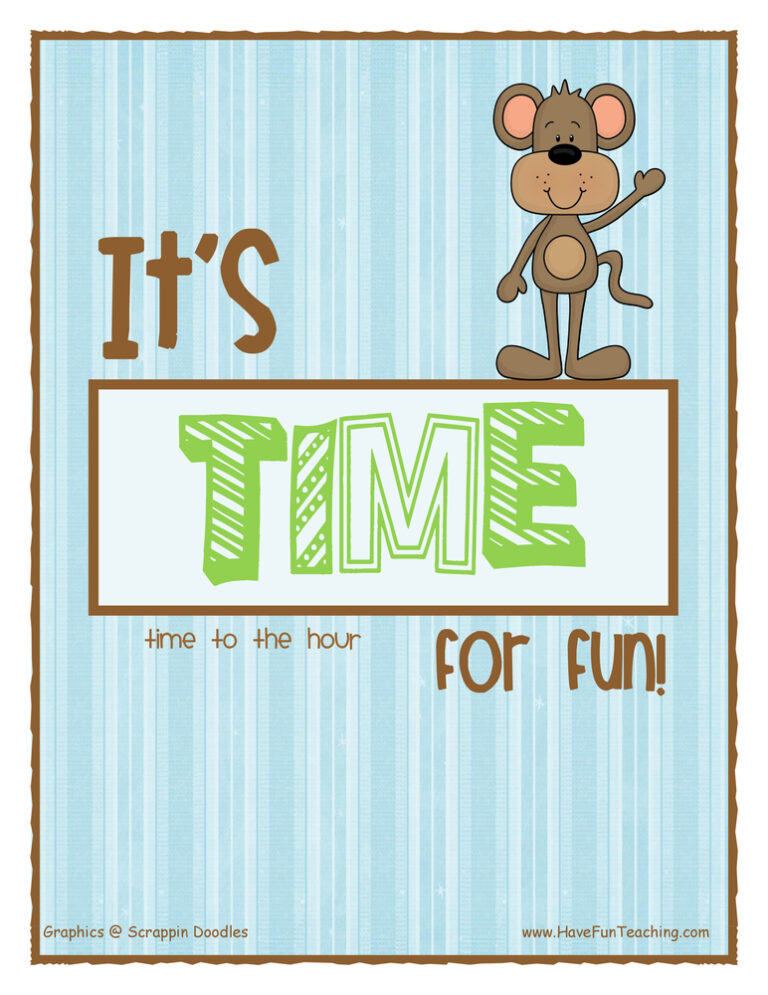
Using this It's Time For Fun To The Hour Clock Activity, students practice telling time to the hour on an analog and digital clock.
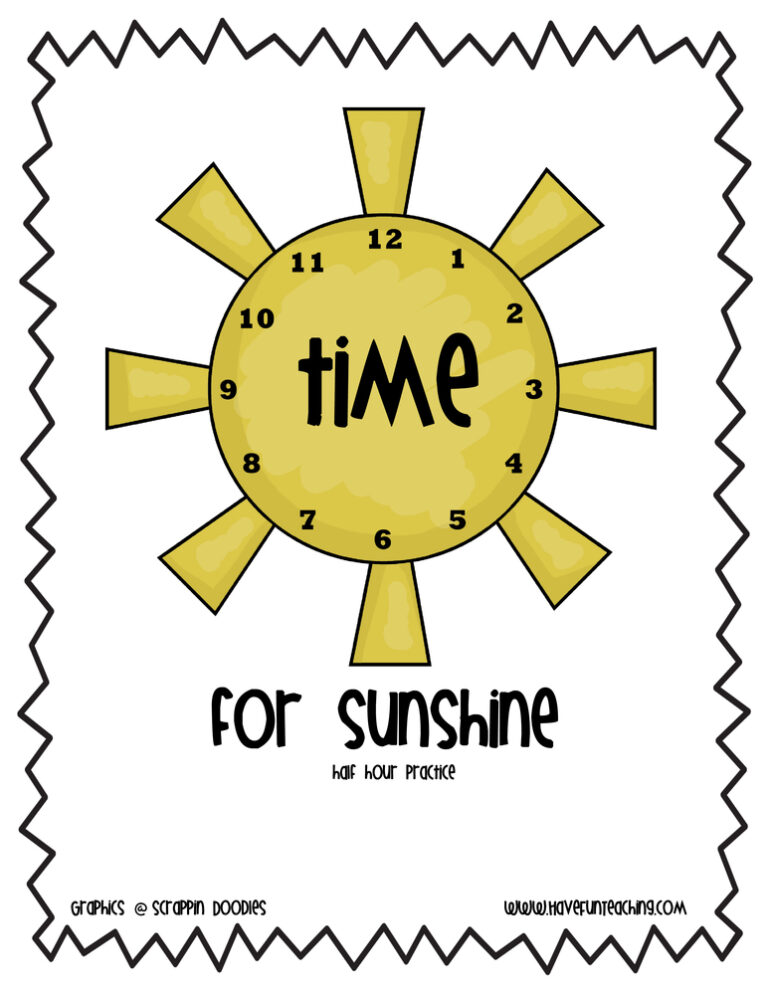
Using this Time for Sunshine To The Half Hour Clock Activity , students practice telling time to the half hour on an analog clock.
This Bee on Time to the Hour Activity teaches students about how to read a clock to the hour and half hour through this matching activity.
Reviews
There are no reviews yet