Skip to content
Start My 3 Free Days $0 today · cancel anytime

English Common Core Lessons

92 English Common Core Lessons, covering speaking and listening, vocabulary, punctuation, plus 20 more topics. How teachers use these

English Common Core Lessons

92 English Common Core Lessons, covering speaking and listening, vocabulary, punctuation, plus 20 more topics. How teachers use these

Common Core Lesson
Common Core LessonKindergartenCommon Core Unit Lesson Plan Template

With our Common Core Unit Lesson Plan Template, you can develop your monthly lessons across a specific unit. First, you will pick the theme of your unit.

Common Core Lesson
Common Core Lesson2nd GradeRF.2.3 Second Grade Common Core Lesson

Using RF.2.3 Second Grade Common Core Lesson, students know and apply grade-level phonics and word analysis skills in decoding words.

Common Core Lesson
Common Core LessonKindergartenSL.K.6 Kindergarten Common Core Lesson

Using this SL.K.6 Kindergarten Common Core Lesson, studentsspeak audibly and express thoughts, feelings, and ideas clearly.

Common Core Lesson
Common Core LessonKindergartenL.K.6 Kindergarten Common Core Lesson

Using L.K.6 Kindergarten Common Core Lesson, students use words and phrases acquired through conversations, reading and being read to, and responding to texts.

Common Core Lesson
Common Core Lesson1st GradeL.1.2 First Grade Common Core Lesson

Using L.1.2 First Grade Common Core Lesson, students use commas to separate single words in a series.

Common Core Lesson
Common Core LessonKindergartenCommon Core Daily Lesson Plan Template

With our Common Core Daily Lesson Plan Template, you will develop an Objective based on a Common Core Standard. Next, you will use the subject column

Common Core Lesson
Common Core LessonKindergartenSL.K.3 Kindergarten Common Core Lesson

Using this SL.K.3 Kindergarten Common Core Lesson, students ask and answer questions in order to seek help, get information, or clarify something that is not understood.

Common Core Lesson
Common Core Lesson2nd GradeRI.2.4 Second Grade Common Core Lesson

Using RI.2.4 Second Grade Common Core Lesson, students determine the meaning of words and phrases in a text relevant to a grade 2 topic or subject area.

Common Core Lesson
Common Core Lesson3rd GradeSL.3.1 Third Grade Common Core Lesson

Using this SL.3.1 Third Grade Common Core Lesson, students engage effectively in a range of collaborative discussionswith diverse partners on grade 3 topics and texts, building on others' ideas and expressing their own clearly.

Common Core Lesson
Common Core Lesson5th GradeRL.5.4 Fifth Grade Common Core Lesson

Using RL.5.4 Fifth Grade Common Core Lesson, students determine the meaning of general academic and domain-specific words and phrases in a text relevant to a grade 5 topic or subject area.

Common Core Lesson
Common Core Lesson5th GradeSL.5.4 Fifth Grade Common Core Lesson

Using this SL.5.4 Fifth Grade Common Core Lesson, students report on a topic or text, tell a story, or recount an experience in an organized manner, using relevant facts, descriptive details andspeak clearly.

Common Core Lesson
Common Core LessonKindergartenCommon Core Lesson Plan Template

With our Common Core Lesson Plan Template, you can develop your weekly lessons across multiple subjects. First, you will date your Lesson Plan and label

Common Core Lesson
Common Core Lesson1st GradeRF.1.1 First Grade Common Core Lesson

Using RF.1.1 First Grade Common Core Lesson, students recognize distinguishing features of a sentence by putting a words in order to create a complete thought.

Common Core Lesson
Common Core Lesson1st GradeSL.1.1 First Grade Common Core Lesson

Using this SL.1.1 First Grade Common Core Lesson, students participate in collaborative conversations with diverse partners about First Grade topics and texts with peers and adults in small and larger groups.

Common Core Lesson
Common Core Lesson1st GradeSL.1.2 First Grade Common Core Lesson

Using this SL.1.2 First Grade Common Core Lesson, students ask and answer questions about key details in a text read aloud or information presented orally or through other media.

Common Core Lesson
Common Core Lesson2nd GradeL.2.4 Second Grade Common Core Lesson

This L.2.4 Second Grade Common Core Lesson includes L.2.4 Worksheets, L.2.4 Activities, L.2.4 Assessment, and L.2.4 Poster.

Common Core Lesson
Common Core Lesson2nd GradeL.2.6 Second Grade Common Core Lesson

Using L.2.6 Second Grade Common Core Lesson, students use words and phrases acquired through conversations, reading and being read to.

Common Core Lesson
Common Core Lesson3rd GradeL.3.1 Third Grade Common Core Lesson

Using L.3.1 Third Grade Common Core Lesson, students sort examples into Past, Present, and Future categories in order to demonstrate a command of standard English grammar.

Common Core Lesson
Common Core Lesson3rd GradeL.3.2 Third Grade Common Core Lesson

Using L.3.2 Third Grade Common Core Lesson, students show correct punctuation, capitalization, and spelling to clearly convey their message.

Common Core Lesson
Common Core Lesson3rd GradeL.3.6 Third Grade Common Core Lesson

Using L.3.6 Third Grade Common Core Lesson, students collect vocabulary words and phrases in their reading into order to use as inspiration in their writing.

From our teachers' playbook

Grammar that kids actually enjoy

What do kids learn in English and grammar?

English class is where kids learn how our language works. They start by writing complete sentences with capital letters and end marks, then learn the parts of speech: nouns, verbs, adjectives and pronouns. Along the way they make plurals, including tricky irregular ones like mouse → mice, and use possessive pronouns like his and their. Older students build vocabulary with prefixes, suffixes and Greek and Latin roots. The click comes when kids catch their own mistakes before you do!

Our favorite ways to teach grammar

Grammar sticks when kids use it, not just memorize rules. These moves keep it active.

Sort the words

Cut apart a noun sort and have kids put words into person, place and thing piles. Then they add their own words to each pile. Sorting makes kids think about what a word does, not just what it looks like.

Why it works: going from real objects to pictures to symbols is a core recommendation of the U.S. Department of Education's elementary math guide.

Noun Sorting WorksheetTry it withNoun Sorting WorksheetWorksheetsOpen it →

Fix it together

Put one messy sentence on the board each morning and fix it as a class: "i went to the park on monday" becomes "I went to the park on Monday." Talk through every change. Then hand out the editing page for kids to try solo.

Why it works: handing over the work step by step, from teacher to student, is one of the most widely used teaching frameworks (Pearson and Gallagher, 1983).

Editing Sentences WorksheetTry it withEditing Sentences WorksheetWorksheetsOpen it →

Plural pop quiz

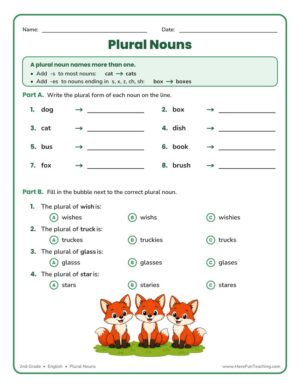
Call out a noun, like box, baby or leaf, and kids write the plural on whiteboards. Mix easy -s words with -es and -ies ones. A quick check like this shows who needs the rule again.

Why it works: researchers who compared ten study methods found practice testing is one of the two that work best (Dunlosky and colleagues, 2013).

Creating Plural Nouns WorksheetTry it withCreating Plural Nouns WorksheetWorksheetsOpen it →

Questions parents and teachers ask about English

What grammar should kids know in elementary school?

Kids learn complete sentences, capitalization and punctuation, nouns and plurals, verbs and tenses, pronouns, adjectives and adverbs. Upper grades add prefixes, suffixes and word roots.

How do I make grammar fun for kids?

Turn it into games, sorts and silly sentences. Let kids fix your mistakes on the board. Kids love catching the teacher being wrong!

What is the best way to teach parts of speech?

Start with what a word does in a sentence: a noun names, a verb shows action, an adjective describes. Sorting words and finding them in real books makes it concrete.

How can I help my child with grammar at home?

Read together and point out punctuation and interesting words. Have them read their own writing aloud to catch mistakes, and try a quick editing worksheet now and then.

Keep exploring