Skip to content
Start My 3 Free Days $0 today · cancel anytime

4th Grade Adverbs Resources

4 4th grade adverbs resources: 3 worksheets and 1 activity. How teachers use these

4th Grade Adverbs Resources

4 4th grade adverbs resources: 3 worksheets and 1 activity. How teachers use these

Worksheet
Worksheet4th GradeComparative & Superlative Adverbs Worksheet

This Comparative & Superlative Adverbs Worksheet asks 4th graders to write the correct -er, -est, more, or most form of each adverb. Includes an answer key for quick, no-prep grammar practice.

Worksheet
Worksheet4th GradeDescribe it Using Adverbs Worksheet

This Describe it Using Adverbs Worksheet gives 3rd graders nine sentences that practice adverbs telling how, when, and where. An answer key is included, so grammar practice takes minutes to assign and score.

Activity
Activity4th GradeDiving Deep Sorting Words Activity

This diving deep sorting words activity for 3rd to 5th grade has students sort 36 transition word cards by the job each word does. Answer key included.

Worksheet
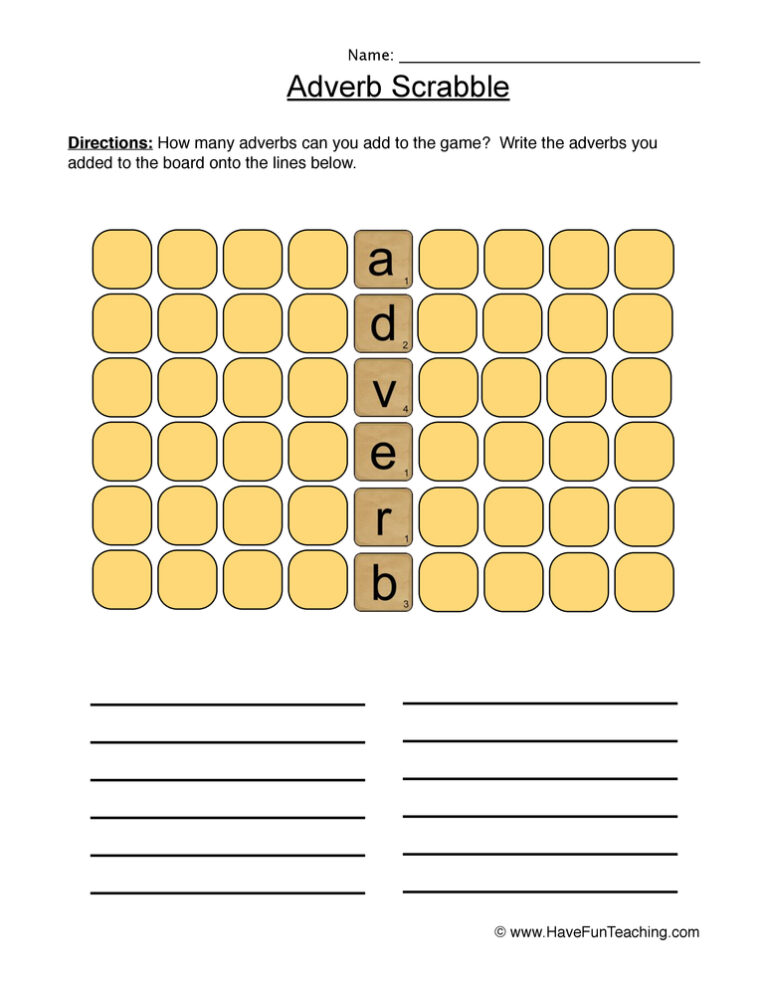
Worksheet4th GradePlay Scrabble Adverbs Worksheet

Using this Play Scrabble Adverbs Worksheet, students will be able to write adverbs while playing Scrabble to build their describing skills.

From our teachers' playbook

How, when, where and how much

What do 4th graders learn about adverbs?

Fourth graders know adverbs describe verbs, telling how, when, where or how much something happens: The dog ran quickly. They learn relative adverbs like where, when and why that connect ideas: "That's the park where we play." They also compare with adverbs: fast, faster, fastest, or carefully, more carefully, most carefully. The click comes when kids swap a boring sentence for a vivid one just by adding the right adverb.

How we teach adverbs in 4th grade

Adverbs make writing come alive. These moves help kids find them and use them well.

Upgrade a sentence

Write "The cat walked" on the board and model adding adverbs: "Yesterday, the cat walked slowly outside." Ask which word tells when, how and where. Then kids upgrade their own boring sentences.

Why it works: showing first, practicing together, then letting kids try alone is the "gradual release" model teachers have relied on for decades (Pearson and Gallagher, 1983).

Describe it Using Adverbs WorksheetTry it withDescribe it Using Adverbs WorksheetWorksheetsOpen it →

Compare with adverbs

Make a three-column chart: one, two, three or more. Fill it with fast, faster, fastest and quietly, more quietly, most quietly. Kids sort adverb cards into the chart. Seeing the pattern helps them know when to add -er or use more.

Why it works: the U.S. Department of Education's guide for teaching elementary math recommends moving from hands-on objects to drawings to numbers.

Comparative & Superlative Adverbs WorksheetTry it withComparative & Superlative Adverbs WorksheetWorksheetsOpen it →

Sort the word types

Mix adverbs, adjectives and verbs on cards and have kids sort them. Then they explain one tricky word, like fast, which can be both. Sorting builds real grammar sense.

Why it works: playful practice with a clear goal keeps kids practicing longer, and simple learning games have been shown to build real skills (Ramani and Siegler, 2008).

Diving Deep Sorting Words ActivityTry it withDiving Deep Sorting Words ActivityActivitiesOpen it →

Questions parents and teachers ask

What is an adverb for 4th graders?

An adverb is a word that describes a verb, adjective or another adverb. It tells how, when, where or how much, like quickly, yesterday, outside or very.

What are relative adverbs?

Relative adverbs are where, when and why. They connect a describing part to a sentence, like "I remember the day when we went camping."

Do all adverbs end in -ly?

No. Many do, like slowly and happily, but words like soon, here, very, always and fast are adverbs too.

How can I help my child learn adverbs?

Play adverb charades at home, or ask your child to describe how someone did something: "How did your brother eat dinner?" Then talk about the adverb they used.