
Skip to content
Start My 3 Free Days $0 today · cancel anytime

Properties Resources

15 properties resources: 6 worksheets, 5 activities and 4 Common Core Lessons. How teachers use these

Properties Resources

15 properties resources: 6 worksheets, 5 activities and 4 Common Core Lessons. How teachers use these

Worksheet
Worksheet1st GradeCommutative and Associative Properties Worksheet

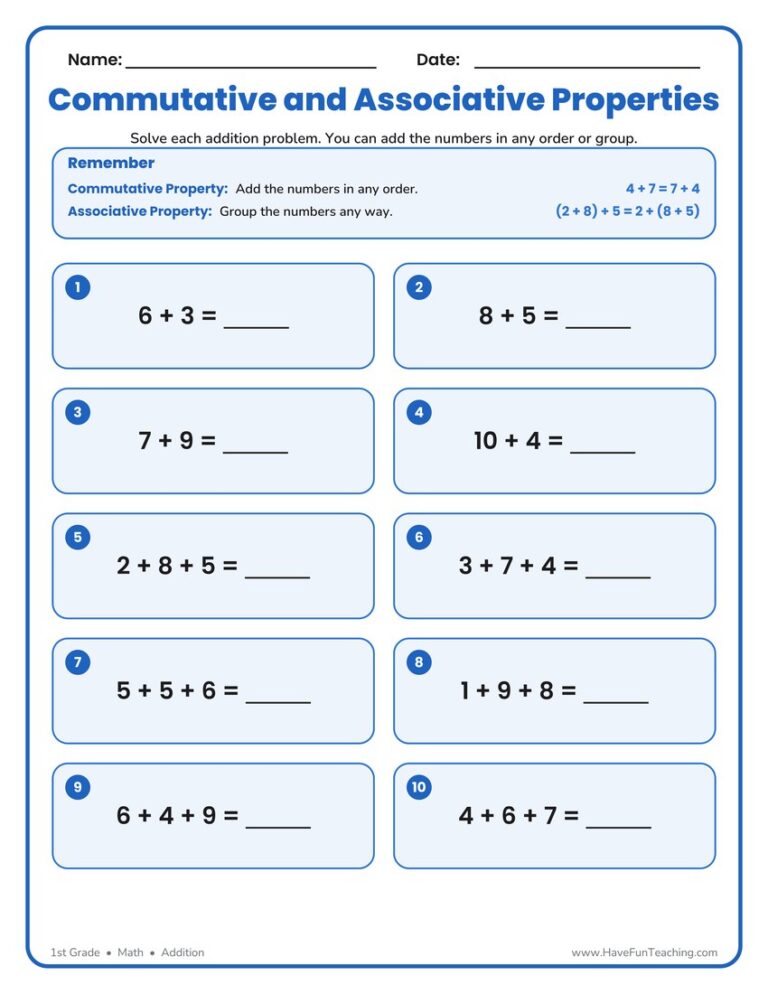
A first-grade commutative and associative properties worksheet where students solve ten addition problems by adding the numbers in any order or group. Includes an answer key and a handy reminder box for no-prep math practice.

Worksheet
Worksheet1st GradeAdding In Any Order Worksheet

This Adding In Any Order Worksheet helps 1st graders see that 3 + 4 and 4 + 3 always match, using picture groups first and quick fact flips second. Answer key included, so practice takes minutes to check.

Worksheet
Worksheet1st GradeCommutative Property Addition Worksheet

The Commutative Property Addition Worksheet gives 1st Grade students six addition facts to write again with the numbers turned around. An answer key is included, so turnaround facts check themselves.

Worksheet
Worksheet2nd GradeWhy It Works Explaining Addition and Subtraction Worksheet

This why it works explaining addition and subtraction worksheet has 2nd graders jump by tens and ones on open number lines to add and subtract within 100. An answer key is included.

Activity
ActivityKindergartenCommutative Property of Addition Activity

Using Commutative Property of Addition Activity, studentsmatch the popcorn cards to the matching popcorn container to show examples of the property.

Activity
Activity3rd GradeProperty Monsters Math Properties Activity

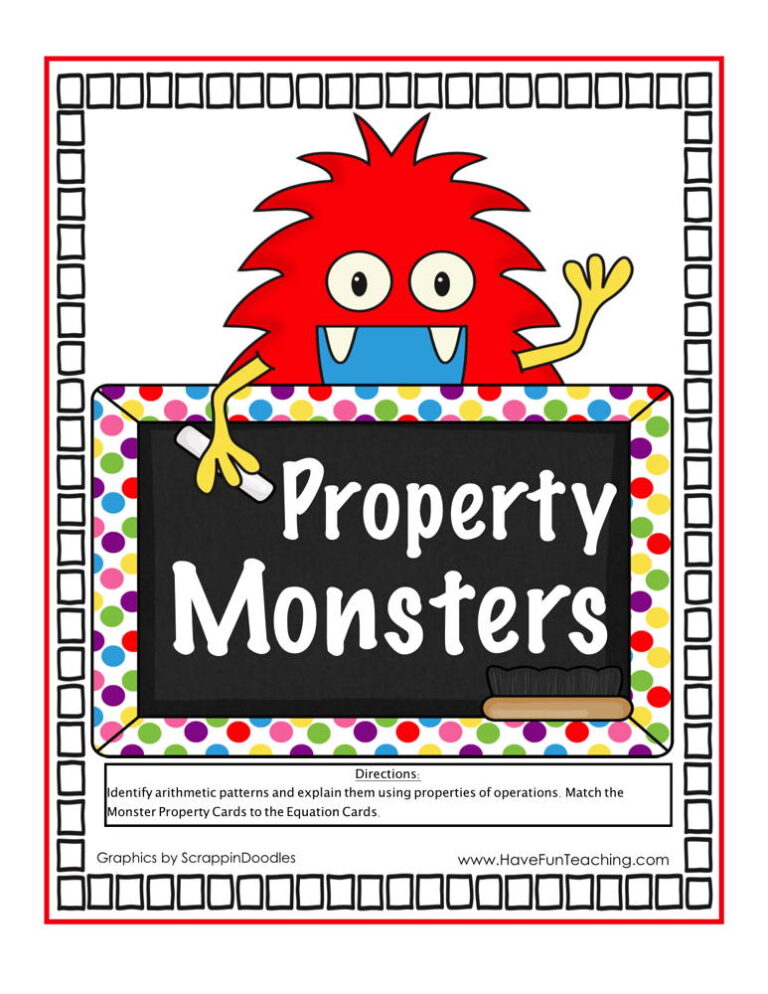
This property monsters math properties activity has 3rd-5th grade students sort equation cards by the commutative, associative, identity, zero and distributive properties. Answer key included.

Activity
Activity3rd GradePenguins Multiplication Division Properties Activity

Using Penguins Multiplication Division Properties Activity, students explain why multiplication and division strategies work.

Worksheet
Worksheet1st GradeIf I Know This Then I Know Addition Worksheet

This if I know this then I know addition worksheet helps 1st grade students use turnaround facts to solve sums within 20, with an answer key included for quick, confident checking.

Worksheet
Worksheet1st GradeUsing Strategies to Solve Equations Worksheet

This using strategies to solve equations worksheet helps 1st graders add three numbers by making a ten first. An answer key is included, so checking work is quick and easy.

Common Core Lesson
Common Core Lesson1st Grade1.OA.3 First Grade Common Core Lesson

In this 1.OA.3 First Grade Common Core Lesson, students discover that you can add in any order and get the same sum each time!

Common Core Lesson
Common Core Lesson3rd Grade3.OA.7 Third Grade Common Core Lesson

In this 3.OA.7 Third Grade Common Core lesson students determine the unknown whole number in a multiplication or division equation.

Activity
ActivityKindergartenWhy Does it Work Addition Subtraction Strategies Activity

Using Why Does it Work Addition Subtraction Strategies Activity, students explain why addition and subtraction strategies work, using place value and the properties of operations.

Common Core Lesson
Common Core Lesson3rd Grade3.OA.5 Third Grade Common Core Lesson

In this 3.OA.5 Third Grade Common Core Lesson, students apply properties of operations as strategies to multiply and divide.

Common Core Lesson
Common Core Lesson5th Grade5.NF.5 Fifth Grade Common Core Lesson

In this 5.NF.5 Fifth Grade Common Core Lesson, students compare the size of a product to the size of one factor to the other factor.

Activity
Activity1st GradeMama Mia Commutative Property Addition Activity

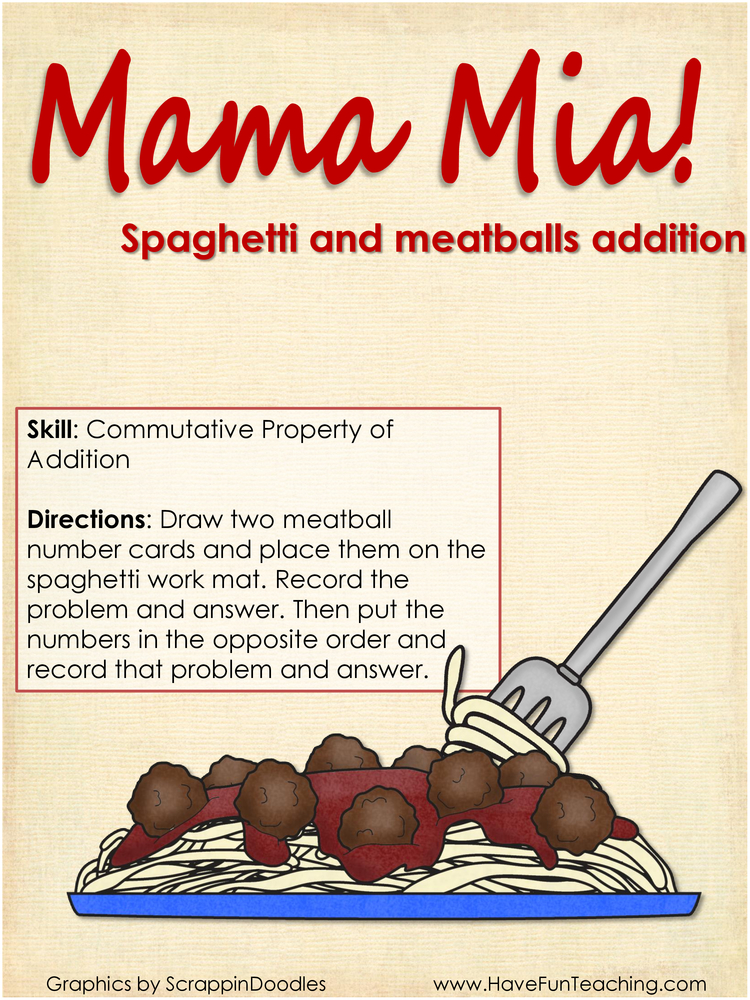
Using thisMama Mia Commutative Property Addition Activity, students practice the Commutative Property of Addition by writing equations in any order.

From our teachers' playbook

The rules that make math easier

What do kids learn about math properties?

Math properties are the rules that let kids move numbers around without changing the answer. The commutative property says order doesn't matter: 3 + 5 = 5 + 3. The associative property says grouping doesn't matter: (2 + 3) + 4 = 2 + (3 + 4). Later kids meet the identity and zero properties and the distributive property, 3 × 14 = 3 × 10 + 3 × 4. First graders use these for addition facts, third graders for multiplication, older kids for mental math. The click comes when kids realize properties are shortcuts, not more rules.

Our favorite ways to teach math properties

Properties make sense when kids discover them, not when they memorize the names. These moves get them there.

Flip the dominoes

Give kids dominoes and have them write the addition sentence, then turn the domino around and write it again. 4 + 2 and 2 + 4 both make 6! Once they see it with objects, the name "commutative" is just a label for what they already know.

Why it works: going from real objects to pictures to symbols is a core recommendation of the U.S. Department of Education's elementary math guide.

Commutative Property of Addition ActivityTry it withCommutative Property of Addition ActivityActivitiesOpen it →

Look for friendly groups

Write 7 + 6 + 3 and think aloud: "I'll add 7 and 3 first because that makes 10." Then show how parentheses move without changing the answer. Model it with three or four problems before kids try finding their own friendly pairs.

Why it works: showing first, practicing together, then letting kids try alone is the "gradual release" model teachers have relied on for decades (Pearson and Gallagher, 1983).

Commutative and Associative Properties WorksheetTry it withCommutative and Associative Properties WorksheetWorksheetsOpen it →

Why does it work?

Ask partners to explain why a shortcut works, not just that it works. "Why is 5 × 8 the same as 8 × 5?" Kids who can explain a property can use it. Sentence stems like "I know ___ so I know ___" help.

Why it works: when kids say the precise math words, their understanding gets sharper, a recommendation of the U.S. Department of Education's elementary math guide.

Why Does it Work Addition Subtraction Strategies ActivityTry it withWhy Does it Work Addition Subtraction Strategies ActivityActivitiesOpen it →

Math property questions parents and teachers ask

What are the math properties kids learn?

The main ones are commutative (order doesn't matter), associative (grouping doesn't matter), identity (adding 0 or multiplying by 1 keeps the number the same), zero (multiplying by 0 gives 0) and distributive (break a number apart to multiply).

What grade learns the commutative property?

Kids start using it in first grade with addition, often without the name. Third graders use it with multiplication and usually learn the formal names.

What is the difference between commutative and associative?

Commutative is about order: 2 + 5 = 5 + 2. Associative is about grouping with parentheses: (2 + 5) + 3 = 2 + (5 + 3). A quick way to remember: commute means to travel, so the numbers move places.

Do properties work for subtraction and division?

No. 8 − 3 isn't the same as 3 − 8, and 12 ÷ 4 isn't the same as 4 ÷ 12. Testing this is a great way for kids to see why properties matter.

Keep exploring



