Skip to content
Start My 3 Free Days $0 today · cancel anytime

Telling Time Activities

17 telling time activities. Teacher favorites: Telling Time Activity and Prime Time Telling Time Activity. How teachers use these

Telling Time Activities

17 telling time activities. Teacher favorites: Telling Time Activity and Prime Time Telling Time Activity. How teachers use these

Activity
Activity1st GradeTelling Time Activity

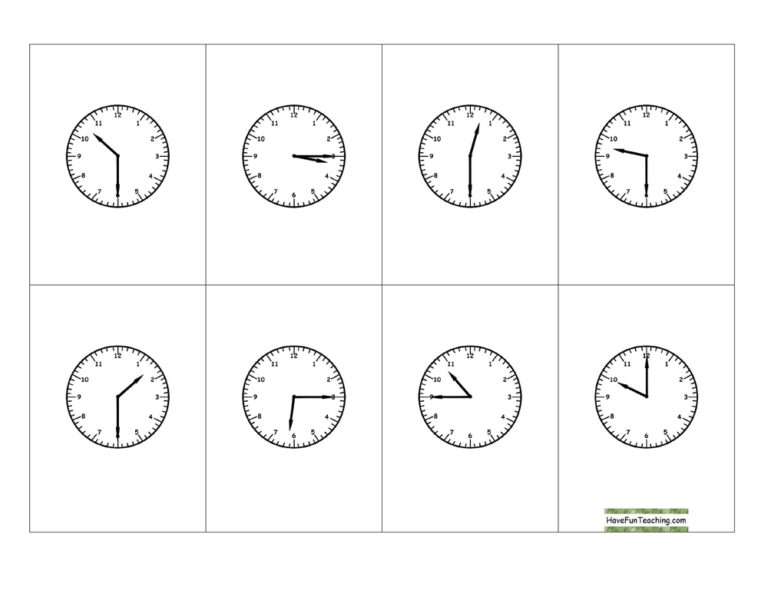
Read analog clocks to the hour, half hour and quarter hour with leveled clock task cards, a recording sheet and a draw-the-hands practice page for 1st and 2nd grade. An answer key is included.

Activity
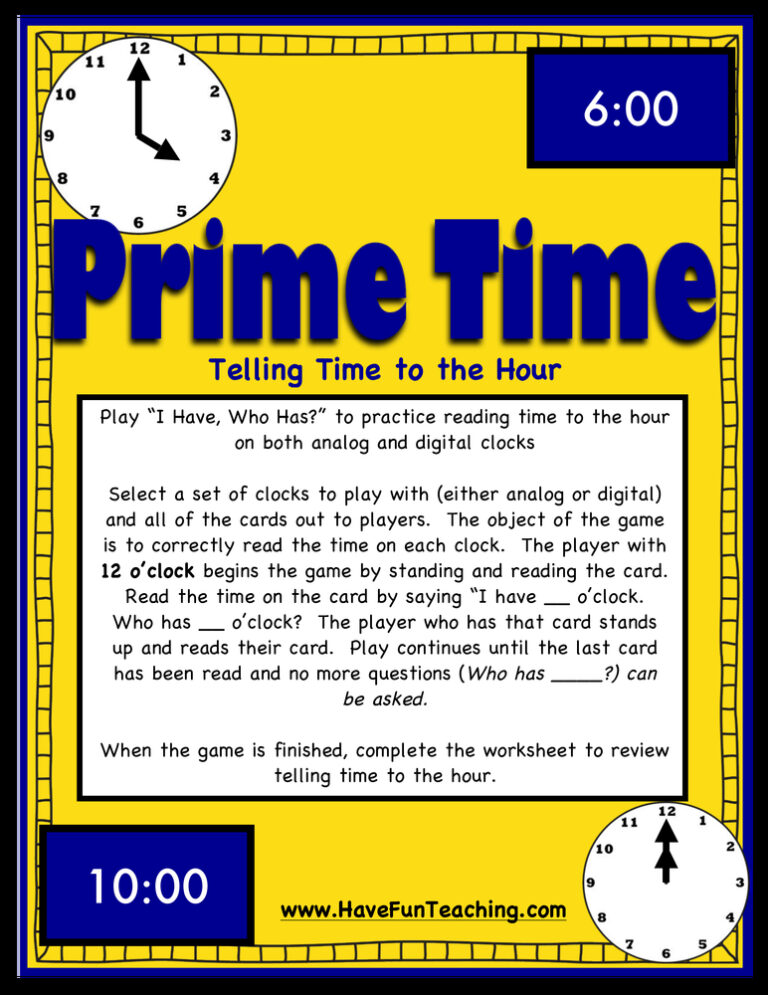
Activity1st GradePrime Time Telling Time Activity

This prime time telling time activity is an I Have, Who Has? game where 1st and 2nd grade children read time to the hour on analog and digital clocks. Answer key included.

Activity
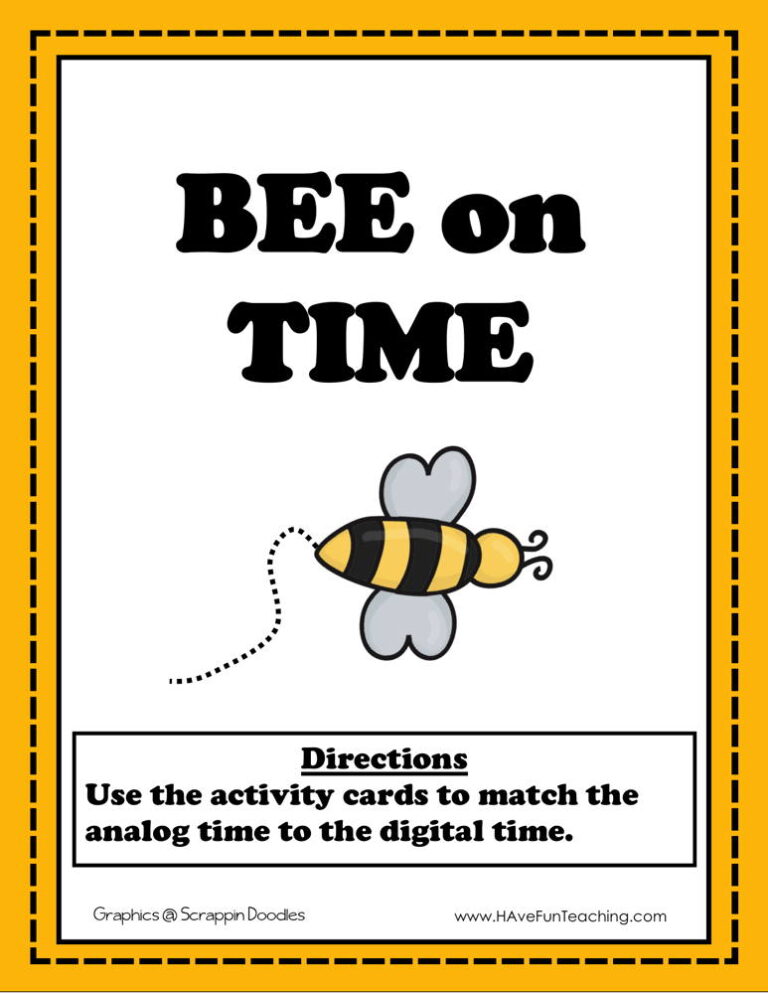
Activity1st GradeBee on Time to the Hour Activity

This Bee on Time to the Hour activity is a memory match game where 1st and 2nd Grade students pair clock cards with honeycomb time cards. Answer key included.

Activity
Activity1st GradeTelling Time Half Hour Clock BINGO

This telling time half hour clock BINGO activity has 1st and 2nd grade children read analog clocks to the hour and half hour on 12 boards. Answer key included.

Activity
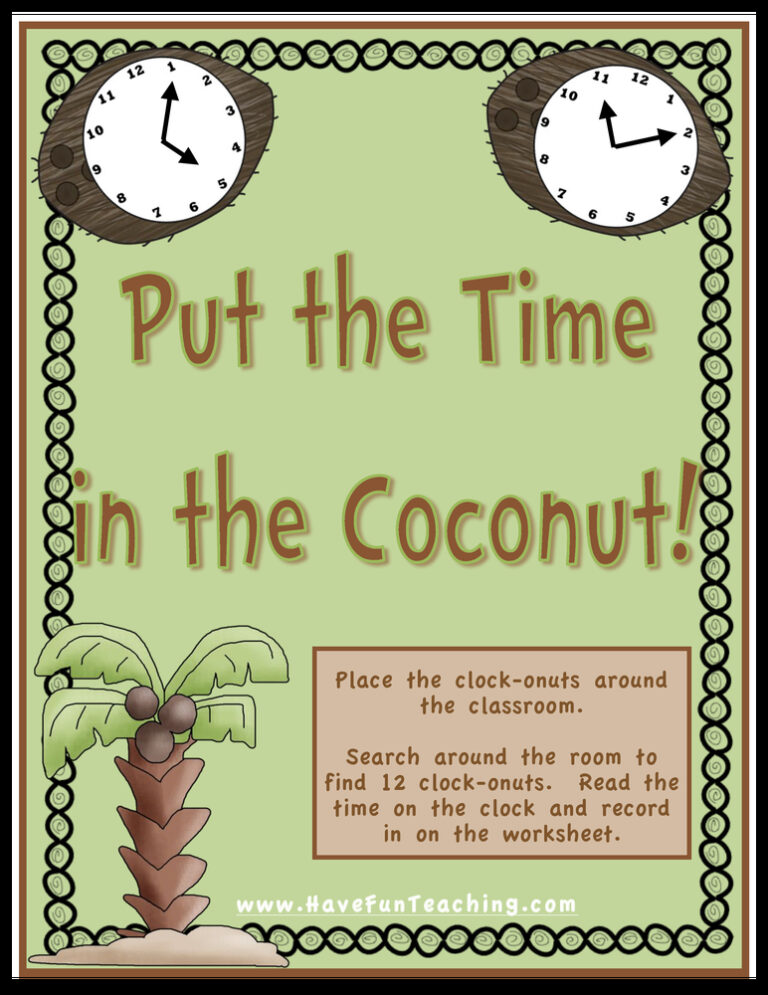
Activity2nd GradePut the Time in the Coconut Activity

This put the time in the coconut activity has 2nd-3rd grade students hunt for coconut clock cards and read each time to five minutes. Answer key included.

Activity
Activity2nd GradeWhat Time Is It to 5 Minutes Activity

This what time is it to 5 minutes activity lets 2nd and 3rd grade students match analog clocks to digital times in a domino circle game. Answer key included for easy checking.

Activity
Activity1st GradeTelling Time To The Hour Clock Activity

This telling time to the hour clock activity lets 1st and 2nd Grade students match analog clocks to fiesta event cards for a Cinco de Mayo schedule. Answer key included.

Activity
Activity1st GradeTelling Time Hour Clock BINGO

This telling time hour clock bingo activity helps 1st to 3rd grade students read analog clocks to the hour with six BINGO boards and caller cards, answer key included.

Activity
Activity1st GradeDon't Be Tardy for the Party Telling Time Half Hour Activity

Using Don't Be Tardy for the Party Telling Time Half Hour Activity, students practice telling time to the half hour on an analog and digital clock.

Activity
Activity1st Grade1.MD.3 Common Core Activity

This 1.MD.3 Common Core Activity teaches students about how to read a clock to the hour and half hour through this matching activity.

Activity
Activity1st GradeTelling Time To The Half Hour Clock Activity

Using this Telling Time To The Half Hour Clock Activity, students practice telling time to the half hour on an analog clock.

Activity
Activity1st GradeTime for Sunshine To The Hour Clock Activity

This time for sunshine to the hour clock activity lets 1st and 2nd Grade kids match sun clocks to digital times on self-checking puzzles. Answer key included.

Activity
Activity3rd GradeTime in the Kitchen Time Intervals Activity

In this time in the kitchen time intervals activity, 3rd-4th grade students solve elapsed time recipe problems and match each answer to an analog clock. Answer key included.

Activity
ActivityKindergartenIt's Time For Fun To The Hour Clock Activity

Kids match clocks with hands to digital times in the It's Time For Fun To The Hour Clock Activity for Kindergarten and 1st Grade. Answer key included.

Activity
ActivityKindergartenTime for Sunshine To The Half Hour Clock Activity

Using this Time for Sunshine To The Half Hour Clock Activity , students practice telling time to the half hour on an analog clock.

Activity
Activity2nd GradeTelling Time Quarter Hour Clock BINGO

Using this Telling Time Quarter Hour Clock BINGO, students practice telling time to the quarter hour on an analog clock.

Activity
ActivityKindergartenSpin It to Win It Telling Time Activity

Using this Spin It to Win It Telling Time Activity, students Play “Hour Power” and “Minute It To Win It” to begin learning about the basic parts of a clock.

From our teachers' playbook

Tick tock, let's read the clock!

What do kids learn about telling time?

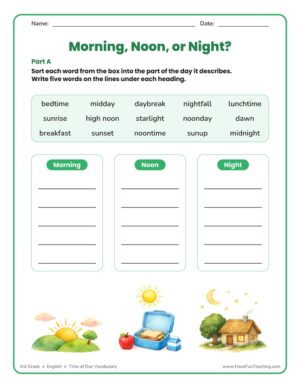
Telling time grows step by step. Little ones start with morning, noon and night, then read the clock to the hour and half hour. Next, kids count by fives around the clock to read time to the nearest five minutes, so the big hand on the 4 means 20 minutes. Older kids read time to the minute and solve elapsed time problems: if recess starts at 10:15 and lasts 25 minutes, it ends at 10:40. The click comes when the minute numbers stop being 1, 2, 3 and become 5, 10, 15!

Our favorite ways to make telling time stick

Clocks are confusing until kids get their hands on one. These moves make time make sense.

Make your own clock

Have each child build a clock with moving hands. Call out a time and everyone sets it, then hold them up to check. Moving the hands themselves teaches more than any picture on a page.

Why it works: kids understand an idea best when they touch it, then draw it, then write it, the order the U.S. Department of Education recommends for elementary math.

Telling Time ActivityTry it withTelling Time ActivityActivitiesOpen it →

Count by fives around the circle

Point to each number on the clock and count by fives together: 5, 10, 15... all the way to 60. Write the minutes outside the numbers in a different color. Once kids see the hidden fives, reading minutes gets easy.

Why it works: showing first, practicing together, then letting kids try alone is the "gradual release" model teachers have relied on for decades (Pearson and Gallagher, 1983).

Count by Fives on a Clock WorksheetTry it withCount by Fives on a Clock WorksheetWorksheetsOpen it →

Time flash challenge

Flash a clock card and kids write the time on their whiteboards. Start with hours, then half hours, then five-minute times. A few minutes a day, and watch their speed jump.

Why it works: a big review of study methods ranked quick self-quizzing among the most powerful ways to remember (Dunlosky and colleagues, 2013).

Time Flash CardsTry it withTime Flash CardsFlash CardsOpen it →

Questions teachers and parents ask

What age should kids learn to tell time?

Most kids learn to read the clock to the hour and half hour in 1st grade. They read to five minutes in 2nd grade and to the minute, plus elapsed time, in 3rd grade.

How do you teach telling time to beginners?

Start with just the hour hand. Once kids can read the hour, add the minute hand and count by fives around the clock. A clock they can move with their own hands helps a lot.

Should kids learn digital or analog clocks first?

Learn both together. Reading an analog clock builds understanding of how time moves, and matching it to the digital time makes the numbers make sense.

What is elapsed time?

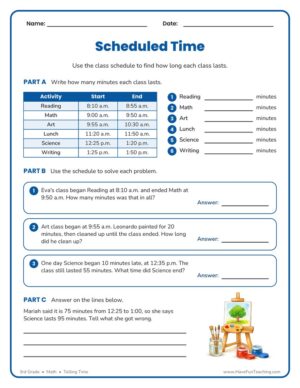
Elapsed time is how much time passes from start to finish. If a movie starts at 2:00 and ends at 3:30, the elapsed time is 1 hour and 30 minutes. A number line makes it easy to see.