
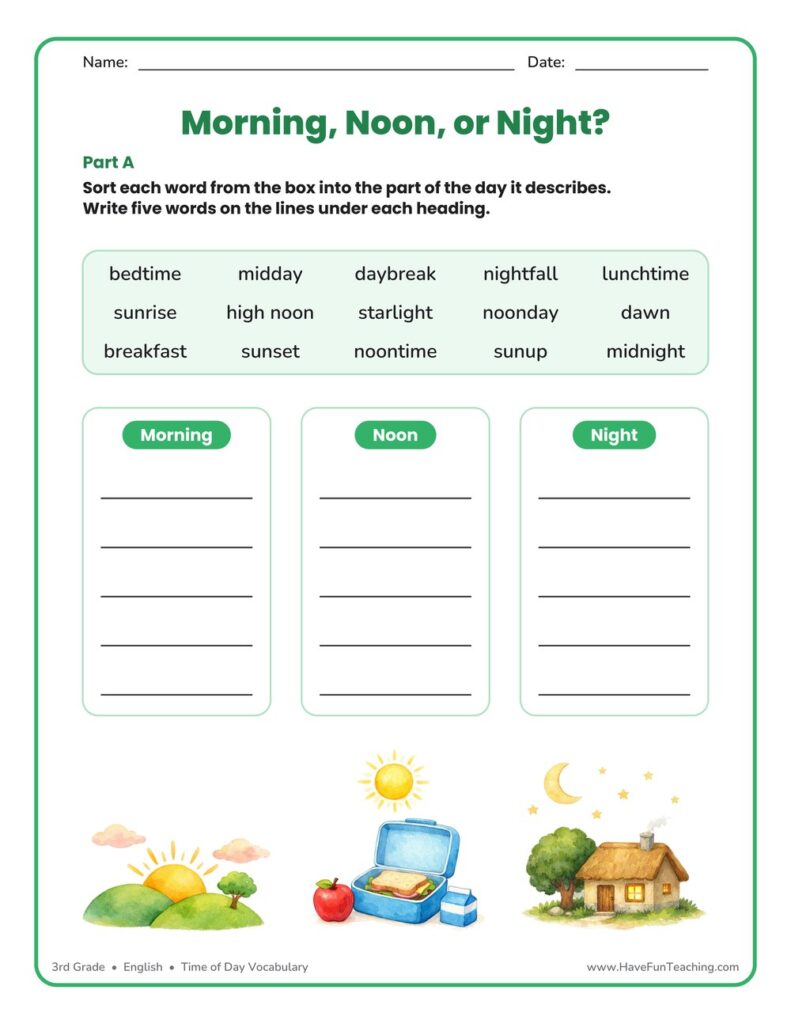
Morning, Noon, or Night Sort Worksheet
The Morning, Noon, or Night Sort Worksheet helps 3rd Grade students sort fifteen time-of-day words, read a.m. and p.m. clocks, and explain their thinking in writing. An answer key is included.
$6.97
Or free with a membership — members pay $3.33/mo for all 10,000+ resources. See plans
Want this one free?
Tell us where to send it and it’s yours — no card, no catch.
One free resource per teacher. We’ll also send free teaching ideas each week — unsubscribe anytime.
Teaching is easier with a membership
Unlimited printables, games & videos for PreK–6th — for your classroom or homeschool. Cancel anytime.
Start your 3-day free trial$0 today · cancel anytime · Instant access to 10,000+ resources
About this resource
Description
Every day is divided into parts, and knowing the words that name those parts helps students talk about time with precision. The Morning, Noon, or Night Sort Worksheet gives 3rd Grade students fifteen time-of-day words to sort, from dawn and daybreak to high noon, starlight, and nightfall. Sorting vocabulary this way builds the background knowledge students need before they read a clock face or write about a daily schedule, and it turns words they hear every day into words they can actually use.
This time of day sorting worksheet is built in three parts. In Part A, students read a fifteen-word bank and write each word under the heading it matches: Morning, Noon, or Night. In Part B, they read four analog clocks paired with a.m. and p.m. digital times and write the part of the day each time belongs to. In Part C, they explain how daybreak and sunset are different, then write their own sentence using a word from the box. Print the two student pages back to back, walk through the first column together, and let students finish the rest on their own.
What’s Included
- A fifteen-word time-of-day word bank with three labeled sorting columns
- Four analog clocks paired with a.m. and p.m. digital times
- Two constructed-response prompts that ask students to explain their thinking
- A complete two-page answer key
There are three reasons this activity helps students. First, it pairs vocabulary with a real skill, so students learn words they can immediately use when reading a schedule, a menu, or a clock. Second, the a.m. and p.m. clocks connect language to number, which reinforces telling time to the hour, half hour, and quarter hour. Third, the written explanation at the end asks students to defend an answer in complete sentences, a habit that shows up on nearly every reading and math assessment.
Teachers can turn Part A into a pocket-chart lesson by writing the fifteen words on cards and sorting them as a class before students write. Parents can extend the Morning, Noon, or Night Sort Worksheet by walking through a family schedule at the kitchen table and naming the part of the day for each event. For an extra challenge, ask students to add one more word to each column from their own morning, noon, and night routines.
Related Resources
What teachers say
Reviews
You must be logged in to post a review.
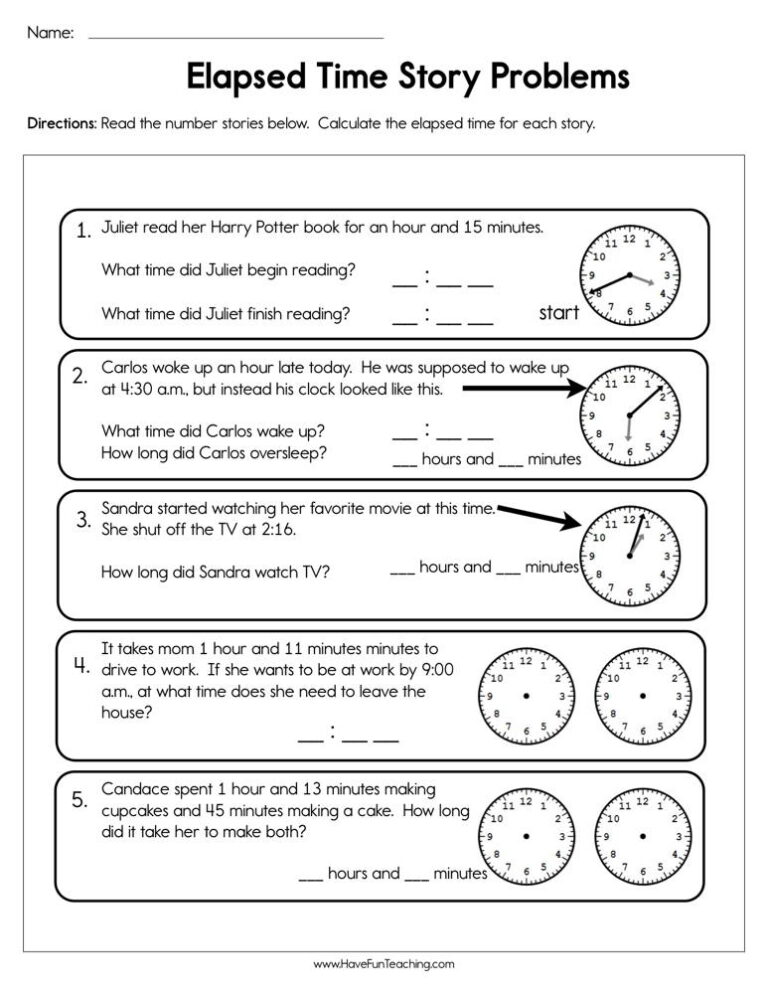
This 3rd grade Elapsed Time Story Problems Worksheet has students read six real-life number stories and calculate how much time has passed. Complete answer key included—perfect for no-prep telling time and subtraction practice.
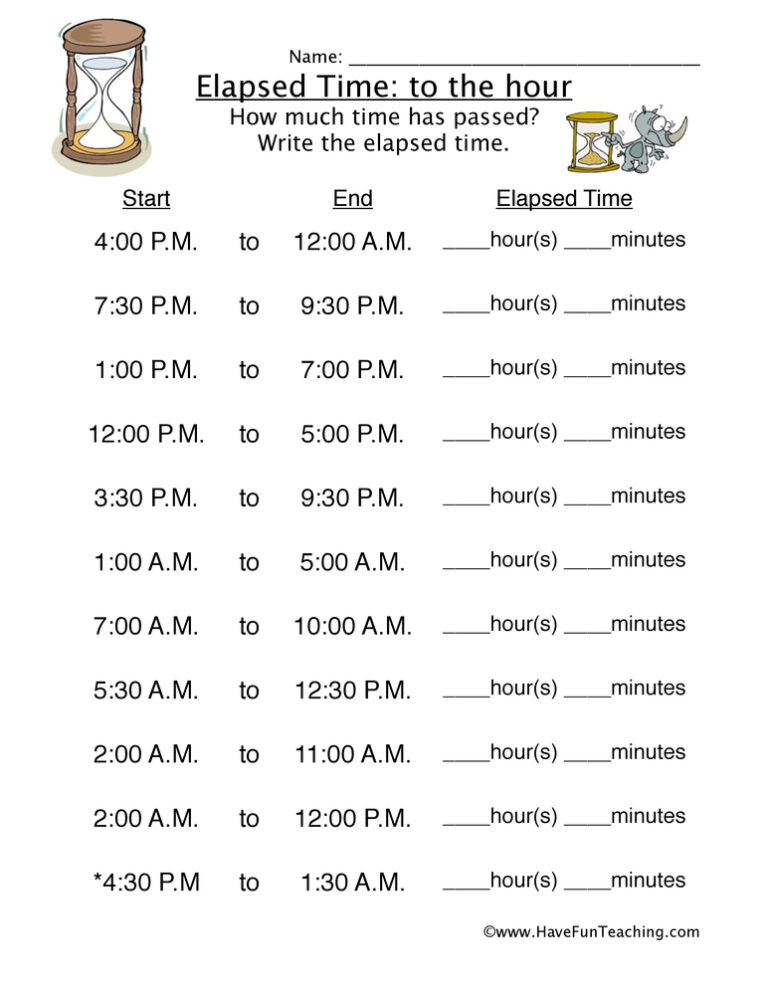
This Elapsed Time Hour Worksheet gives 3rd Grade students practice finding how many whole hours pass between a start clock and an end clock, plus two story problems. Answer key included, so checking work takes seconds.
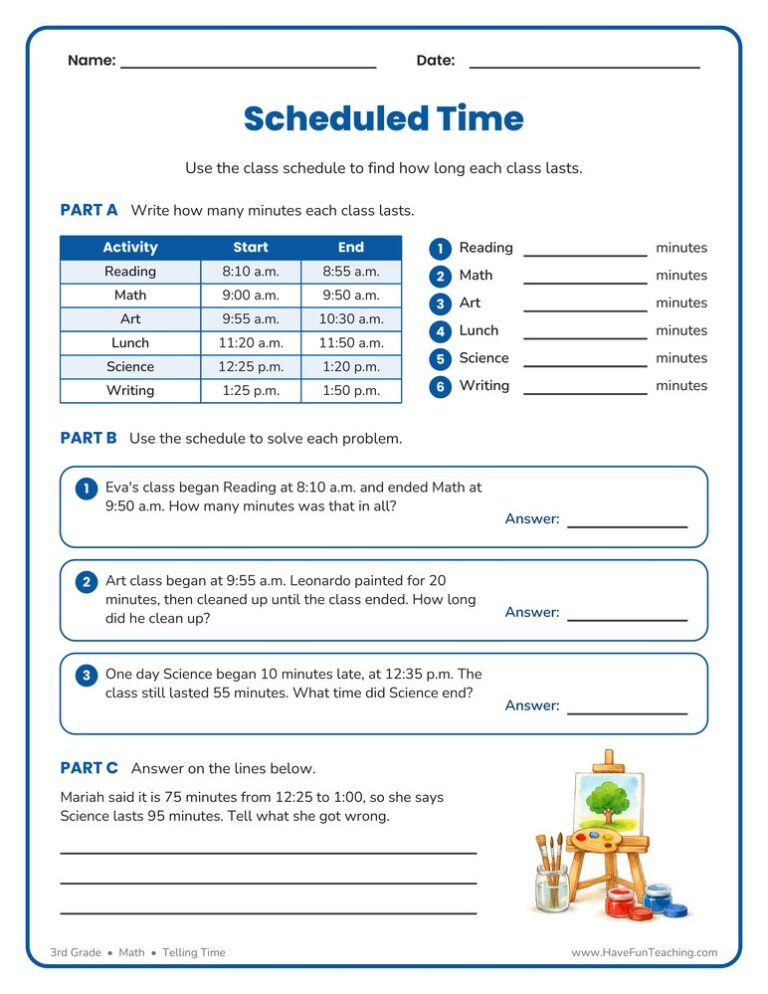
This scheduled time worksheet has 3rd graders read a school schedule and find how many minutes each class lasts, then solve multi-step elapsed time problems. Answer key included for fast, no-prep practice.

An elapsed time word problem solving worksheet for 3rd grade, with four analog clocks and three multi-step time problems. Answer key included, so students get fast feedback and real practice reading a real day.

This elapsed time half hour worksheet asks 3rd Grade students to read paired analog clocks and solve two word problems, with an answer key included, so counting forward across the hour finally clicks.
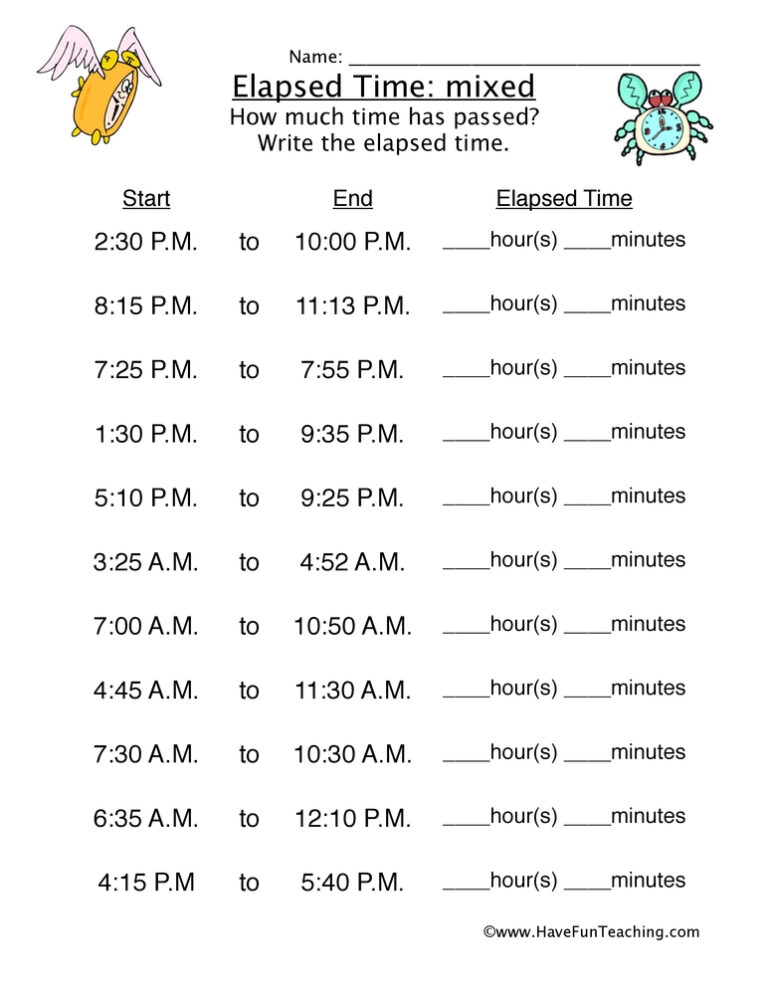
This elapsed time mixed worksheet gives 3rd graders four start-and-end clock problems and two story problems that cross from morning into afternoon. An answer key is included, so checking work takes seconds.

Using these Time Flash Cards, students identifying the time which represents the picture provide in order toimprove their telling time skills.
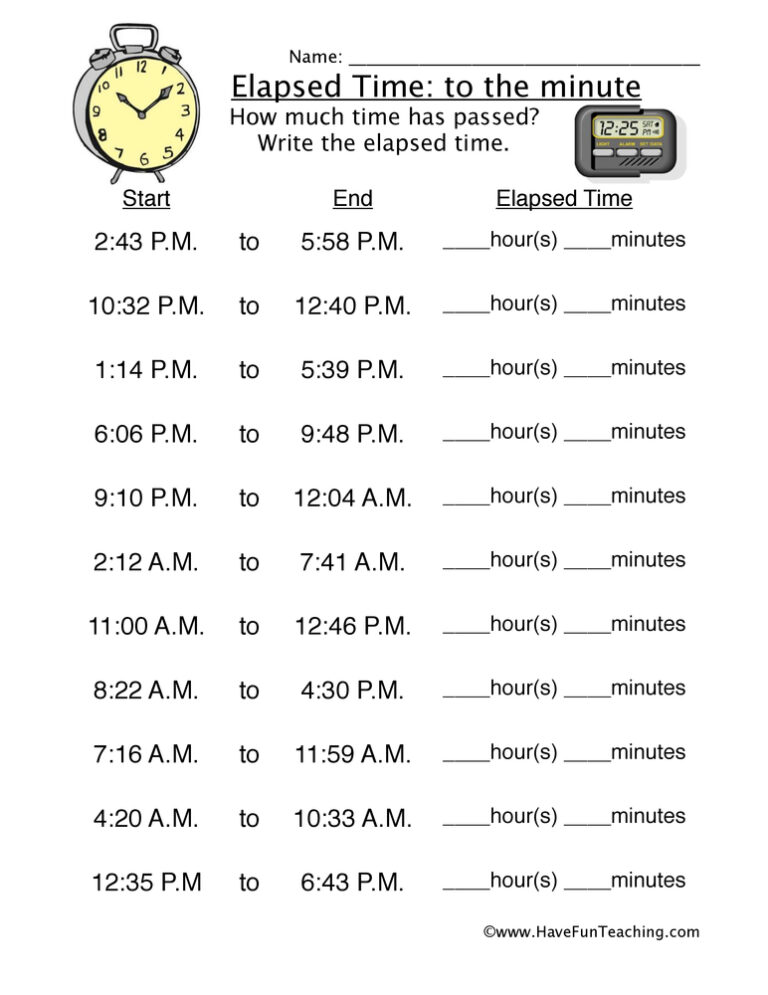
This minute elapsed time worksheet gives 3rd graders eight start-to-end intervals that regroup across the hour plus two story problems. Answer key included for quick, no-prep practice telling time to the minute.
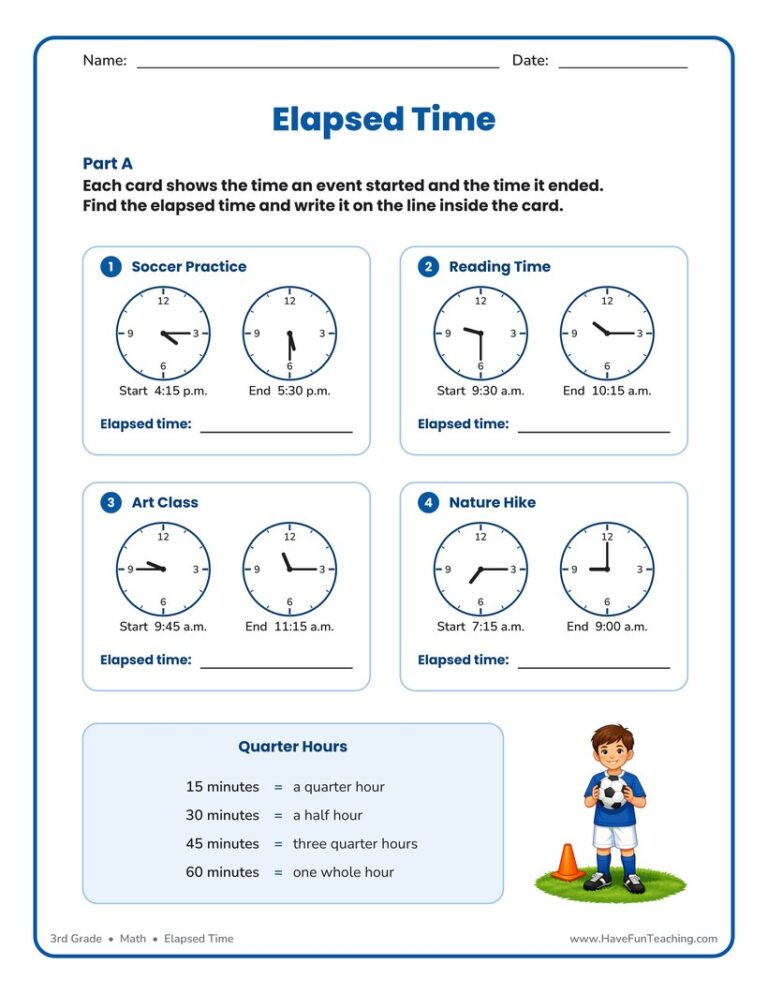
This Elapsed Time Quarter Hour Worksheet helps 3rd Grade students read start and end clocks, solve time word problems, and explain their thinking. An answer key is included, so checking work takes seconds.

This time estimation worksheet helps 3rd grade students pick the better estimate for everyday activities and add estimated minutes. An answer key is included, so checking work takes seconds.

This time patterns worksheet has 3rd grade students find the rule, draw missing clock hands, and write missing digital times. An answer key is included for quick, easy checking.
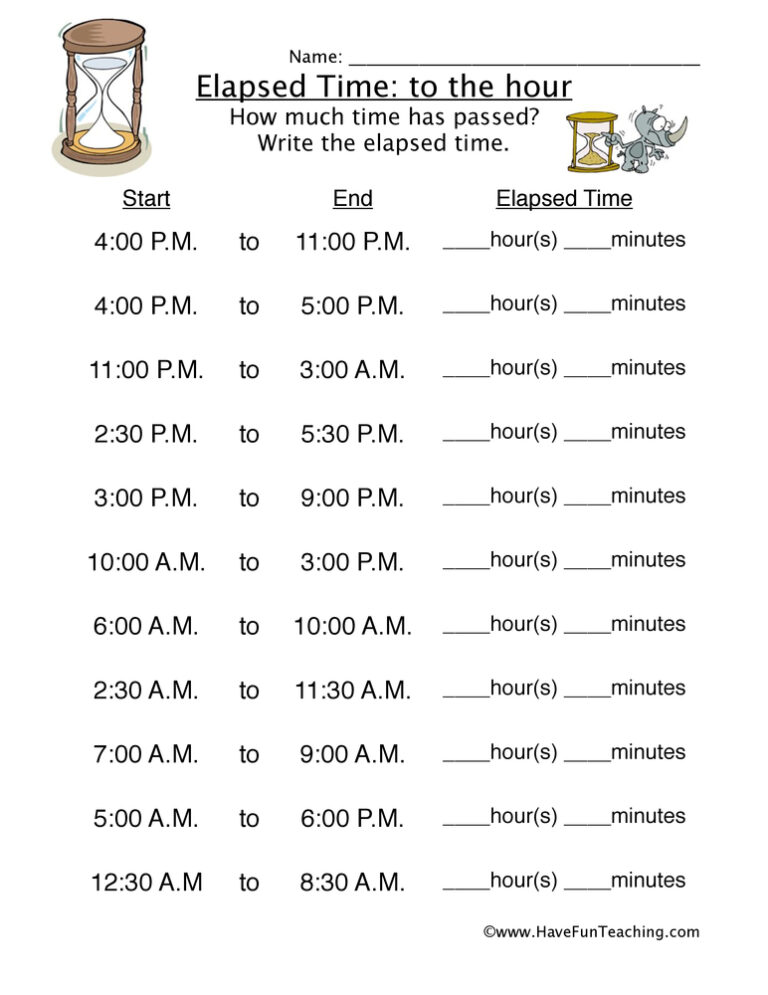
This hour elapsed time worksheet gives 3rd graders four clock cards that count back whole hours and two word problems that cross noon. An answer key is included, so time practice is ready with no prep.
Reviews
There are no reviews yet