Skip to content
Start My 3 Free Days $0 today · cancel anytime

Moon Resources

15 moon resources: 10 worksheets, 3 activities, 2 songs and more. How teachers use these

Moon Resources

15 moon resources: 10 worksheets, 3 activities, 2 songs and more. How teachers use these

Video
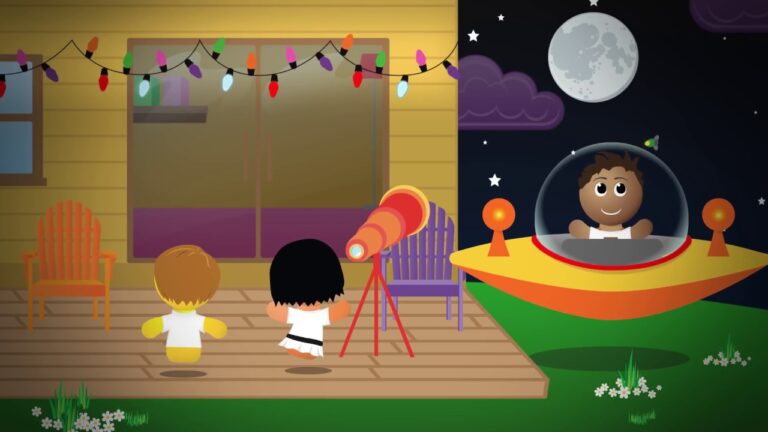
VideoPreschoolMoon Song (Animated Music Video)

Using thisMoon Song (Animated Music Video), students learn about the phases of the moon through catchy, interesting lyrics.

Worksheet
Worksheet4th GradeDrawing Moon Phases Worksheet

This Drawing Moon Phases Worksheet gives 4th grade students eight circles to shade, one for every phase of the moon in order, plus two questions to explain what they see. An answer key is included.

Activity
Activity2nd GradeSolar System Activity

This solar system activity is a Space Race game where 2nd to 5th Grade students spin, write and color the eight planets in order. Includes trivia cards, practice and answer key.

Worksheet
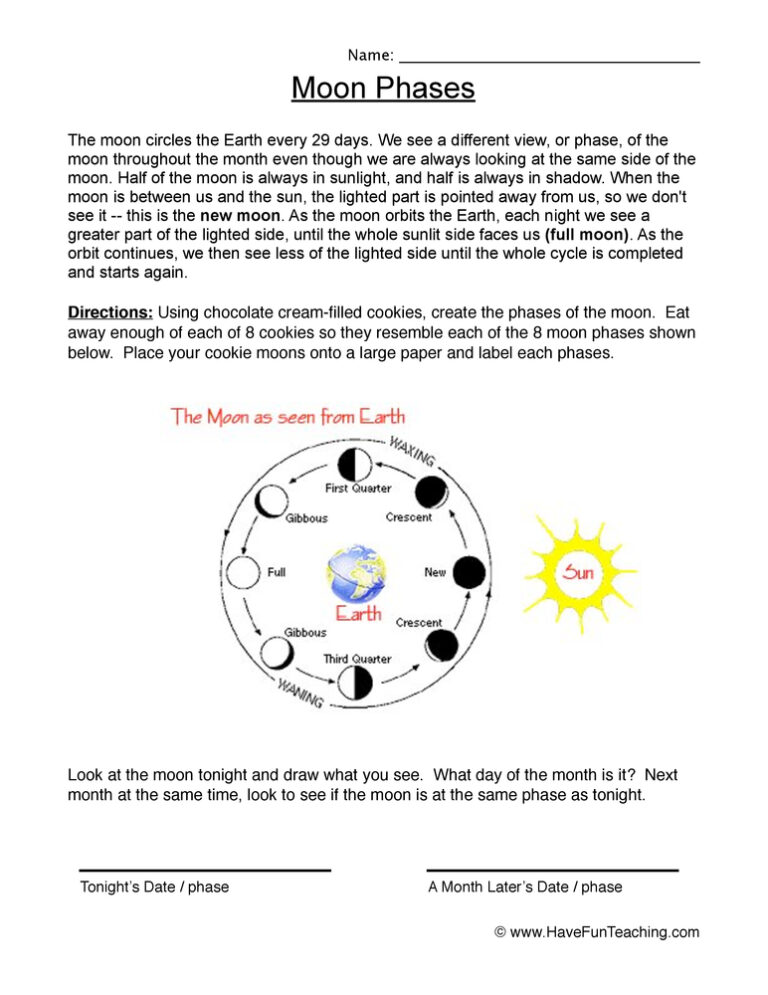
Worksheet4th GradeMoon Phases Cookies Worksheet

This Moon Phases Cookies Worksheet asks 4th graders to name all eight moon phases from drawings and explain what they see. An answer key is included, so it is ready to print and teach.

Worksheet
Worksheet2nd GradeMoon Writing Worksheet

This Moon Writing Worksheet gives 2nd grade students five short facts about the Moon, four questions to answer on the lines, and space to write two sentences of their own. An answer key is included for quick checking.

Worksheet
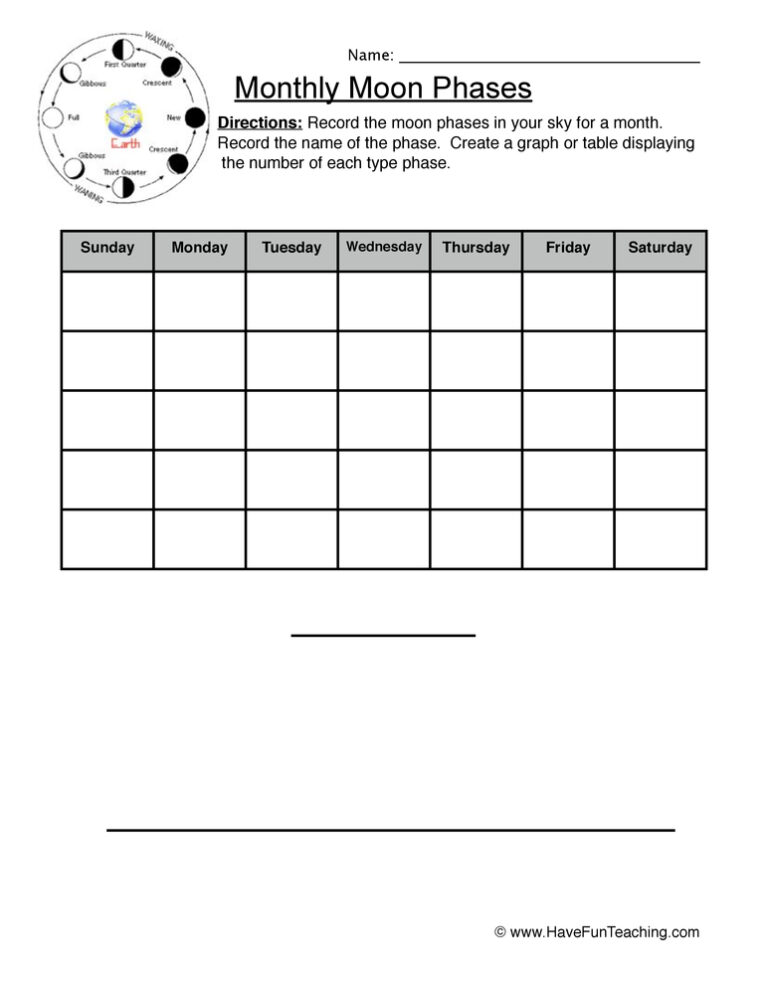
Worksheet5th GradeMonthly Moon Phases Worksheet

This monthly moon phases worksheet has 5th grade students count a month of moon observations, fill in a phase table, and explain the lunar cycle. An answer key is included for quick checking.

Song
SongPreschoolMoon Song (MP3)

Using thisMoon Song (MP3), students learn about the phases of the moon through catchy, interesting lyrics.

Activity
Activity1st GradeMoon Activity

Send students on a read-the-room moon activity with 12 fact cards, a recording sheet and a Yes or No practice page for 1st and 2nd grade, answer key included, so learning about the moon feels like an adventure.

Assessment
Assessment2nd GradeThe Beautiful Moon Reading Comprehension Worksheet

The Beautiful Moon Reading Comprehension Worksheet gives 2nd grade readers a short non-fiction passage about the moon, four multiple choice questions, a written response, and an answer key, so comprehension practice stays quick and clear.

Worksheet
Worksheet3rd GradeMoon True or False Worksheet

This Moon True or False Worksheet asks 3rd graders to judge eight facts about the Moon and rewrite one false sentence correctly. An answer key is included for fast, no-prep earth science.

Worksheet
Worksheet5th GradeTotal Solar Eclipse Worksheet

A diagram-based total solar eclipse worksheet where 5th graders label the umbra and penumbra, then explain why the Moon can cover the Sun. Answer key included for fast, no-prep space science practice.

Worksheet
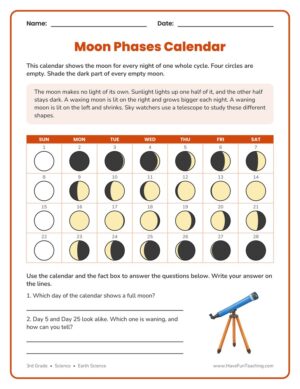
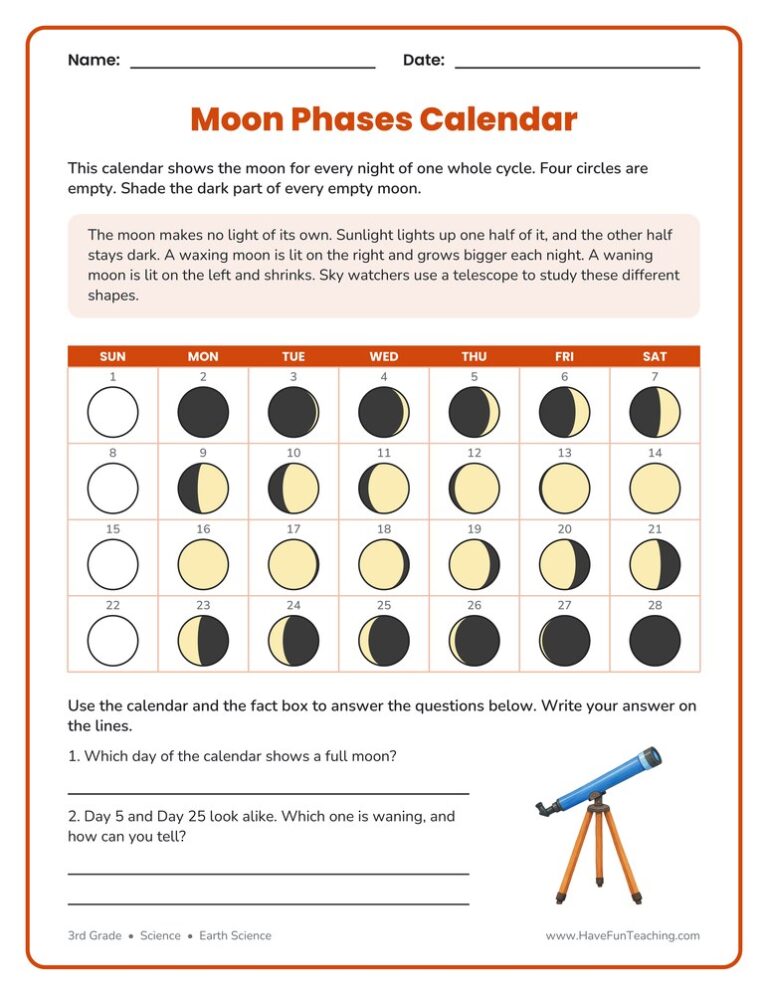
Worksheet3rd GradeMoon Phases Calendar Worksheet

This moon phases calendar worksheet gives 3rd graders a full 28-night calendar, four phases to shade, and two reasoning questions. An answer key is included, so moon phases take no prep at all.

Worksheet
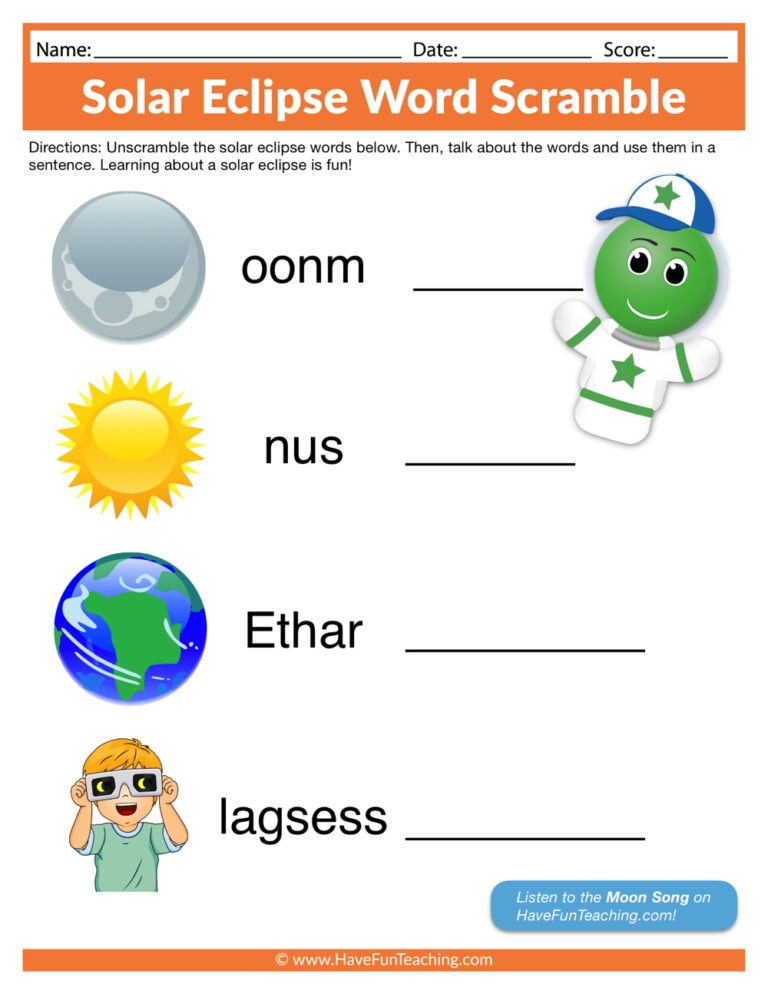
Worksheet2nd GradeSolar Eclipse Word Scramble Worksheet

This Solar Eclipse Word Scramble Worksheet gives second grade students six scrambled science words and a word box to unscramble them. An answer key is included, so checking eclipse vocabulary takes only a moment.

Worksheet
Worksheet4th GradeEarth Shadows the Moon Worksheet

This earth shadows the moon worksheet helps 4th grade students draw Earth's shadow, spot a total lunar eclipse, and explain when eclipses happen. An answer key is included for quick checking.

Activity
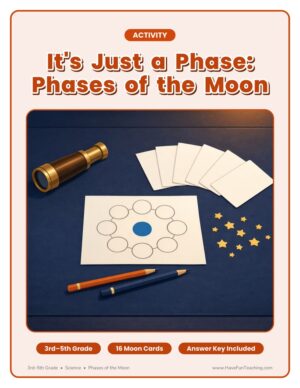
Activity3rd GradeIts Just a Phase Phases of the Moon Activity

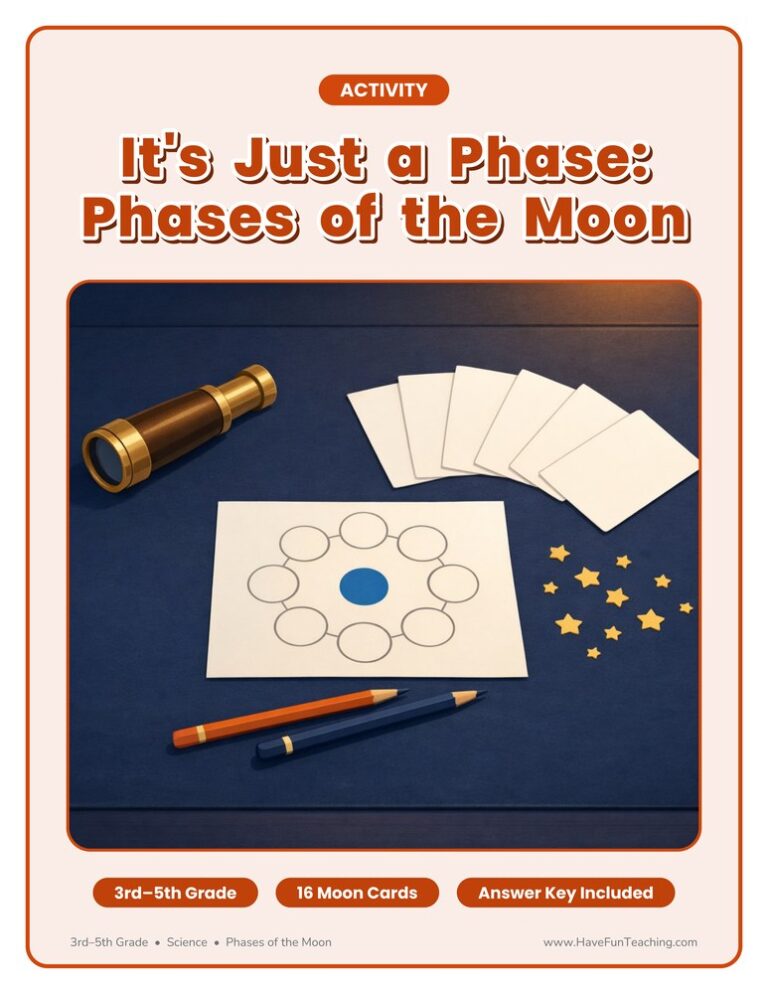
This Its Just a Phase Phases of the Moon Activity helps 3rd to 5th Grade students match, order and label the eight moon phases. A practice page and answer key are included.

From our teachers' playbook

Crescent, half, full and back again

What do kids learn about the moon?

Young learners notice that the moon changes shape and shows up in the day and night sky. Older kids learn why: the moon doesn't make its own light, it reflects sunlight, and as it travels around Earth we see different amounts of its lit side. That's the cycle of phases, from new moon to full moon and back, in about a month. Kids also learn the moon is Earth's natural satellite, has craters and no air, and causes eclipses when it lines up with the sun. The click comes when kids realize the moon isn't changing shape at all. Our view is.

Our favorite ways to teach the moon

The moon is in the sky for everyone to see. These moves turn that into real science.

Sing the phases in order

Play the moon song and have kids hold up paper circles shaded for each phase as it is sung. Repeat daily for a week. Music makes the order of the phases stick long after the unit.

Why it works: words set to a repeating melody are easier to recall than the same words spoken (Wallace, 1994).
Moon Song (Animated Music Video)Try it withMoon Song (Animated Music Video)SongsOpen it →

Draw what you see

Have kids observe and draw the moon each night for two weeks (with family help). Back in class, line up the drawings and look for the pattern. Real observations turn phases from vocabulary into discovery.

Why it works: children learn more from words and pictures together than from words alone (Mayer, 2009).

Drawing Moon Phases WorksheetTry it withDrawing Moon Phases WorksheetWorksheetsOpen it →

Cookie phases

Use sandwich cookies and scrape away frosting to show each phase, from full to crescent to new. Kids label each cookie and arrange them in order. Building the phases by hand makes the shapes memorable, and tasty.

Why it works: the U.S. Department of Education's guide for teaching elementary math recommends moving from hands-on objects to drawings to numbers.

Moon Phases Cookies WorksheetTry it withMoon Phases Cookies WorksheetWorksheetsOpen it →

Moon questions parents and teachers ask

Why does the moon change shape?

It doesn't really change shape. The moon reflects sunlight, and as it orbits Earth we see different parts of its lit side. These changing views are called phases.

What are the 8 phases of the moon?

New moon, waxing crescent, first quarter, waxing gibbous, full moon, waning gibbous, third quarter and waning crescent. The whole cycle takes about 29.5 days.

What grade learns about moon phases?

Young kids notice the moon's changing shape in preschool and kindergarten. Moon phases are usually taught in more detail in grades 3 to 5, often alongside the sun and Earth.

Why can we see the moon during the day?

The moon is bright enough to see whenever it's above the horizon and lit by the sun. Its orbit puts it in the daytime sky for part of each month.

Keep exploring