
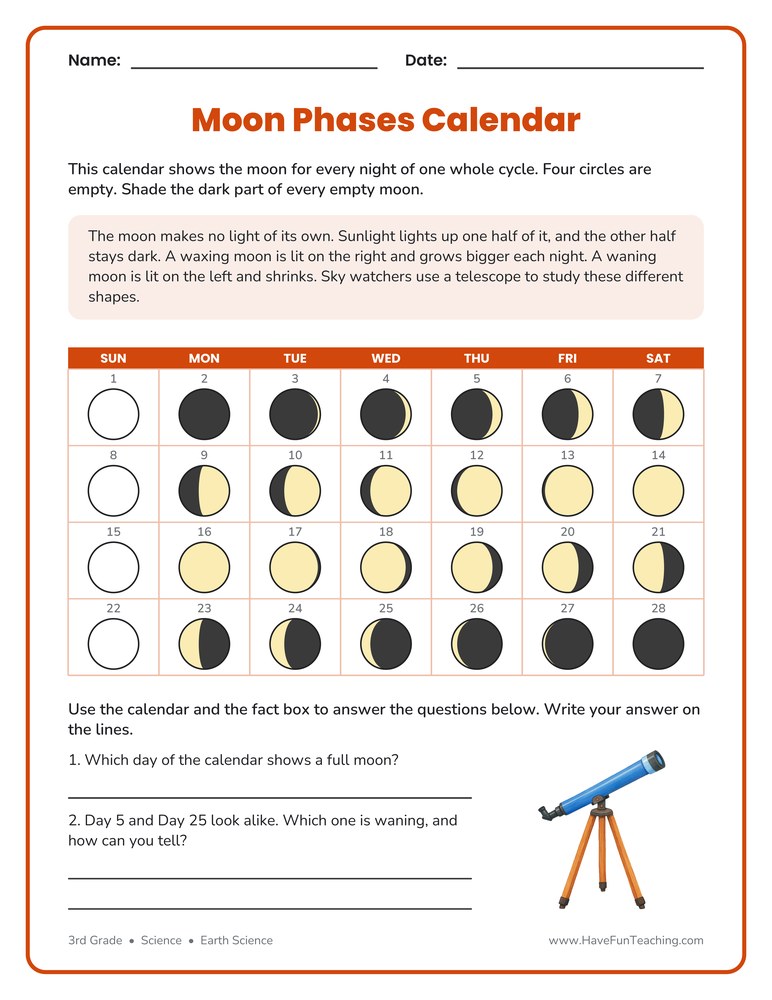
Moon Phases Calendar Worksheet
This moon phases calendar worksheet gives 3rd graders a full 28-night calendar, four phases to shade, and two reasoning questions. An answer key is included, so moon phases take no prep at all.
$6.97
Or free with a membership — members pay $3.33/mo for all 10,000+ resources. See plans
Want this one free?
Tell us where to send it and it’s yours — no card, no catch.
One free resource per teacher. We’ll also send free teaching ideas each week — unsubscribe anytime.
Teaching is easier with a membership
Unlimited printables, games & videos for PreK–6th — for your classroom or homeschool. Cancel anytime.
Start your 3-day free trial$0 today · cancel anytime · Instant access to 10,000+ resources
About this resource
Description
The moon looks different every night, and that pattern repeats itself about once a month. Learning to track it is one of the first real lessons in observing nature over time, and this moon phases calendar worksheet gives 3rd graders a month-long view of the whole cycle on a single page. Students see how the lit part of the moon grows from a thin crescent to a full circle and then shrinks back again, night after night, in an order that never changes.
This 3rd grade earth science worksheet is built around a real four-week calendar. Twenty-four of the twenty-eight nights are already drawn, and four circles have been left empty on the first night of each week. Students read the fact box, study the nights around each gap, and shade the dark part of every empty moon to show the new moon, the first quarter, the full moon, and the last quarter. Two written questions then ask them to find the full moon on the calendar and to compare two nights that look alike but are moving in opposite directions.
What’s Included
- 1 print-ready PDF worksheet
- Answer key
- A 28-night moon calendar with 4 phases to shade and 2 written questions
This moon phases calendar worksheet helps children in three ways. First, it teaches a pattern instead of a list of names, because every night in the cycle sits side by side and students can see the order for themselves rather than memorizing it. Second, shading the four main phases turns a reading task into a drawing task, and drawing a half-lit or fully dark moon forces a child to decide exactly how much of it the sun is lighting. Third, the comparison question builds real reasoning: two nights can show the same amount of light and still be different phases, and the only way to tell them apart is to notice which side is lit.
Try keeping a real moon journal for a month alongside the sheet, and have students sketch the moon on each clear night. Cookies with the frosting scraped into different shapes make a memorable hands-on model, and a lamp, a ball, and a darkened room will show the whole cycle in a few minutes. Older students can compare their own observations with the calendar and talk about why the real cycle is closer to twenty-nine and a half nights. Reading a book about the night sky or singing along with the Moon Song is an easy way to start or end the lesson.
Related Resources
What teachers say
Reviews
You must be logged in to post a review.

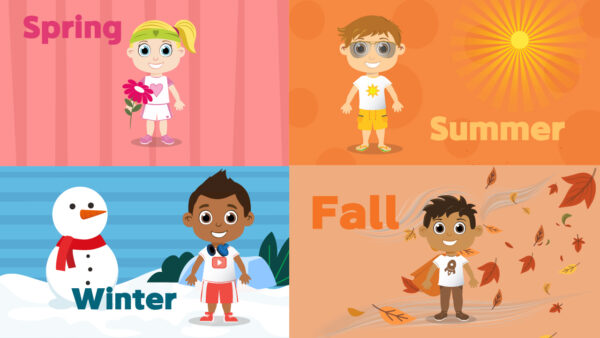
The Seasons Song by Have Fun Teaching is perfect for teaching and learning all about the seasons of the year. This is a fun way for kids to learn the seasons. With this seasons song, your kids can learn about Spring, Summer, Fall, and Winter. While listening to the Seasons…
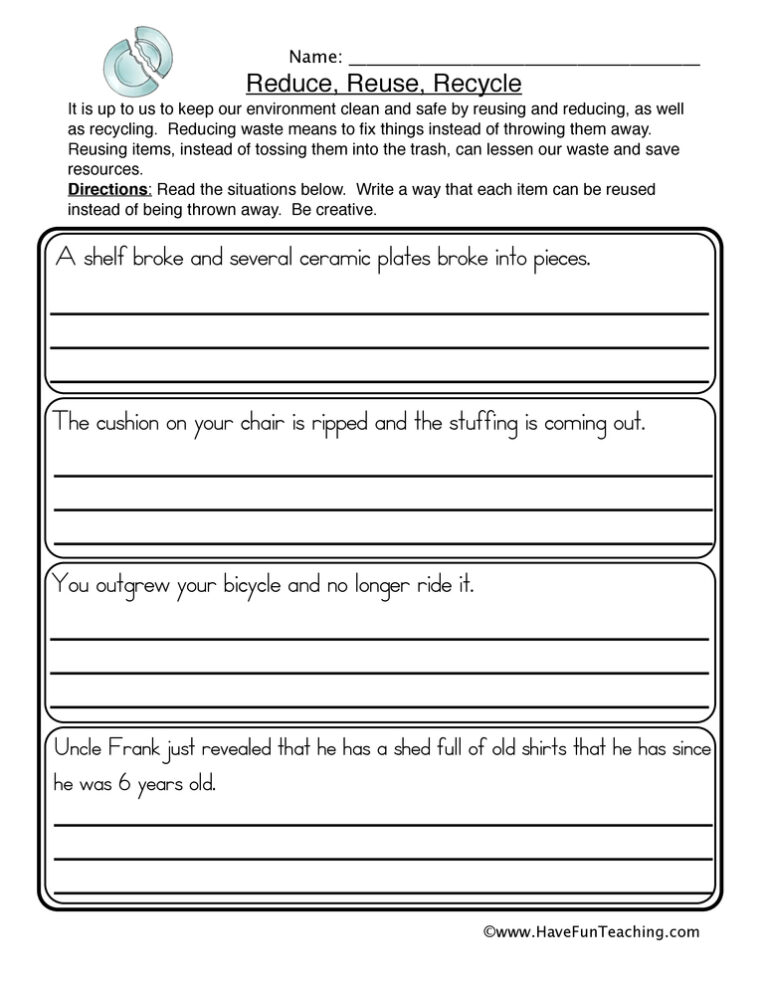
Read six real-life situations and decide whether each one shows reducing, reusing, or recycling on this reduce, reuse, recycle scenarios worksheet for 3rd grade. Answer key included, so Earth Day science practice takes no prep.
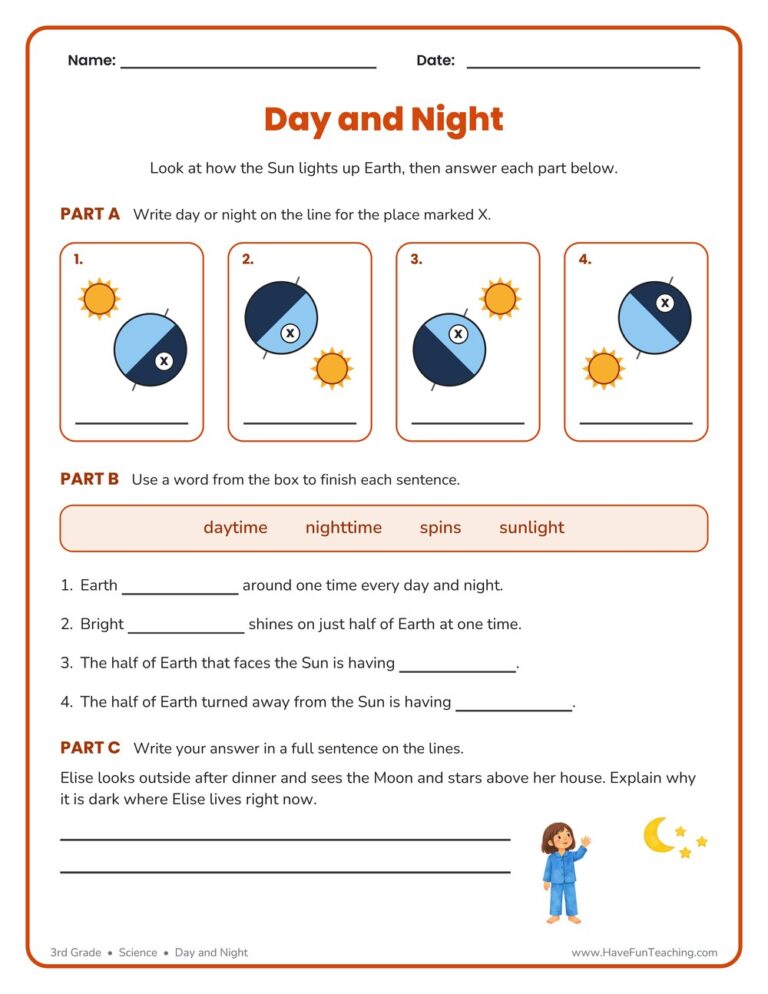
A hands-on day and night worksheet where 3rd graders read Sun and Earth diagrams, finish science sentences from a word box, and explain what makes it dark. Answer key included for quick, no-prep review.
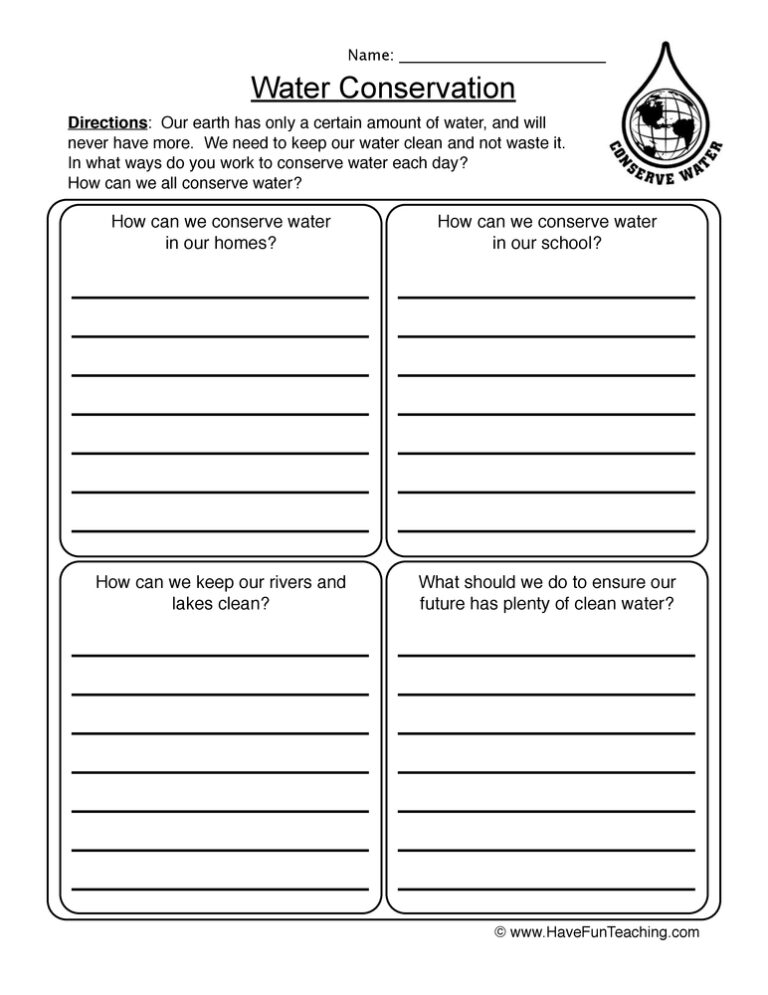
Students use this Water Conservation Worksheet to define key terms, sort water-saving habits, and solve a two-step drip problem. Built for 3rd Grade, with an answer key included for fast, no-prep science practice.
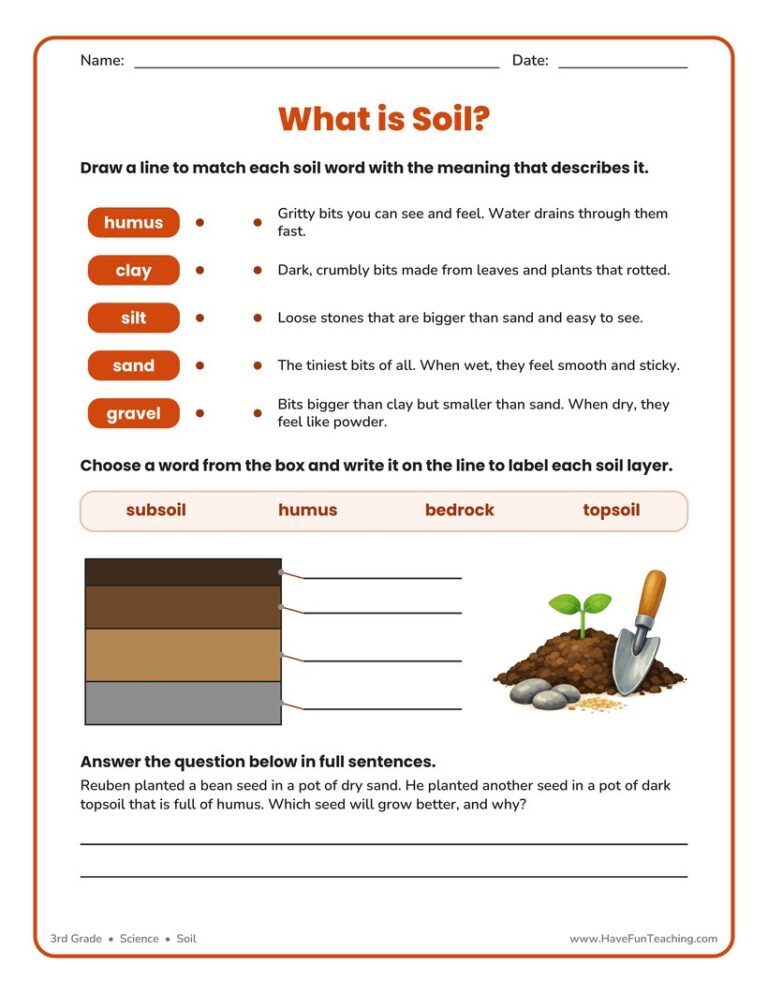
This Soil Matching Worksheet gives 3rd Grade students hands-on practice matching soil words to their meanings and labeling the four soil layers. An answer key is included, so checking work takes seconds.
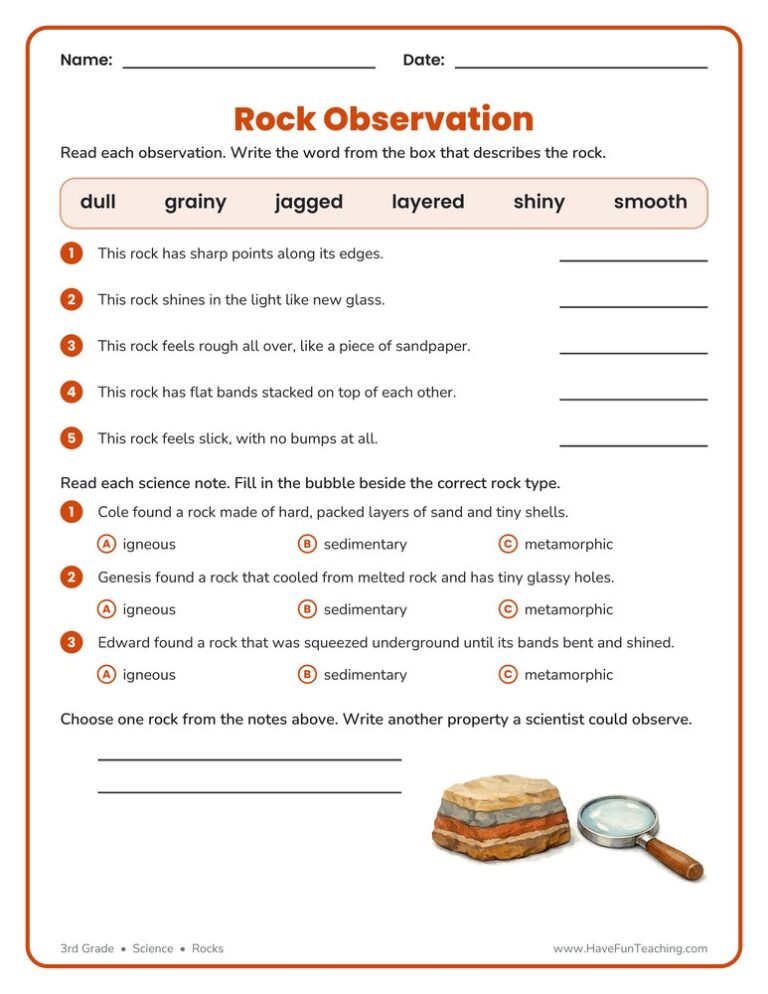
This Rock Observation Worksheet has 3rd grade students match describing words to five rock observations, name three rock types, and record one more property. An answer key is included, so it is ready to print.
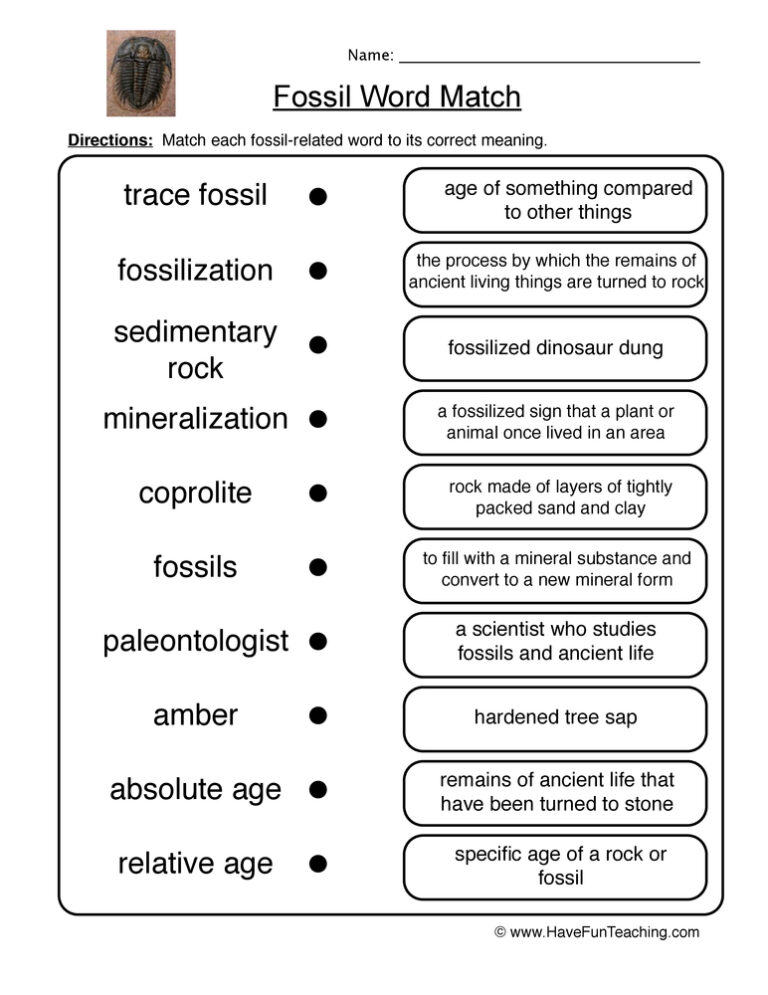
This fossil definitions worksheet gives 3rd grade students matching, fill-in-the-blank, and written-response practice with key fossil vocabulary. An answer key is included, so review is quick and confident.
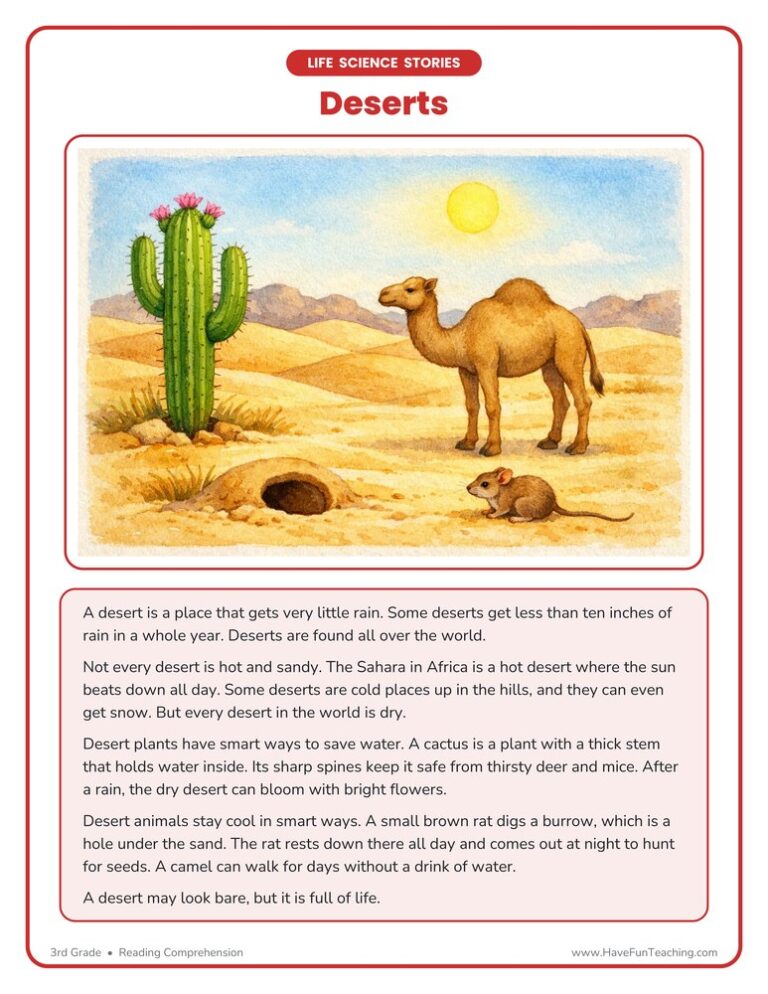
This Deserts Life Science Reading Comprehension Worksheet gives 3rd Grade readers a short nonfiction passage about hot and cold deserts, with comprehension questions and an answer key included, so science reading practice takes minutes to prep.
This What is Soil? Worksheet asks 3rd grade students to name what soil is made of, identify its three layers from a reference box, and explain why humus matters, with an answer key.

While watching the Creation Song, students learn about the days of Creation perfect for Sunday school, kid's church, and Bible lessons for kids. Bring joy and understanding into your kid's church, Sunday school, and classroom with this song about the days of Creation. Your kids will love a new way…
This layers of the earth word search worksheet gives 3rd grade students a 10-word Earth Science puzzle plus six fill-in-the-blank sentences, with an answer key included, so science vocabulary sticks the first time.
This Mountains Worksheet helps 3rd Grade students match six landform words, use them in sentences, and explain erosion in their own writing. Answer key included, so review takes seconds.
Reviews
There are no reviews yet