
Skip to content
Start My 3 Free Days $0 today · cancel anytime

Motion Resources

5 motion resources: 4 worksheets and 1 flash card. How teachers use these

Motion Resources

5 motion resources: 4 worksheets and 1 flash card. How teachers use these

Worksheet
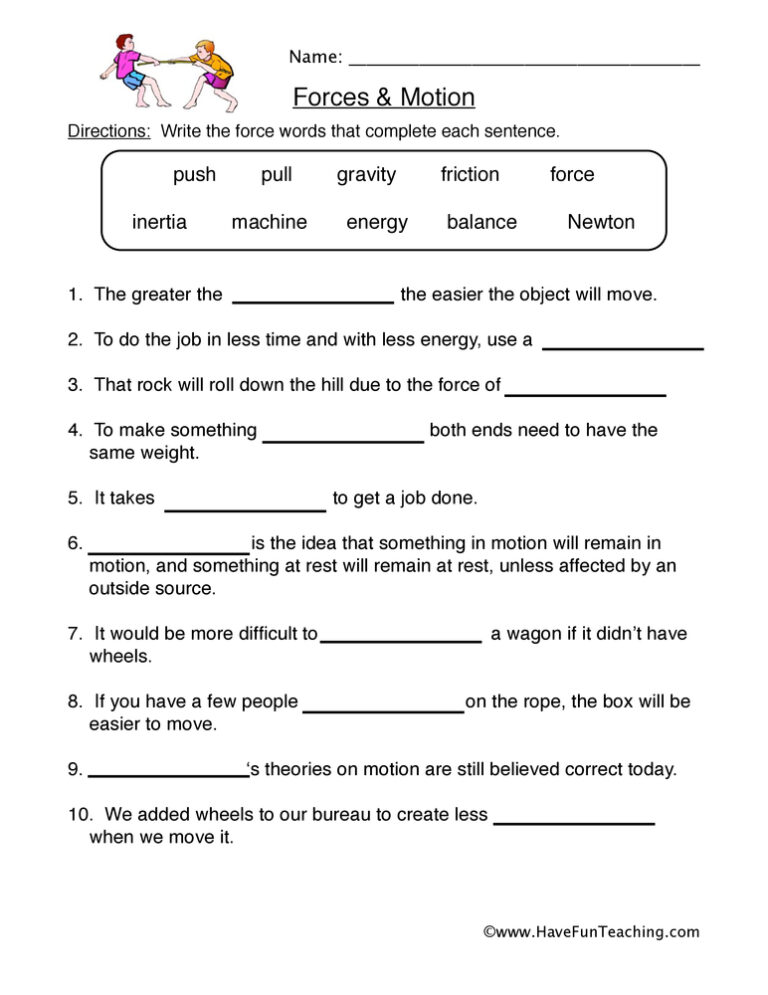
Worksheet3rd GradeForces Motion Worksheet

A 3rd grade forces motion worksheet where students use a word bank to complete eight sentences about force, push, pull, gravity, friction, motion, speed, and magnets. Includes an answer key for easy, no-prep science practice.

Worksheet
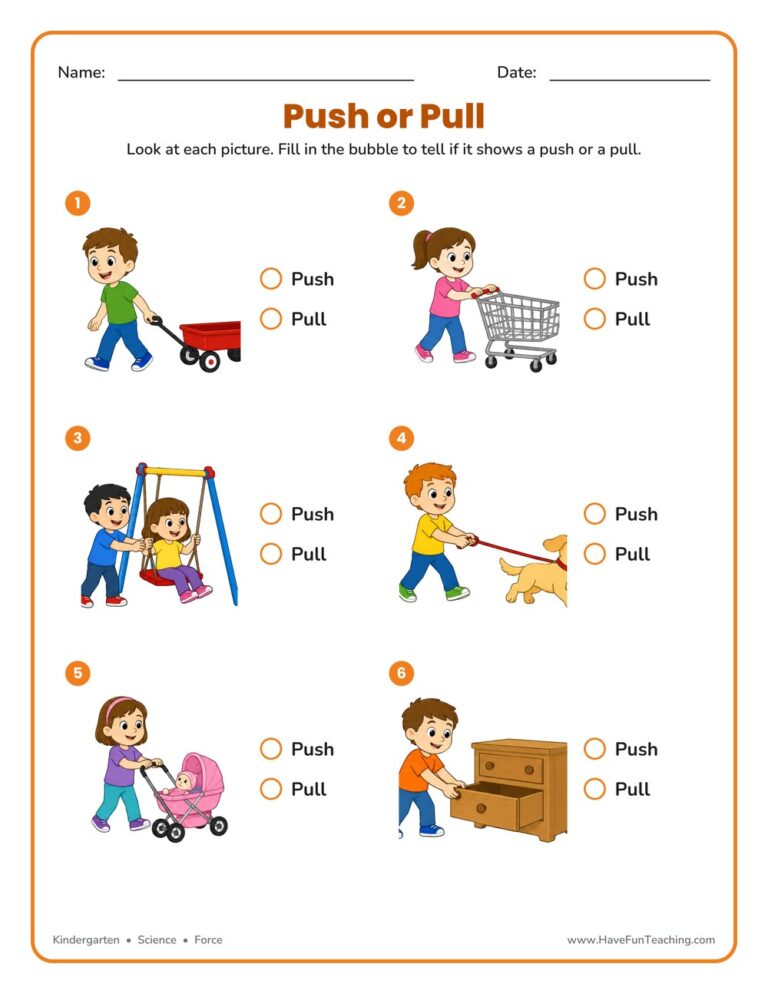
WorksheetKindergartenPush or Pull Force Worksheet

This push or pull force worksheet lets kindergarten students look at six pictures and fill in the bubble to show whether each action is a push or a pull. Includes an answer key—a simple, no-prep introduction to force.

Worksheet
Worksheet5th GradeNewton's Laws Force and Motion Worksheet

This Newton's Laws force and motion worksheet has 5th grade students name the law behind six everyday events and explain one in writing, with an answer key for fast checking.

Worksheet
Worksheet5th GradeSimple Machines Worksheet

This simple machines worksheet has 5th graders sort everyday objects into six machine columns and name the machine each tool uses. An answer key is included for quick, confident checking.

Flash Cards
Flash Cards2nd GradeForce and Motion Word Wall

Post these force and motion word wall flash cards for 2nd to 5th grade: 16 science words with kid-friendly meanings, plus a vocabulary practice page, answer key included.

From our teachers' playbook

Push it, pull it, watch it go!

What do kids learn about force and motion?

Motion starts with one simple idea: things move when a force, a push or a pull, acts on them. Younger kids test pushes and pulls with balls, wagons and toy cars and notice that a bigger push makes something go farther. Older students learn about gravity, friction and magnetism, measure speed, and meet Newton's laws: an object stays still or keeps moving until a force changes it. The click comes when kids realize a rolling ball stops not by itself, but because friction is pulling against it the whole time.

How we teach force and motion

Motion is the most hands-on topic in science. These moves get kids testing before they write.

Ramps and racers

Set up a ramp with a book and a toy car. Have kids predict how far it rolls, then change one thing: raise the ramp, add a towel, add weight. They record each result and explain which force made the difference. It is a lab and a fair test all in one.

Why it works: going from real objects to pictures to symbols is a core recommendation of the U.S. Department of Education's elementary math guide.

Forces Motion WorksheetTry it withForces Motion WorksheetWorksheetsOpen it →
Push or pull?

Show pictures of everyday actions, like kicking a ball or opening a drawer, and have kids sort each one as a push or a pull. Then let them act it out. Simple sorting gives younger students the words they need for every later lesson.

Why it works: children learn more from words and pictures together than from words alone (Mayer, 2009).

Push or Pull Force WorksheetTry it withPush or Pull Force WorksheetWorksheetsOpen it →

Law of the day

Teach one of Newton's laws at a time with a quick demo, like a coin on a card flicked off a cup. Then have kids explain it in their own words and answer a couple of questions the next day. Short checks spread over a week help the three laws stay separate in their minds.

Why it works: researchers who compared ten study methods found practice testing is one of the two that work best (Dunlosky and colleagues, 2013).

Newton's Laws Force and Motion WorksheetTry it withNewton's Laws Force and Motion WorksheetWorksheetsOpen it →

Questions parents and teachers ask

What is force and motion for kids?

A force is a push or a pull, and motion is a change in position. Forces make things start moving, stop, speed up, slow down or change direction.

What are Newton's three laws of motion in simple terms?

First, things keep doing what they are doing until a force changes them. Second, a bigger force makes a bigger change, and heavier things need more force. Third, every push has an equal push back, like a balloon zooming as air rushes out.

What grade learns about force and motion?

Kindergarten often starts with pushes and pulls, 3rd grade usually studies balanced and unbalanced forces, and upper elementary adds speed, gravity and Newton's laws. The ideas build year after year.

What is an easy force and motion experiment at home?

Roll a toy car down a ramp onto carpet, then onto a smooth floor, and measure how far it goes. Kids see friction in action right away.

Keep exploring



